
Book Review: Literary Critic Harold Bloom — The Man Who Read Too Much?
By Matt Hanson
A new collection of Harold Bloom’s letters reveals a critic who found the heights of Western literature far more inviting than the “drab” reality of a Vermont forest.
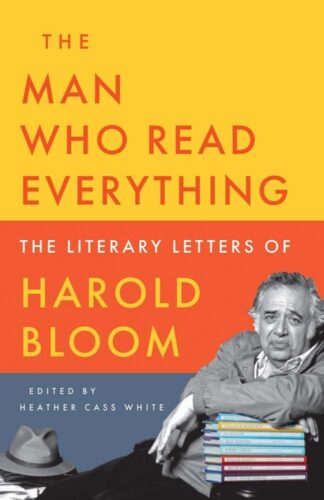
The Man Who Read Everything: The Literary Letters of Harold Bloom. Edited by Heather Cass White. Yale University Press, 248 pages, $30.
Version 1.0.0
The title alone of the new selected letters of Harold Bloom, The Man Who Read Everything, sounds like something fantastical. It could describe an erudite phantom from one of Borges’ stories, speaking of another person who had probably read everything. An old English professor I once mentioned offhandedly remarked that the last person to have likely read everything was probably John Milton, and he ended up going blind, so better not to try it. Come to think of it, Borges did too.
Accepting all reasonable caveats, Harold Bloom probably really did read it all. Anecdotes abound about how the self-described “bardolator brontosaurus Bloom” could read and fully absorb at least a couple of long novels in a day, recite the entirety of Paradise Lost and Moby-Dick—and much else—from memory, and taught the entire works of Shakespeare every semester for decades at Yale.
Even if you have spent much of your life reading, there’s good reason to question the value of such a claim. What about someone who has, say, climbed a hundred mountains or cooked a thousand gourmet meals or raised ten children or fought in a war or sang in operas? Couldn’t they be equally or more interesting, experienced, and wise? Nietzsche says somewhere that a Venetian gondolier might know more about life than any philosopher. As Bloom’s baleful visage gazes dourly at us on the cover, it seems like all that reading didn’t get him any closer to peace.
Calling this an edition of Bloom’s “literary letters” is misleading. One reason is that he evidently didn’t do much else in his long life but read and write and teach, so there probably aren’t any other kinds of letters. As much as I admire and enjoy his books, it seems like there were plenty of interesting life experiences that Bloom never really said much about: his impoverished childhood in the Bronx, being the youngest son of Russian Jewish immigrants, teaching himself English as a second language at ten by reading Hart Crane, getting married and having children, hanging out in the lively 1950s New York cultural scene, being a long-time teacher at an elite university, and so on.
Instead, Bloom was always ringing the same canonical bell: read and reread Shakespeare, Dante, Homer, Milton, Proust, and all the rest, he demanded. Not bad advice, to be sure. But it would have been much more interesting to have Bloom occasionally descend from Mount Olympus and tell us about lesser-known writers who were interesting but not found in Norton anthologies or college syllabi. I haven’t gotten around to John Crowley’s Little, Big, but I’ve heard enough enthusiasm—from Bloom and others—to have it on the list. There must be plenty of other writers like that who desperately needed the endorsement of a renowned critical figure like Bloom. Shakespeare and Dante will always be doing just fine.
Even if I happen to somewhat share Bloom’s disinterest in Stephen King, Harry Potter, and JRR Tolkien, they clearly offer a substantive reading experience for millions of people. Sometimes a text can be trite, but the person who reads it can discover a deeper meaning. Just ask someone in AA, for example. David Foster Wallace discovered that those banal homilies (“one day at a time”) still make profound changes in people’s lives. It almost goes without saying that having actual life experience can be more informative than anything you learn. And while we’re at it, Bloom’s brusque dismissal of the intricate labyrinths of Infinite Jest (“he can’t think, he can’t write…no discernible talent”) is piffle.
The second issue is that these letters were sent back and forth to a selected coterie of writers whom the ever-prickly Bloom deemed worthy of his attention: Henri Cole, Ursula Le Guin, John Ashbery, A.R. Ammons, James Merrill, among others. A very solid selection. But annoyingly, Bloom doesn’t really say too much about their work other than that they are good and he likes them and he is weary, oh so weary, of everything else. I’m sure finding out that Bloom thought the mid-’70s would be “the Age of Ashbery” is interesting to someone, but true or not I don’t think it’s all that important or controversial. It’s much more fun to hear him refer to his great friend the poet and critic John Hollander as “Foo-Foo” or “Foofy-Foo, mein Treu-lieb.”
The value of reading an artist’s letters depends on how much they wanted to hide. Hearing someone let loose with a trusted friend or anguished lover can be illuminating or deeply sympathetic precisely because it’s an invasion of the person’s privacy. We overhear them working out their inner soliloquies within the hidden theatre of the self. Kafka would have probably been horrified to find out that people were poking through his tormented letters to his father and his lovers, but we learn so much more about him precisely because what we are privy to is what he didn’t want to be publicized.
For all his genuine talk of the solitude of reading, Bloom really didn’t hide his light under a bushel. He seems to have pretty well left as much of his opinions and observations and vexations on the field, so to speak, in his dozens of hefty books and long interviews. You would think someone would have plenty churning within themselves after devouring that much literature, but apparently much of Bloom’s inner life—not just his critical thinking—remained below the surface, assuming there was a difference.
Criticism can certainly be reductive or imperialistic, both of which Bloom was accused of, or it can be a creative endeavor in its own right. Oscar Wilde made the latter claim, which Bloom appreciated. I still don’t think that I really understand the terms of Bloom’s Kabbalistic systematizing of writers in his book Genius, the rough draft of which appears in one of the letters. But I do find his mystical approach intriguing.
Paraphrasing a long debate, I’m a big fan of the idea that art is essentially about “making the stone stony,” as one theorist put it. If an artist’s eye is keen enough to perceive something new in the minutiae of the human condition or in the grandness of the universe, it helps us see it afresh.
The clouds overhead might drift differently after you read Wordsworth or Wallace Stevens, the ancient ocean waves pound a little harder after Melville or Homer or Coleridge. Robert Frost’s ominous New England forests aren’t William Blake’s Edenic landscapes, or anyone else’s for that matter. And those trees will keep changing shape before our very eyes if someone with a pen or a brush or a camera or whatever has enough skill and imagination to transmit what they see.
So, it’s both funny and a little sad to read a 1965 letter from Bloom to Hollander from “Middle‑of‑Nowhere” Vermont, where he’s writing on a porch “overlooking our 400‑ft. drop of Wordsworthian landscape.” So far, so good. And yet poor bookish Bloom is having a terrible time: “What shall I cry? What shall I cry? It is very scenic if you like scenery…we have mice, raccoons, and garter snakes inside the house, and woodchucks, deer, porcupines, and skunks directly outside. I am not delighted by any of this, and begin to hate trees, which if you stop to consider them are such drab objects.”
Granted, I wouldn’t be too happy to find that woodland creatures had overrun my kitchen either. But the hilarious, Larry David‑esque prissiness of those exasperated italics really tells you something about where Bloom’s head is at. It’s the use of the word drab that really gives the game away. Sure, compared to immersing yourself in a tale as wild and vivid as The Iliad or King Lear or whatever, those poor humble trees don’t stand a chance.
But then again, all those writers I just mentioned—Strangely, all those writers I mentioned above—namely Homer, Shakespeare, and whoever else gloomy Bloom proudly venerated—found something worth writing about in that raw, drab pulp of existence. Could it be that the bibliomaniac Bloom had been doing it wrong all along?
Poetry to the rescue. A.R. Ammons, a close friend whose excellent poetry was also admired by Bloom, writes to him about five years later. He goes on about Emerson (pro) and Yeats (con) for a bit, and then, when Ammons lifts his head from the page, something happens. “When I look out my window here and see the wind bear against the maple leaves, I feel the whole atmosphere involved (as it is), and the currents of all the seas (the thermodynamics of that), and all the pressure of plains and forests.” That’s more like it.
And then Ammons drops this pearl of poetic wisdom: “the visionary world is identical with the real world, except that the visionary world is luminous with sight.” You don’t have to have read everything to ponder such a notion. Perhaps it’s just that kind of pithy observation that Bloom, for all his vast erudition, might have spent a lot of time reading and thinking about but evidently had a much harder time seeing for himself. Always a Bardolator, poor Bloom, but never quite a bard.
Matt Hanson is a contributing editor at The Arts Fuse whose work has also appeared in The American Interest, The Baffler, The Guardian, The Millions, The New Yorker, The Smart Set, and elsewhere. A longtime resident of Boston, he now lives in New Orleans.
Wonderful review Matt. And I agree with everything you say.
I read Bloom with interest for years. And he is brilliant and so are the insights. But I never liked how he dismissed a poet if they didn’t “fit” into his parameters, which is basically Romanticism.
He ignored Robert Lowell. Sorry, he was a great poet. And notoriously dismissed Auden, etc.
Anyway, thank you!
What a great article. I’m getting back into books after not reading much of anything since a kid and Harold Bloom just shows up everywhere in the discussions. He’s even in one of the first books I got by chance, the collected works of William Blake. It’s so synchronistic to me that in coming across this article by way of Bloom’s stodgy yet occasionally very helpful additions to Blake, you state so clearly the reason I believe people should read in the first place: so they can start to properly get grounded and more involved in their lives with a greater repertoire of knowledge, cognition, and spiritual depth.
We have a serious lack when it comes to these things in modern writing culture, but also a serious lack of people reading, but I swear I’m seeing it come back and it’s coming back big. At least I hope. The Bloomian form of blowing the classics like it was (and it literally was) his job is fine and all but we are so long overdue for a real fresh crop of literary writers with crucially a new or improved system to support them (Substack?).
I really don’t have any doubt that the novel has not been exhausted, in fact, I think that’s nearly impossible. Imagination is making a comeback! or I’ll kill myself!