
Fest Review: IFFBoston Shorts — Part One
By Betsy Sherman
Part one of a run-down of live-action narrative shorts. As usual for the IFFBoston, the quality is high, with intriguing subject matter and technical polish.
Shorts Berkeley: Narrative Thursday April 23 at 6:30 p.m., Sunday April 26 7:45 p.m. at the Somerville Theatre.
Shorts Exeter: Narrative Thursday April 23 at 8:45 p.m., Monday April 27 8:00 p.m. at the Somerville Theatre.
This year The Independent Film Festival Boston boasts ten programs of live-action narrative and documentary shorts, a program of animated shorts and a Student Shorts Showcase (collections are named after streets in the Back Bay). This review is part one of a run-down of live-action narrative shorts. As usual for the festival, the quality is high, with intriguing subject matter and technical polish. Many of the 2026 shorts deal with issues of trauma and grief. It’s been that kind of year. There is occasional joy, though. There are many good performances, which is always a treat. Expect in-person appearances by some of the filmmakers at the screenings.
Shorts Berkeley (total 78 minutes)
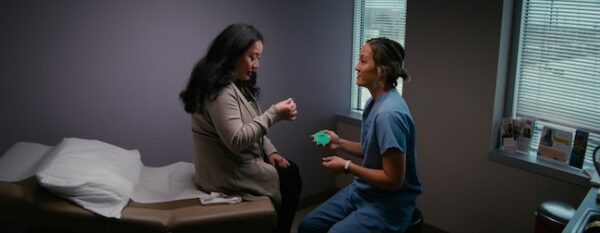
A scene from Amanda Williams’ Insensible Losses. Photo: IFFBoston
Insensible Losses—Noreen Mao stars as OB/GYN Dr. Smith, with whom we share a crucial day-in-the-life. During morning banter with her husband, we find out the doctor is at an early stage of pregnancy. A bump from a passerby, spilling coffee on her clothes, is the first kink in the day. There’s an authentic feel for the “backstage” of the practice as team members do their part to smooth the experience for doctor and patients. Passing actions, like a change out of that stained clothing, remind us that, despite her position, the doctor shares much with her patients. There’s no doubt she is compassionate, as we see with her interaction with a young woman suffering a miscarriage. But events unfold towards a disturbing question: does she really put her patients above all? Mao’s sure-footed performance carries the piece, and the cast provides ample support. The sensitive drama’s director, Amanda Williams, is a Houston-based medical doctor as well as filmmaker.
Me: JFK, You: ICN—With this message, using airport codes (the second serving Seoul), U.S.-based, Korean-born flight attendant Ina (Haley Lee) tries to swap routes so she can attend her brother’s wedding in Korea. For a time, we see the unglamorous side of her job; it leaves her so exhausted that, upon opening her apartment door, she sinks onto the invitingly plush carpet. Her mother is giddy about the wedding during a video chat, but Ina is evasive about whether she’ll go. Coming to the forefront of her mind are memories of her brother’s sexual abuse, something she has never disclosed. A teenage version of her brother appears in her bedroom, then her bathroom, echoing his old manipulative language. Haley Lee conveys Ina’s shame and withdrawal with gentle empathy. There’s no magic wand for Ina, but she begins to gather the inner strength to take a step toward getting help. The film is an affecting depiction of a far too common story. Boston-based director Jiyeon Kim earned an MFA in Film and Media Art from Emerson College. In English and Korean with subtitles.
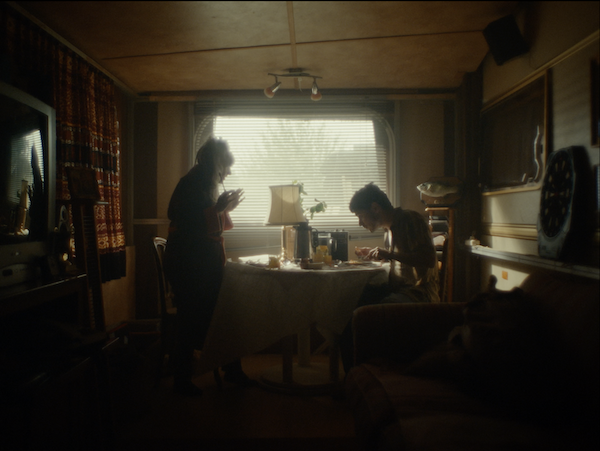
A scene from Tanguy Pichon’s Nothing But the End. Photo: IFFBoston
Nothing But the End—Made by Geneva, Switzerland–native Tanguy Pichon, this is the visceral crescendo of the program. It’s the near future, and the end times are upon us (“don’t look up,” indeed). The three central characters are a young man named Dax (Davide Rao), the ebullient, bold Wendy (Fanny Baudet), and Dax’s mother, Joyce (Fanny Brunet). Early scenes depict the euphoric young love between Dax and Wendy, who wants them to treat these uncertain days as an adventure. However, Dax also wants to stand by his mother, who is manically planning their survival by turning their trailer into a bunker. She has a (justifiable) obsession with stockpiling socks. Her loving son tries to help her, until the atmosphere becomes tomb-like. Sound and visuals build toward the climax as the film intercuts among the characters, a high-energy rave, and glimpses of what’s happening in the sky. Pichon intends to expand the dynamic short into a feature.
Szypliszki—The title of Jordan Axelrod’s engaging, Queens-set tale is the name of a town in Poland. The American romantic who is on his way there is Syd’s Uncle Sam (Danny Wolohan). There’s a hint in the airport opening that Sam may be naïve, or at least not very observant. Sam is staying for the night at the apartment of Syd (Susannah Perkins) and her girlfriend, Ruby (Haley Wong), before catching a morning flight to meet Basia, the Polish woman with whom he’s been having an online relationship and intends to marry. The young couple suspect the lonely bachelor may have been scammed, but they adopt a celebratory stance. They pull Sam away from his Polish-language studies to hang out at a nearby bar. Sam views the couple through rose-colored glasses; he’s always wanted “someone I can make happy.” But we hear their spat: Ruby is jealous of Syd’s attentiveness to a friend, and Syd denies it. Later that night, Ruby discovers a powerful piece of information. A finger is pointed at the viewer—what would you do? The three leads are excellent, with Wolohan suggesting the quality of a young Peter Boyle.

A scene from Ryan Harman’s Your Cookie. Photo: IFFBoston
Your Cookie—Brooklyn-based Ryan Harman’s comedy of manners (or lack thereof) is both sketchy and insightful. Protagonist Dustin, played by Niccolò Walsh, is a good-looking, willowy young stylist—or aspiring stylist—working for an interior designer named Jasmine. She’s a constant presence on his phone and in his copious complaints about her. His workday is spent languorously exploring luxury décor shops. The film’s lengthiest stretch of dialogue at a lunch (tab paid by Jasmine) that Dustin shares with his friend—possibly something more—Logan. Flirtatiously, and perhaps leaning into the sexual connotation, Dustin buys two cookies to go and insists Logan try one. Logan demurs, prompting a performative attempt by Dustin to spread Jasmine’s wealth to the needy; it doesn’t go well. But my favorite passage is his interaction with a young woman at the counter of a high-end shop. Nicely played by Nancy Kimball, she tactfully handles a couple of Dustin’s snafus—an inappropriate phone conversation about porn and an issue with a credit card—then cheerfully signals solidarity with him as a fellow worker on the lower rungs of New York society.
The Spanish Lesson directed by Simone Stadler wasn’t available for preview.
Shorts Exeter (total 85 minutes)
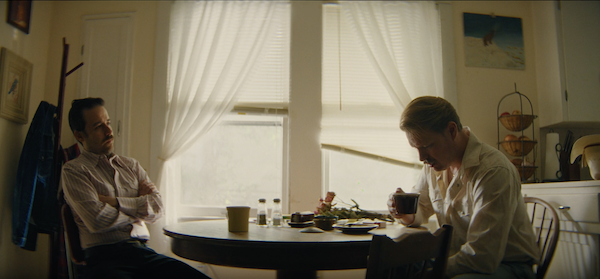
A scene from Justin Arnold’s Whoopin’. Photo: IFFBoston
Whoopin’—Grief, old resentments, and a messed-up view of paternal role modeling weigh heavily on two Texan brothers in writer-director-composer Justin Arnold’s scathing look at corporal punishment. The bellicose Leroy (Arnold) arrives at the home of family man Rubin (Frank Mosley) and makes an odd request: “Did they bury Daddy with his belt? I’d like to have it.” He believes their father’s belt-whipping ways did them both good; Rubin is not convinced. When Rubin raises a situation in which his own son may need to be punished and wonders what to do, violence breaks out in the kitchen. A scattering of Froot Loops on the floor absurdly underscores the “domestic” in domestic violence. Leroy’s bluster and desperation, and Rubin’s overreactions, testify to Daddy’s legacy. A final shot of Rubin, his wife, and his son relaxing amid summer scenery appears calm on the surface, but something may be simmering beneath.
Recesses—Director Dylan Trupiano presents a story in which winter and its early darkness set the mood. At a Michigan elementary school, secretary Shelley (Solia Cates) agrees to stay after hours until a boy’s father arrives to pick him up. Bailey has a stomachache; he’s also under scrutiny after making a drawing depicting himself inappropriately exposed (the drawing drives the story but is not shown in full). As Bailey rests, Shelley infers what might have prompted it. With good intentions, she tries to find out what happened, but she can’t do so without “leading the witness” (brief flashes show Bailey being chased by a classmate). There’s a tingle of both excitement and dread when the boy has a chance to wander through the school at night. The film’s unforced pacing and strong performances keep us emotionally engaged as we juggle our own judgments about the children and the adults.
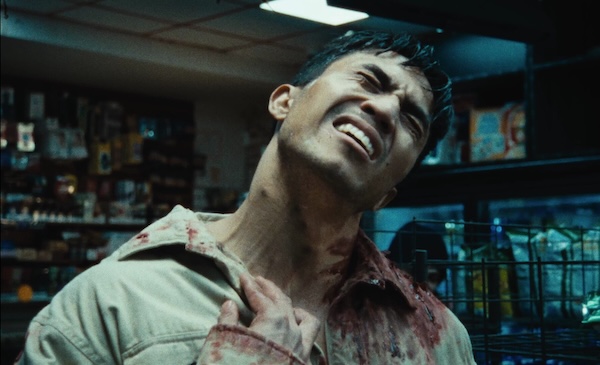
A scene from Daddy is a Hunter. Photo: IFFBoston
Daddy Is a Hunter—This incisively executed tale from the dark side comes from New York–based Japanese American filmmaker Marcus Fahey. The superb character actor John Ortiz plays Carl, a graying elementary school counselor who seems to have heard everything—until student Thomas Okami opens his mouth. The boy’s statement, “Daddy is a hunter,” is deemed problematic. As Thomas tries to find words to explain “hunting”—and to defend his daddy—we get flashes of the father’s nocturnal activities: his clothes are bloody, and movement beneath his skin signals an impending transformation. I’ll just say it: Thomas finds the good side of having a werewolf as a daddy (Mom, not so much). Fahey draws a wonderfully poised performance from Camden Kwok as the boy who carefully reveals a secret (“He’s not a monster—he just turns into one”). Ortiz’s Carl is pulled out of his “I’m your buddy” routine into uncharted territory. For an extra touch, the short has a faux-scratchy texture, like an old drive-in movie.
Breadsong—Estonian director Katariina Aule has created a handsome slice of 19th-century life in the Baltic nation that turns into satisfying, tongue-in-cheek folk horror. Village women sit around a large table, singing runic songs and sewing. On her way home, Leida gathers items from the woods to concoct a meal for herself, her husband Hendrik, and their two young children. The bread she bakes has a bluish sheen. After the children eat some, they briefly become possessed by a radio signal from the future. A modern pop song emanates from their wide-open mouths, their eyes glazed over (an image that’s hard to shake). Despite Leida’s objections, Hendrik subjects them to the ordeal again, fixated on a mention of a buried treasure in the message. His greed places him among the Bad Dads in this program. In Estonian with subtitles.
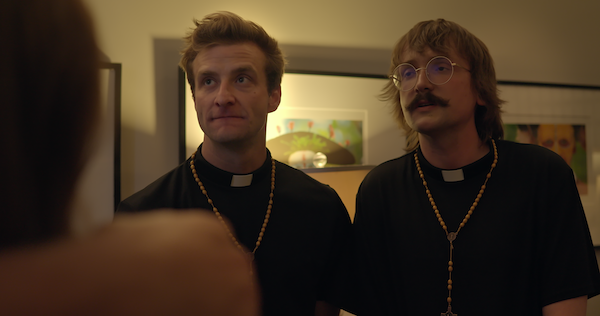
A scene from Zachary Fields’Hail Mary. Photo: IFFBoston
Hail Mary—Zachary Fields’ short complements last year’s Ambush at St. Mary’s by also featuring two crooks impersonating priests. That film was a Western; this is a modern story of dumbass scammers, “mastermind” Dylan (Dylan Stanley) and sidekick Zac (Carter Evan Coleman). They arrive at a suburban home one night to, ahem, perform an exorcism on a despairing couple’s daughter. Dylan’s laid-back bluffing style is pretty hilarious. They tell the parents to “take a load off,” then enter the Linda Blair–style subject’s room. The film is a fun little goof and lets the audience, too, take a load off after the deeper psychology at the beginning of the program.
The Lord of All Future Space & Time—In the same vein of diversion, though less succinct, is this combo of humor and metaphysics directed by Chris Paul Russell. It’s a Western in which the fabric of time is torn by a valise from the future; the objects inside help the good guys, led by Roy Williams Jr., fight the bad guys. It’s also a lecture, delivered by a lone speaker in the desert, explaining time travel and how it can vastly improve a genetic line. Set in an alternate version of American history, it tells the origin story of Rachel, Nevada. At nearly half an hour, it’s a bit tiring. There are laughs and fun ideas in it, but its slickness cries out, “I’m a crowd-pleaser!”
Betsy Sherman has written about movies, old and new, for The Boston Globe, The Boston Phoenix, and The Improper Bostonian, among others. She holds a degree in archives management from Simmons Graduate School of Library and Information Science. When she grows up, she wants to be Barbara Stanwyck.
1 Comment
Leave a Comment

I’m so glad that you reviewed the shorts. Your descriptions got me out to the Exeter shorts, which were compelling as described. The production values of several were remarkable. Breadsong was practically a dream. Daddy is a Hunter was shot on film, which the filmmaker, in a great talk back, described as the most expensive part. “I had a lot of friends involved”, he said. Perhaps it helps, as he mentioned, when you work for Saturday Live.