Film Commentary: “Castration Movie Chapter iii. Junior Ghosts,” “The Serpent’s Skin,” and the New Trans Cinema Moment
By Nicole Veneto
If a truly trans cinema canon is to exist, then it must reclaim authorship over how trans people and narratives are represented on screen by giving trans artists the means and opportunity to create a cinema of their own.
Castration Movie Chapter iii. Junior Ghosts—Premorphic Drift; a fragmentary passage held its North American premiere as part of the Wicked Queer film festival. The Serpent’s Skin had its Massachusetts premiere as part of the Boston Underground Film Festival and is now available on VoD.
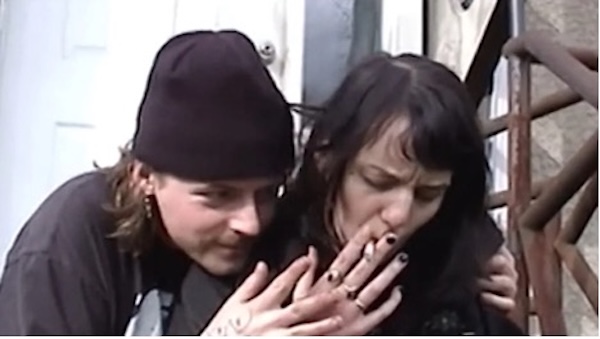
Trent/Tiffany (Henry Gillespi) and Izzy (Avalon Fast) enjoying a smoke break in Castration Movie Chapter iii. Junior Ghosts—Premorphic Drift; a fragmentary passage. Photo: Hentai Cop
This past February, New Hampshire House Republicans passed HB 1792, a.k.a. the “CHARLIE Act” (Countering Hate and Revolutionary Leftist Indoctrination in Education), a bill that targets (among other things) “inculcating LGBTQ+ ideology” and the affirmation of transgender identity in public schools. This bill joins a wave of anti-trans legislation proposed in state governments since 2023 — in 2025 alone, 1,022 were introduced, of which 126 passed. Over ten years since Time magazine celebrated the “Transgender Tipping Point,” a government-backed anti-trans backlash is in full effect. From bans on gender-affirming healthcare for trans youth to scaremongering about trans women in sports, stripping trans people of their rights and personhood has become a major policy goal in the second Trump administration. This political scapegoating is so shameless, so patently opportunistic, that in the middle of another ego-fueled publicity stunt, Trump asked an elderly DoorDash driver whether “men should play in women’s sports?” (To DoorDash Grandma’s credit, she said, “I don’t really have an opinion on that.”)
As in all periods of reactionary backlash, a counter-cultural cinema has emerged. The recent groundswell of independent cinema from trans and queer filmmakers has no official name. These filmmakers make different films in different genres: quarantine comedies like Theda Hammel’s Stress Positions, shoegaze dysphoria-horror like Jane Schoenbrun’s I Saw the TV Glow, and documentaries such as Kokomo City and The Stroll. Several terms have been suggested: Trans New Wave, Trans New Weird, and New Trans Cinema (the term I’ll be using here). By far the most exciting, transgressive, and ambitious of these films has been Louise Weard’s Castration Movie Anthology, an ongoing multi-part screen epic à la Out 1—if it were filmed like Inland Empire. Weard’s Castration Movie project examines the abjection of modern transgender lives, digging into wounds considered too ugly, too shameful, too politically irresponsible to depict lest it make trans people look bad. But, by eschewing the tropes of respectability politics, Weard asserts the humanity of her deeply flawed trans subjects and the audience’s need to empathize with them, even if the things they do go against their own self-interests. After all, “to suck is to be human,” according to Weard.
A truncated edit of the yet-unreleased third film in the series, Castration Movie Chapter III: Junior Ghosts—Premorphic Drift, this fragmentary passage follows crisis hotline operator Izzy (Avalon Fast) and her longtime partner Trent (Henry Gillespie), a skateboarding layabout whose sudden desire to transition throws their already disintegrating relationship into complete disarray. Still reeling from her association with a gender-based act of mass violence, Izzy’s unattended emotional turmoil curdles into the transphobic resentment associated with so-called “trans widows,” those unable to adjust to (never mind accept) Trent/Tiffany’s claim to womanhood. Whether Trent/Tiffany’s transition is quote-unquote “valid” is beside the point—being a bad partner has nothing to do with being trans. Weard has no interest in gatekeeping transgender identity or charting the process of transition. Rather, Junior Ghosts exposes the rationale behind trans-exclusionary feminist thought, framing it as a failure of empathy. Izzy’s descent into TERF-dom can only end one way, and it is no less jaw-dropping for its inevitability..
Though cut to a festival-friendly 127 minutes, Junior Ghosts retains the uncompromising, Dogme 95–esque approach that has made the series a cult phenomenon. In keeping with Weard’s goal of creating a transfeminine cinematic language, all of Castration Movie Anthology was shot on consumer-grade Hi8 camcorders in long, single takes with improvised dialogue. Scenes play out in real time, inviting viewers to become immersed in every agonizing moment. During a pivotal scene in which Izzy confides in another cis woman about her relationship troubles, Weard’s omniscient camera stands in for the trans viewer, drawing out an increasingly transphobic conversation to the point of ridicule. In the tradition of political discourses that legislate trans personhood into oblivion, cinema has long erased trans subjectivity from narratives purportedly about—but seldom authored by—trans people. Junior Ghosts is Weard’s effort to assert trans authorship over increasingly powerful discourses that seek to invalidate their existence.
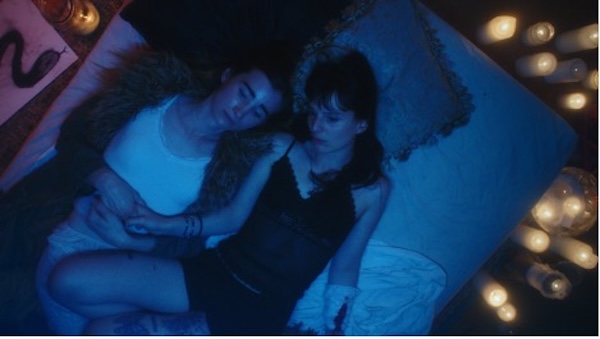
Modern witches Anna (Alexandra McVicker) and Gen (Avalon Fast) share a tender moment in The Serpent’s Skin. Photo: Darkstar Pictures
Meanwhile, Avalon Fast’s character in Alice Maio Mackay’s The Serpent’s Skin couldn’t be more different. In Mackay’s sixth feature—which screened alongside Fast’s own film CAMP at the Boston Underground Film Festival—Fast plays tattoo artist Gen, the supportive lover of fellow witch Anna (Alexandra McVicker, Castration Movie Anthology II: The Best of Both Worlds), a young trans woman. At only 21 years old, the Aussie-born Mackay stands as one of the most prolific voices in New Trans Cinema, averaging more than a film per year since her 2021 debut, So Vam. The youthful energy of Mackay’s proudly transgender films is a key point of distinction. Her work is radically optimistic in the face of the trans backlash, offering narratives in which trans youth persevere against the challenging social realities and political injustices that too often define their existence. In The Serpent’s Skin, Anna refines her latent psychic powers by “popping” the brains of abusive men and incinerating flyers for “gender-critical” awareness groups. Even the Commander in Chief gets a shout-out, with a prolonged shot of a “FUCK TRUMP” tattoo.
Unlike the central relationship in Castration Movie Chapter III: Junior Ghosts, the supernatural, sapphic bond between McVicker’s Anna and Fast’s Gen is a site of healing and validation, all the stronger because the two women’s identities are so closely intertwined. They quite literally see themselves in each other, whereas Fast’s Izzy resents the idea of her partner claiming a feminine identity, to the point of tumbling down the TERF pipeline and logging onto Mumsnet. Even when the couple’s insecurities manifest in the form of a demon that possesses Anna’s former hook-up Danny (Jordan Dulieu, bearer of the aforementioned “FUCK TRUMP” tattoo), their love holds strong. Anna’s transness is practically incidental; her identity as a woman is never questioned or undermined in relation to Gen. This notion of sisterhood across gender identity is where The Serpent’s Skin is most forceful: a common-cause political statement, an assertion of love as a spiritual force against social evil.
 It’s worth noting that The Serpent’s Skin is the second collaboration between Mackay and Louise Weard. Mackay was a featured player in Castration Movie Anthology I: Traps, while Weard is a credited producer on The Serpent’s Skin. If there is a single quality that unifies New Trans Cinema as a canonical film movement, it is the communal, collaborative spirit of its members, including editor/The People’s Joker director Vera Drew and Jane Schoenbrun, whose upcoming film Teenage Sex and Death and Camp Miasma co-stars Weard and Fast. As one of the few trans producers working in the film industry, Weard and her Castration Movie project have acted as a kind of nexus point for New Trans Cinema. If a truly trans cinema canon is to exist, then it must reclaim authorship over how trans people and narratives are represented on screen by giving trans artists the means and opportunity to create a cinema of their own. These artists lift one another up, find spaces to work together, and form a vanguard that is changing the landscape of independent cinema, one aggressively trans film at a time.
My position as a queer cisgender woman necessarily limits my understanding of the trans experience and the cinema it has inspired. On a fundamental level, I will always be a tourist in these film spaces, temporarily assuming a gaze I can set aside when the credits roll. Yet the kinship I feel—as both a woman and a member of the LGBTQ+ community—demands solidarity. Some of the most rewarding conversations I have had about femininity and womanhood have been with my trans sisters; our experiences navigating the world as gendered individuals overlap and echo one another. The anti-trans backlash intersects with the ongoing rollback of the limited gains achieved by fourth-wave feminism and #MeToo in the previous decade. These attacks on bodily autonomy undermine our existence. Cinema is no substitute for meaningful political action in times of crisis, but it can (and does) provide community, solidarity, and a space to mount cultural resistance against the powers that be.
Nicole Veneto is a locally revered abject woman and acclaimed millennial hag with an MA in Women’s, Gender, and Sexuality Studies from Brandeis University, where she concentrated on feminist media studies. Her writing has been featured in MAI Feminism & Visual Culture, Film Matters Magazine, and Boston University’s Hoochie Reader. She’s the co-host of the podcast Marvelous! Or, the Death of Cinema and a features programmer for the Boston Underground Film Festival. You can follow her on Letterboxd, Substack, and her podcast on Twitter @MarvelousDeath.
Tagged: "Castration Movie Chapter iii. Junior Ghosts—Premorphic Drift; a fragmentary passage", "The Serpent’s Skin", Alice Maio Mackay, Louise Weard, New Trans Cinema, Trans New Wave