
Classical Music Commentary: What’s Next for the Boston Symphony? — Lessons from the Past
By Joseph Horowitz
With today’s Boston Symphony in an uproar, lacking direction, attention should be paid to Henry Higginson, who invented the Boston Symphony. He knew what he was doing. He knew how to scout and hire conductors. He knew what music he wanted played. He knew what the orchestra was for.
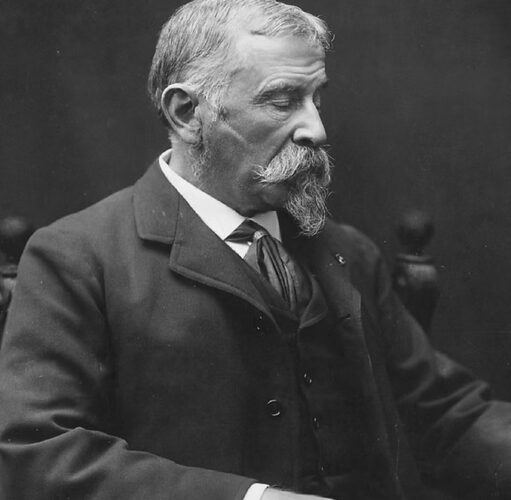
Henry Higginson Photo: Harvard University Archives
About a dozen years ago I was invited, impromptu, to address a gifted youth orchestra at Boston’s Symphony Hall. I mounted the podium and asked how many people had heard of Henry Higginson. I was unsurprised to discover that his name was wholly unknown. He invented the Boston Symphony in 1881, I explained. He built this hall 19 years later. It could have been called Higginson Hall, but he vetoed that. The exposed wood, the absence of boxes, the thin upholstery, the spare New England ambience — all Higginson, I said. I added that he also decided to reserve 25-cent nonsubscription seats for all concerts, and to offer public rehearsals for which all seats cost a quarter.
With today’s Boston Symphony in an uproar, lacking direction, attention should be paid to Henry Higginson. He knew what he was doing. He knew how to scout and hire conductors. He knew what music he wanted played. He knew what the orchestra was for.
In my books, I call Higginson and Theodore Thomas the two most “colossal” figures in the history of American classical music. More than anyone else, they made the concert orchestra an American specialty, in contradistinction to the pit orchestras abroad. Thomas’s very credo was: “A symphony orchestra shows the culture of the community, not opera.” His was the first world-class American orchestra. It was itinerant, plying the “Thomas Highway” from coast to coast beginning in the 1860s. He was ultimately the founding music director of the Chicago Orchestra (now the Chicago Symphony) in 1891.
People assume Higginson was a Boston Brahmin. He was born in New York in 1834. He studied music in Vienna, where he could not afford three meals a day. He composed songs. He discovered himself unequal to a musical vocation. He subsequently served in the Civil War, commanding a company of Union soldiers from all walks of life. After that, he purchased a dormant Georgia plantation whose employees were freed Black Americans. He later recalled: “We had done our best to upset the social conditions in the South, and helped free the negroes, and it seemed fair that we should try to help in their education.” He eventually resolved to go into banking with the goal of amassing money enough to create a permanent orchestra for the city of Boston.
Incredibly, there is no biography of Henry Higginson. The fullest treatment is my own: a 56-page chapter in Moral Fire: Musical Portraits from America’s Fin de Siecle (2012). Here’s an excerpt:
As an embodiment of what was best about Boston, Higginson’s symphony was quicker to acquire a fully appropriate home than a fully appropriate conductor. Wilhelm Gericke, who came and left twice, proved an ideal builder and trainer…. The violinist Sam Franko, who quit the Boston Symphony …, was not alone in finding Gericke’s performances “full of subtle nuances, finely balanced” and yet without “spontaneity and life.”… But Higginson did manage to place two great names on his Boston podium. These were Arthur Nikisch and Karl Muck…
Nikisch arrived in Boston in 1889 at the age of thirty-three. He was not yet Europe’s idolized Svengali of the baton, concurrently conductor of the Berlin Philharmonic and of the Leipzig Gewandhaus Orchestra. [In four Boston seasons, Nikisch led nearly 400 concerts; in those days, conductors stayed put.] But Nikisch split Boston opinion…. Higginson acknowledged the sorcerer in Nikisch. He appreciated the stature of Nikisch the musician; he even called him a “genius.” But … Higginson mistrusted Nikisch the man.
Like the creation of the Boston Symphony Orchestra, like the building of Symphony Hall, the process by which Higginson acquired Karl Muck — the conductor he ultimately favored above all others — illustrates the singular modus operandi of a useful citizen who knew what he wanted and how to obtain it…. Higginson instigated a conductor search. The orchestra’s manager, Charles Ellis, and the composer George Chadwick were Higginson’s agents abroad. He also conferred frequently with his Viennese friend Julius Epstein [an eminent pianist whom Higginson knew from the Vienna Conservatory], with the singer Milka Ternina, and with two key members of his orchestra who knew the European scene: Kneisel, the concertmaster … and Charles Martin Loeffler, who also happened to be one of America’s leading composers. A list of twenty-five candidates was assembled — a virtual who’s who of Germanic podium talent. Higginson quickly weeded out Gustav Mahler and Willem Mengelberg, whose restless interpretive predilections and progressive repertoire choices he recognized. He had no compunction about considering the Jewish Bruno Walter but felt that at thirty Walter was probably too young. He eventually narrowed the field to four reckonable names: Niksich [again], Muck, Hans Richter, and Felix Mottl.
The ensuing negotiations were direct and business like. The conductors had no agents. Higginson’s assessments characteristically weighted personal integrity alongside artistic prowess….
Muck was as strict as Gericke without constraining his men…. He sampled repertoire new to Boston, including … — from a sense of duty — Schoenberg’s [non-tonal] Five Pieces for Orchestra. He scheduled considerable quantities of French, Russian, and American music, known and unknown…. In sum, no less than did Henry Higginson, Muck’s Boston programs plied a middle course, rejecting the snobbish insularity of many a Brahmin and the radical reform being espoused by young Leopold Stokowski in Philadelphia….
Other than Theodore Thomas’s itinerant band, Higginson’s was the first American orchestra to acquire an international reputation. As early as 1902 Richard Strauss called it “the most marvelous in the world.”… The city’s prominent composers — Chadwick and Loeffler, Arthur Foote and Amy Beach — were regularly performed. Chadwick sometimes conducted; Loeffler, Foote, and Beach appeared as soloists. Isabella Stewart Gardner might attend wearing a Red Sox hatband. When George Henschel [the first music director] bade farewell, the orchestra broke into “Auld Lang Syne”; the audience rose and sang along. For the summer Proms, patrons ate and drank at tables, and called out for the repetition of favorite numbers. Even New York was quick to concede the caliber of Higginson’s constituency. Visiting Boston for Nikisch’s debut in 1889, Henry Krehbiel [the dean of New York’s music critics] observed “the gentleness of the city’s taste in music, the genuineness of her appreciation, the thoroughness of her understanding and earnestness of her devotion…. She is blessed beyond measure in the disposition of her people toward an art which makes for the civic virtues in a degree scarcely equaled by another other agent of civilization.”…
At the Museum of Fine Arts, cultivated Bostonians would tour the galleries in deferential silence. At Symphony Hall a defining spectacle was the frantic upstairs race of rush-ticket holders, vying for the best second balcony seats…. [Higginson once observed that] “the audience is not from the Back Bay or from an particular set of people. They are town folks and country folks, and they come to hear the music.”…
Higginson seized the opportunities at hand with surgical precision. He replaced existing local orchestras with a single, exemplary band, fortified with imported talent and iron discipline. He replaced existing concert facilities with a single, exemplary hall, whose plainness of democratic décor supported a demonstrative communal exercise. He replaced existing musical leaders with a Berlin conductor not selected for his name or reputation or for any considerations expedient of financial, but because he fit specific Boston needs. His Symphony Orchestra both embodied and led the community of culture that it served.
I first explored the genius of Henry Higginson in Classical Music in America: A History of Its Rise and Fall (2005). On that occasion, I was invited by the BSO to give a talk. I have a big mouth, and seized the occasion to suggest to the BSO’s managing director, Mark Volpe (who would graciously furnish a jacket endorsement for Moral Fire), that a strong topic for a BSO festival would be “Stravinsky in Boston.” I made the same suggestion at Harvard, which I also had occasion to visit. Stravinsky had delivered his famous Norton Lectures at Harvard in 1939-40. Concurrently, the Boston Symphony’s Serge Koussevitzky was by far his greatest champion among American orchestra leaders. A Harvard/BSO collaboration around this topic, with participating scholars, seemed a nifty idea to me. It still seems a nifty idea to me.
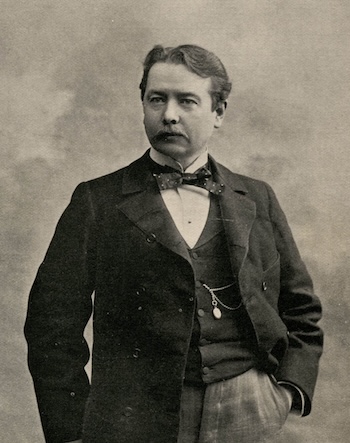
Composer George Chadwick. Photo: NEC
In general, I have long believed that the Boston Symphony, with the most august history of any American musical institution, should celebrate and explore its own astonishing past. Bostonians today have no idea how distinguished Boston’s composers once were. A piece like George Chadwick’s Jubilee (1895) deserves to be as well known to American audiences as John Philip Sousa’s contemporaneous The Stars and Stripes Forever. Chadwick was also the director of the New England Conservatory. Chadwick cuts a bigger swath in Classical Music in America than Aaron Copland. He’s also the topic of one of my NPR “More than Music” shows, about musical Boston. This season’s BSO programs purport to celebrate “America 250.” They barely even go through the motions.
The late Robert Freeman, whose distinguished career included an embattled stint trying to run the New England Conservatory (I was there), sometimes spoke to me about his father, long the principal double bass of the BSO. Henry Freeman, said Bob, traced a steady decline in the orchestra’s stature — from Koussevitzky to Charles Munch to Erich Leinsdorf. In fact, after Higginson and Koussevitzky, the BSO has never found its way. A tantalizing question is what might have happened had the trustees chosen Leonard Bernstein, Koussevitzky’s anointed successor, rather than Munch in 1949.
What’s happening now is anyone’s guess. The administration and board have broken with Andris Nelsons. The musicians are loudly calling for him to stay. Time’s up: the orchestra needs to chart an explicit and considered new course. It needs to define a Boston mission and, within that, a Boston-based role for Nelsons’s successor. It’s nothing less than what Henry Higginson undertook, courageously, for four decades.
P.S. – You can find on YouTube a splendid performance of the New World Symphony with a very young Andris Nelsons leading the Bavarian Radio Orchestra — a better performance, with a better orchestra, than the one I heard from Nelsons at Carnegie Hall last Thursday.
Joseph Horowitz is the author of 14 books dealing with the history of American music. His blog is www.artsjournal.com/uq. His website is www.josephhorowitz.com
Tagged: "Classical Music in America: A History of Its Rise and Fall", George Chadwick
4 Comments
Leave a Comment
Terrific article. I hope everyone at the BSO reads it. The orchestra needs a music director with a mission, or vision. It came close with Levine, but for too many reasons that didn’t end well. And Nelsons maybe was the best of the bunch of finalists when he was hired, but too many possibilities didn’t even seem to be under consideration.
Great information on Higginson! Would someone please explain what this “mission” is. I have seen it in every article about this travesty for a month now and no one even hints at what direction they are talking about.
This is just a simple case of corporate bullying. Mr Andris doesn’t go to Sox games and wear a baseball cap is what this is all about. We have one of the best orchestras in the world, one of the most sought after conductors in the world and we would to head in a new direction. Poor management is the real problem. Attendance is down, please give me a list of orchestras with rising attendance.
Recently read an article about the Gardner and their nasturtiums adding a new touch. Let’s see maybe Mr Smith would like to program a week of Philip Glass symphonies, that would really pack em in. What draws an audience? Let’s try a week of Beethoven symphonies, oh, we did that and yes it was a tremendous success. Why? In general the best attended concerts are those featuring classical music that the masses love. We certainly can’t let contemporary music die but we are not doing that. One selection makes almost every concert.
Poor management, this example is with the Pops, but it almost provides my point more. My wife and I went to a marvelous Holiday Pops concert this past December. It had everything one could wish for the season. However, it cost $400 for us to go to the concert on a Wednesday afternoon. At intermission I turned around and noticed the floor was barely half full. This is not due to poor programming or even that Mr Lockhart is seen around Boston all the time. It is due to poor management, which is not a Nelsons’ problem.
The fact that Boston performance groups have more performances scheduled than any other group in the country should be addressed. We could easily cut back on a few concerts with all groups and maybe charge a little less for tickets so more people could afford to come. They cry their money woes and yet an endowments far greater than other orchestras. Again, poor management. Anyone look at the reception of Andris and the BSO at Carnegie Hall, I guess they understand the quality of orchestra and conductor we have.
The NY Times gave that Carnegie Hall performance a lethally negative review.
An excellent summary of the history of the BSO and the fountainheads of American orchestral history in general. It’s something that is not taught in conservatories and is important to understanding the American business model of running orchestras which has a different model than in Europe.
It is indeed interesting to contemplate Bernstein as inheriting the BSO from Koussy. However, even after that, he was a constant presence at Tanglewood so his influence was felt on that orchestra for decades.
It’s also interesting to note how much compositional talent there was in Boston in those early years. Many of those names were foundational to the American School of composition.