
Theater Review: Good Theater’s “Grand Horizons” — An Entertaining, At Times Unsettling, Domestic Dramedy
By David Greenham
A renovated and flexible performance space with unlimited free parking is what every theater company from Boston to Portland dreams of.
Grand Horizons by Bess Wohl. Directed by Nathan Gregory. Scenic design by Tracy Washburn and Steve Underwood. Costume design by Rebecca Copeland, lighting design by Emily Kenny, sound design by Cory Macgowan. Produced by Good Theater, Stevens Square Community Center, Stevens Avenue, Portland, Maine, through April 19.
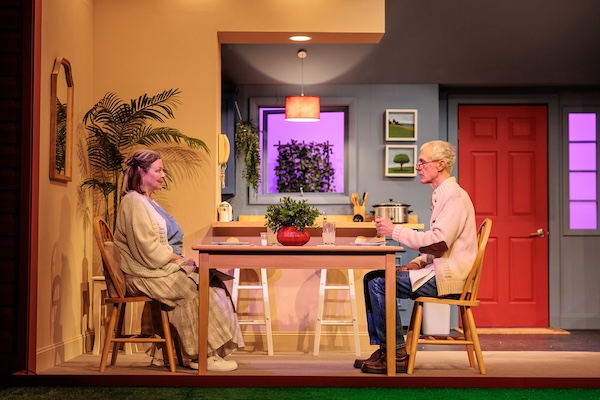
Laura Houck and Bill Underwood in the Good Theater production of Grand Horizons. Photo: Kat Moraros Photography
There’s a new performance space in Portland that seems destined to be a success. It’s in the former school auditorium on the campus of the former Catherine McAuley High School, which closed its doors about a decade ago. Luckily, the ambitious Good Theater jumped at the opportunity to program what has become a 480-seat theater in what is now the Stevens Square Community Center. The company, started as a labor of love by Brian P. Allen and Stephen Underwood, began more than 20 years ago; it has endured to become a Portland mainstay, specializing in hiring local professional theater artists. Two years ago, the company left its old spot on Portland’s Munjoy Hill to move into its new digs in the Deering neighborhood.
A renovated and flexible space with unlimited free parking is what every theater company from Boston to Portland dreams of. And, when you walk into the sparkling lobby of Good Theater’s new space, it is clear that the building’s developers had “location” in mind: this professional theater sits right next door to a 55+ housing development called Stevens Square at Baxter Woods, which has set up a large marketing display in the lobby.
Given those facts on the ground, the choice to stage Bess Wohl’s popular comic-drama Grand Horizons makes sense. The play is set in an independent living community for 55+ residents. Nancy (Laura Houck), and Bill (Good Theater co-founder Underwood), a couple who have been married for more than 50 years, seem like the perfect residents of a local housing development.
The pair’s modern, if plain, apartment contains a compact kitchen, dining room, and living room on the first floor, bedrooms up above. We first meet the couple as they’re navigating their dinner routine: Nancy prepares the plates while Bill sets the table and fills their water glasses. They sit and eat in silence until Nancy stops quietly and says, “I think I’d like a divorce.” Bill, without missing a beat, shrugs and says, “Okay.” With that, Wohl’s episodic comedy— with some edge— starts to roll.
While this turn of events doesn’t startle either of the key players in this romp, their sons, Ben (Daniel Cuff) a corporate middleman, and Brian (Nick Sutton), a gay high-school drama teacher, are thrown into panic. They descend on the house in agony, bringing along Ben’s very pregnant wife Jess (Casey Turner), who seems just days away from making Bill and Nancy grandparents.
“This is not you!” Brian emotes, “This is not who you are, so we’re gonna hash this out.” Nancy isn’t so interested in hashing. For his part, Bill confesses calmly that he “would have just slogged it out.”
For Ben, timing is a big part of the problem: “If you wanted to get divorced, you should have done it when we went to college like normal people do!”
There is a brief moment where Jess, a counselor, tries to intervene and calm things down. She gets her in-laws to hold hands and suggests that they talk about imagination, fantasy, or even the value of role-playing. The boys dismiss the effort, while both Nancy and Bill admit that at this point they want to end the roles they’ve been playing as a happy married couple.
What makes Wohl’s comedy work so well is her willingness to push her frustrated characters into a corner, to mine their yearnings for escape. Bill wants to be more than a retired pharmacist. He’s taking a stand-up comedy class and at least one classmate, flamboyant Carla (Kathleen Kimball), thinks he’s funny.
Brian is a little too passionate about inclusion. At one point, he describes a disastrous-sounding production of The Crucible in which he cast 200 students. When he brings home bar pick-up Tommy (Keating Babcock) for a romp, it’s clear the guy’s got some intimacy issues to work through. Meanwhile, with a baby due any day, cracks are showing in Ben and Jess’ relationship — and they explode sideways in an emotional outburst.
Nancy, who has devoted her life to her husband and children, still remembers her high school sweetheart, Hal, the one who got away. Our hearts go out to the woman, who hopes that it is not too late to discover herself. Unlike her husband, Nancy hasn’t given up. Grand Horizons’ most poignant moment comes when Nancy chastises whiny Ben for demanding that she be content to simply be his mom. “I will be a whole person to you,” she asserts. Its a statement that most mothers could make to their children at some point.
The cast navigates the humor and dramatic conflicts successfully. Houck’s Nancy is a step above everyone else in the cast. The scene where Houck shares her memories of Hal with Brian is the evening’s highlight. There’s also a hilarious encounter between Nancy and Carla that skillfully mingles the carefree fun of flirting with the day-to-day reality of marriage.
The approach to the visual staging is the same as it was in Gloucester Stage’s production in 2022. It is purely conventional. Tracy Washburn and Steve Underwood’s set reflects the terminal indifference of Bill and Nancy’s marriage; Rebecca Copeland creates more interesting costumes for ‘outsiders’ Tommy and Carla; Emily Kenny’s lighting does what’s required. The only wild card ingredient is the sound, and Cory Macgowan manages that successfully, although some levels might benefit from adjustment.
Grand Horizons runs two hours plus intermission, and it is an entertaining, at times unsettling, domestic comedy. In this case, it’s also a thoughtful programming choice, given that the property surrounding the theater is a 55+ community.
Still, after having seen two fine productions of Grand Horizons, I have concluded that the script is missing something, perhaps a lack of nerve. The story has depth — all of the characters have stuff to work out, as we all do. Yet, at the end, Wohl opts to suggest a happy ending for Nancy and Bill, while the rest of those involved appear to be condemned to continue to sleepwalk through their lives. The playwright flinches at getting to the heart of what looks to be a cautionary tale about how poorly we communicate with each other, especially with those we love.
David Greenham is an arts and culture consultant, adjunct lecturer on Drama at the University of Maine at Augusta, and is the former executive director of the Maine Arts Commission. He can be found at https://davidgreenham.com/
Why does the term “dramedy” exist? It hardly seems necessary.