
Book Review: “Great Pond” — Where Beauty and Hard Truths Swim Together
By Carolynn Kingyens
Ed Meek’s ability to harness language and cadence is comparable to watching a cowboy harness a wild mustang.
Great Pond by Ed Meek. Kelsay Books, 88 pages, $20
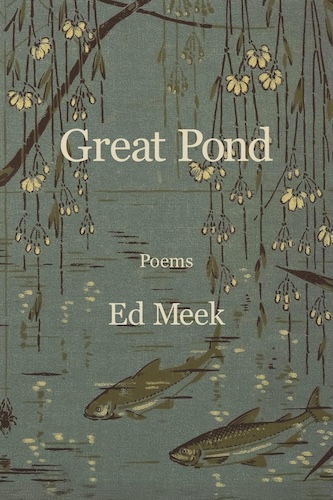
I was thrilled to review Ed Meek’s previous collection, his third book, 2020’s High Tide. I’ve been a friend and fan of his work ever since. One of the immediate signs of good poetry is the strength of the narrator’s voice and tone; it should guide the reader through its arrangement of poems with the skill of a consummate host. This was my experience while reading Meek’s fourth book—Great Pond. As Steph
The transference of point-of-view takes real mastery on the part of the poet, to have the reader see what the poet sees, feel what the poet feels. Meek accomplishes this transference brilliantly, almost effortlessly, starting with his eponymous poem, “Great Pond.” While swimming alone at the pond in Wellfleet, he is joined by two young girls and their American Quarter horses that had emerged from the woods:
They were lithe and lovely, tanned in their swimsuits.
I thought they were stopping for water, but the girls
Rode their horses into the pond,
Slipped off their backs and swam beside them,
Ropes in hand, as if it were the most
Natural thing in the world. Then
They slid back on like seals and rode the horses out,
into the woods…
The horse theme returns in the poem “Mustangs,” after the narrator “pulled off the highway in Montana to take a piss” but is caught up instead, with the rapture of witnessing “a pack of feral mustangs” running free:
…galloping for the unharnessed pleasure of speed
as if it were a hundred and fifty years ago
when Blackfeet chased them down for fun.
Nature is also a key presence in his poem “In the Provinces,” which focuses on a summer spent in Wellfleet during the COVID pandemic:
the sun assumes his throne.
Mornings, the kettle ponds shimmer.
Pitch pines admire their reflection
from the banks. We watch
an osprey catch a perch
to feed her chicks before
we immerse ourselves
in the pristine water.
The poem then takes a turn, focusing on other towns “far, far away” from the coastal town of Wellfleet, where the virus runs rampant in nursing homes and prisons. Meek personifies the virus with witty duality:
The virus needs a drink at a bar after a hard day
working the line at the meatpacking plant.
The virus decides to post an ad in the personals:
Loves to party and hang out with friends!
Loves beach blanket bingo!
We were all witnesses to what happened in Minneapolis. In “Asylum,” Meek hones in on the trauma, concentrating on the threat to the bond between mothers and their children when faced with thuggish violence as “the agents must learn to ignore the crying and screams.” This poem recalls the haunting spirit of the novel Sophie’s Choice:
It’s as easy as cutting a cord,
to separate the mothers and children—
the ones seeking asylum
from gangs and violence,
so desperate to flee
they’ll risk seizure
by the border patrol
and customs agents who need
at least two officials—
one who grabs the kids,
the other the mothers—
pinning their arms from behind,
to pry them apart
like oysters.
And, in the poem “Warhol’s Marilyn,” he compares, with linguistic panache, the buxom blonde movie star to a commodity rapidly increasing in value:
…How Marilyn the symbol
multiplied exponentially
like bunnies in the suburbs in spring
until omnipresent as rap music
she was a goddess available to all
who worshipped her,
she was claimed
by an athlete, a playwright, a president…
They say the loss of a child is the most painful of all human experiences—a club no parent wants to join. In his brief but powerful poem, “The Death of a Child,” Meek describes grief as a black cat in the basement of memory. “The Last Thing He Said” is about a son who shoots himself due to “an overwhelming sense of shame.” Nagging questions remain for his mother and sister:
If only I’d supported him, she said,
instead of fighting;
over what, she’s forgotten now.
The injustice of the world
what triggered him most—
he argued until his aunts and uncles
refused to host and his mother
suggested he leave her house.
In the poems “Class of ’69” and “Hungover Sundays” Meek reminisces about his university fraternity days, echoing Eddie Money’s classic song, “I Wanna Go Back” …and do it all over but I can’t go back, I know:
…And the times we’d been jumped—fights we’d gotten into
and pulled each other out of. Nights we’d blacked out
and woke in strange beds and backyards
and the back seat of strangers’ cars.
And girls who picked us up or who we picked up—
beautiful crazy sexy ugly girls we wish
we could remember or forget.
Meek’s ability to harness language and cadence is comparable to watching a cowboy harness a wild mustang. That athleticism is underscored in his quasi-ode to Allen Ginsberg, “In the Starry Dynamo.” This poem approaches perfection:
And didn’t he harbor an eye for detail channeling Whitman
whose steps he followed into the vast and fertile fields
of his mind’s illustrious eye while cultivating his ear
for the music of poetry that we all hear in our childhood
of imaginary friends whom we banish
on the savage psychotic battlefields of adolescence.
It is difficult not to follow Meek’s inviting voice, meandering around the beautiful, though at times alarming, shores of Great Pond, where wander the ghosts of his parents along with the bodies of hard-knock people, surviving on society’s fringes, pushing their “Homeless Shopping Carts.”
Carolynn Kingyens is the author of the poetry collections Before the Big Bang Makes a Sound (2020) and Coupling (2021). Her forthcoming and most existential book, Lost in the Bardo, is scheduled for release in a few weeks. In addition to poetry, Kingyens writes narrative essays, reviews, and short fiction. Two of her short stories were selected for Best of Fiction 2021 and 2023.