Film Review: Stalin’s Labyrinth — Blind Justice in “Two Prosecutors”
By Steve Erickson
The power of Ukrainian director Sergei Loznitsa’s film stems from its deep repugnance at an acceptance of the aesthetic and moral poverty of dictatorship.
Two Prosecutors, directed by Sergei Loznitsa. Streaming on The Criterion Channel
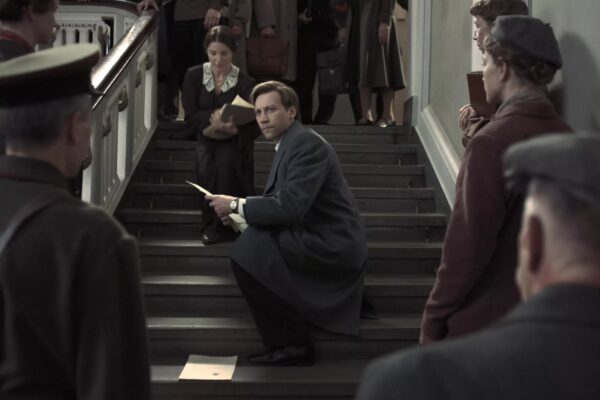
Aleksandr Kuznetsov in Two Prosecutors. Photo: Janus Films
Two Prosecutors is set in a time and place when corruption has become the law of the land — 1937 in the USSR — although tyrannical power renders it invisible. The visual world is grayed out: cinematography, costumes, and set design are devoid of lively colors. The remaining shades of brown don’t feel very warm. Rather, they infuse the atmosphere of decaying leaves into the narrative. For a period piece, Two Prosecutors takes the unusual step of using digital video to bleach out its look.
Prosecuting attorney Kornyev (Aleksandr Kuznetsov) arrives at a jail to take up the case of Stepniak (Aleksandr Filippenko), an old man who claims that he’s been unjustly imprisoned. The system does not take such challenges seriously. Surrounded by scraps of paper relating accounts of false imprisonment and confessions coerced by torture, one of the prison’s workers slowly burns them. Denied pencil and paper and beaten so badly that his organs are failing, Stepniak is scribbling in his own blood. Kornyev decides to visit the prisoner, to look into the charges of judicial malfeasance. Stepniak believes deeply in Stalin, and urges the prosecutor to inform Soviet leadership about a spread of dishonesty that’s destroyed so many lives. Kornyev takes a long train ride to Moscow to do so, waiting in an endless line to speak with Procurator General Andrey Vishinsky (Anatoly Beliy).
Loznitsa has become Ukraine’s most prominent living director, but the film does not engage directly with his homeland, aside from acknowledging the fact that it was once part of the USSR. (Of course, during the current war, there’s a tremendous fear that the oppressive past will return.) To make Two Prosecutors, Loznitsa had to reconstruct the USSR outside of Russia. It was shot in Riga, Latvia, using a real prison. Kuznetsov and Filippenko both left Russia because of their opposition to its war against Ukraine; the former now lives in the U.K., the latter in Lithuania.
Loznitsa himself lives at a remove from the invasion of Ukraine—he’s based in Germany. Though he is best known as a documentarian, the director has made narrative features since 2010. Haunted by the Holocaust and Stalinism, his films inevitably return to the period when Two Prosecutors is set. His non-fiction work confronts political chaos more directly, but the two forms can’t help but intertwine. For example, his 2018 feature Donbass fictionalizes real incidents that occurred in Russian-occupied Ukraine. (Some of the original versions of these images can be found on YouTube.) Loznitsa has also added new soundtracks to compilations of archival footage.
In terms of narrative, there are few surprises in Two Prosecutors. The key to the film is that the viewers know far more than Kornyev. We can see the outline of the maze that he is not even aware he is in. He sincerely believes that the government operates fairly. Even though he is well aware of the suffering in the prison, he remains fatally naïve. The irony is unmissable: the decent people in this film are the true believers in communism, not the rebels out to destroy it. The best and the brightest don’t realize that they’re trapped in a society that uses a thin veneer of egalitarian idealism as bait.
Kornyev has barely graduated from law school. He looks younger than his actor’s 33 years. His handsomeness is in stark contrast with Stepniak’s ruined body and the grimacing prison guards. He may still be a virgin; in any case, he has no interest in anything beyond his work. The film doesn’t flesh out the prosecutor’s personality — he is simply devoted to doing his job well. While visiting the jail, Kornyev is guided by two guards through endless corridors lined with locked doors. Images of dismal endless passageways recur; there are similarly winding staircases and hallways in the Moscow courthouse where Kornyev ends up. Tellingly, jail cells are among the few spaces in Two Prosecutors that offer human beings any solitude. Loznitsa’s USSR feels like an impossibly constructed space worthy of a M. C. Escher drawing.
Two Prosecutors makes its points about life under authoritarianism with little subtlety. There are parallels with life under Putin, Trump, and would-be tyrants but, almost 90 years after these events, excessive idealism in government isn’t a major political problem in the West. A blind faith in strong-arm leaders is, however, and that is compounded by a debilitating cynicism. Are we any more in touch with reality than the dutiful Kornyev? At least he believes in the possibility of change. What are we willing to act on? The sensation of being trapped within an irredeemable system — which crushes or co-opts all attempts to hold it accountable — only makes the passive acceptance of the way things are stronger. The power of Loznitsa’s film stems from its deep repugnance at an acceptance of the aesthetic and moral poverty of dictatorship.
Steve Erickson writes about film and music for Gay City News, Slant Magazine, the Nashville Scene, Trouser Press, and other outlets. He also produces electronic music under the tag callinamagician. His latest album, Bells and Whistles, was released in January 2024, and is available to stream here. He presents a biweekly freeform radio show, Radio Not Radio, featuring an eclectic selection of music from around the world.