
Film Review: “John Lilly and the Earth Coincidence Control Office” — A Sober Look at a Psychedelic Mind
By Steve Erickson
Faced with the bizarre evolution of John Lilly’s life and ideas, the directors were wise to refrain from sensationalism.
John Lilly and the Earth Coincidence Control Office, directed by Michael Almereyda and Courtney Stephens. Screening at the Brattle Theatre on April 13.
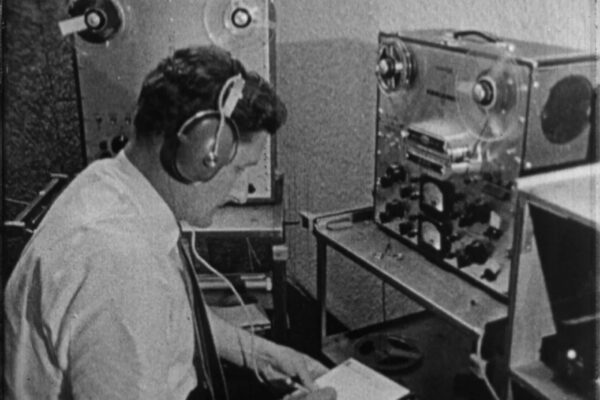
A scene from the documentary John Lilly and the Earth Coincidence Control Office. Photo: Oscilloscope Laboratories
If John Lilly hadn’t been a real person, a science fiction writer would no doubt have created him. In fact, Arthur C. Clarke’s novel Dolphin Island and two films — Mike Nichols’s The Day of the Dolphin and Ken Russell’s Altered States — feature characters inspired by the man. A scientist whose greatest test subject was the human mind and body, he left a cultural footprint more akin to that of Timothy Leary or William S. Burroughs than Stephen Jay Gould. His work inspired the video game Ecco the Dolphin and an episode of the anime series Serial Experiments Lain; it also sparked the popularity of whale song as New Age music.
Born into a wealthy family, Lilly became a doctor, psychoanalyst, and neurophysicist. This film picks up his story in the early 1950s, when he was experimenting on monkeys. Working with the US government, he aimed to devise ways to manipulate the minds of animals and humans alike. In 1953, he invented the isolation tank and then became one of its biggest users. He spent hours drifting in its warm fluids, overwhelmed by hallucinatory images. He became fascinated with the singsong clicks dolphins make, convinced that it was a form of language as complex as the ones humans speak. (Scientific consensus remains out on that.) His assistants spoke and sang to dolphins, who responded in kind. At one point, waking from a coma, he was convinced that paranormal beings had ushered him back to life. (He was dropping acid regularly then.) When Lilly added ketamine to the mix (sometimes taking it hourly), his beliefs became far stranger. Lilly insisted he was in contact with aliens and that dolphins were sending him holographic images. The second half of the film’s title refers to Lilly’s growing belief that fate was guided by nonhuman forces. Parallels with sci-fi writer Philip K. Dick’s musings on the far-fetched idea — that images of the past or alternate realities were being beamed directly into his brain — are hard to miss. But Lilly didn’t have any doubt about the truth of those notions.
Faced with the bizarre evolution of Lilly’s life and ideas, directors Almereyda and Stephens were wise to refrain from sensationalism. For a film about a man who used psychedelics regularly, this is a remarkably grounded narrative. It never becomes staid, though it might easily have done so — PBS could have produced this rational take on a fundamentally irrational person. Chloë Sevigny’s narration is steady, patient, and informative. Lilly died in 2001, so the directors were unable to speak to him. They did manage to interview a few of his associates, including filmmaker Alejandro Jodorowsky, but the main focus of John Lilly and the Earth Coincidence Control Office is its montage of period archival footage.
Lilly was a walking paradox. A man who desired to learn from dolphins and believed he’d developed the means to communicate with them, he nevertheless treated the animals abusively. His intent — “I just want to talk to such ancient creatures and see if they have any wisdom for us” — sounds benevolent, but he experimented on dolphins without any respect for their own needs. He killed several in attempts to anesthetize them and also injected dolphins with LSD. His lab took them out of the wild, where they swim in pods and roam a vast expanse, and placed them in small tanks. As Lilly’s care grew more neglectful, the dolphins became miserable and physically ill. Five of the eight animals kept at his lab died. Lilly saw their passing as suicides. On the one hand, he put dolphins to different uses than aquariums, which teach them tricks — but in the end he doesn’t seem any less exploitative.
Still, with all of that mistreatment in mind, Lilly’s yearning to communicate with another species remains touching. Others dream of contact with aliens from outer space; he sought out the depths of inner space and the ocean. Long before he began using drugs, the man was open to a belief in the paranormal — he eventually cast aside the façade of an academic scientist to become a New Age guru. The film refrains from passing judgment — or even any firm conclusions — on the extremes of Lilly’s personality.
To quote film critic Leonard Goi, “Where others might have played the most salacious aspects of Lilly’s saga and astonishing drug intake for shock value, Almereyda and Stephens are after something different — namely, the processes through which ideas can be absorbed into the mainstream and meaningfully shape it.” In both positive and negative ways, Lilly was a revealing product of his conspiratorial times. His exploitation by the Cold War military-industrial complex and the CIA’s MKULTRA program are an essential part of his history. (The US government gave Lilly the LSD he used on dolphins and on himself) Yet the scientist’s thinking also paved the way for Greenpeace and the broader environmental movement. He also helped propagate the notion that dolphins and other animals are worthy of our respect and of fair treatment, including rights. If you want a version of Lilly’s experiences transformed into a trippy monster movie, watch Altered States. John Lilly and the Earth Coincidence Control Office is a work of sober observation.
Steve Erickson writes about film and music for Gay City News, Slant Magazine, the Nashville Scene, Trouser Press, and other outlets. He also produces electronic music under the tag callinamagician. His latest album, Bells and Whistles, was released in January 2024, and is available to stream here. He presents a biweekly freeform radio show, Radio Not Radio, featuring an eclectic selection of music from around the world.
Tagged: "John Lilly And The Earth Coincidence Control Office", Courtney Stephens, LSD, Michael Almereyda, dolphins