
Jazz Album Reviews: LP Reissues Spotlight the Enduring Craft of Guaraldi, Garnett, and Chambers
By Michael Ullman
Three recent high-end LP reissues that have only become more valuable over time.
Joe Chambers/ Larry Young: Double Exposure (1977, Time Traveller LP)
Carlos Garnett: Cosmos Nucleus (1976, Time Traveller LP)
Vince Guaraldi and Bola Sete: From All Sides (1964, Fantasy LP)
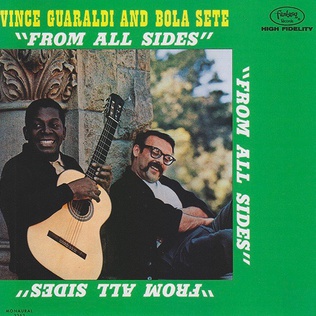 A trio of LP reissues that have never sounded better. They are all appealing. The careers of the leaders certainly varied. Chambers and Garnett are lesser known out of jazz circles, but pianist Vince Guaraldi attained stardom beyond the typical jazz crowd. Born in California in 1928 and deceased 47 years later, Guaraldi had an extensive early recording career, working with Woody Herman, Cal Tjader, and others. (He traveled with the Woody Herman big band.) He led his own groups as well. In the spring of 1957, he recorded a trio album, A Flower Is a Lovesome Thing, for Fantasy. It was respectfully received. He continued to record regularly, without making waves, until 1962, when he had an unlikely hit with “Cast Your Fate to the Wind” from his album Jazz Impressions of “Black Orpheus.” The song won a Grammy, and during the rest of the ’60s, as I remember, Guaraldi was all over the radio. His music attracted listeners (my college roommates included) who did not typically listen to jazz. Guaraldi had a talent for writing memorable melodies that sound as cheerful as a summer day.
The Black Orpheus recording led serendipitously to even greater career triumphs. The producer of the animated TV show A Boy Named Charlie Brown heard “Cast Your Fate to the Wind” and hired Guaraldi to write the music for the animated show. Amusingly, his success here made Guaraldi suspect in some hardcore jazz circles: asked if he had sold out, Guaraldi wittily replied that he had bought in. I am glad he did. As we can hear in his album From All Sides, his playing remained buoyant, his composing and arranging still inventive and inviting.
From All Sides is co-led by the Brazilian guitarist Bola Sete: this was their second collaboration. It was made at a time when, according to the album’s notes, Sete still could barely speak English. The leaders communicated through music. The record opens with a surprise: after a lovely two-bar intro by Sete, Guaraldi enters playing the theme from Mozart’s famous G minor symphony. They call the tune “Choro” and Guaraldi takes credit for the composition. (No harm done — Mozart no longer needs the money.) Throughout the LP, the two leaders work seamlessly together, weaving in and out of each other’s phrases. They perform “The Girl From Ipanema” delicately; it differs from any other recording of this timeless, perhaps overplayed, classic. Guaraldi solos, nonchalantly supplying a flow of original melodies. The duo and accompanists transform “A Taste of Honey” into a vigorous Latin tune. It works because of the musicians’ tact as well as their graceful improvisations. This version makes the much more famous rendition by Herb Alpert sound like a lot of chatter. Never to my knowledge a hit record, From All Sides is worth seeking out.
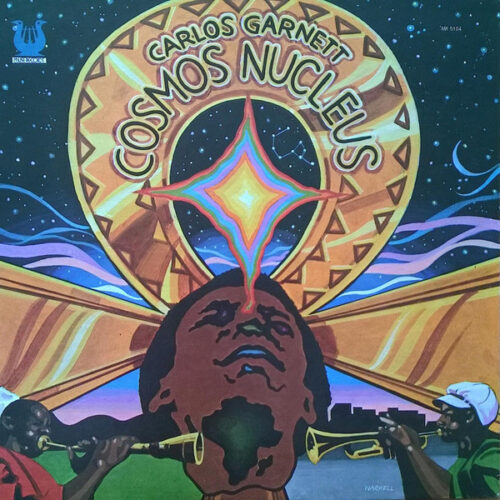 Born in Panama in 1938, tenor saxophonist Carlos Garnett made Cosmos Nucleus 12 years after From All Sides. It’s a big band session in which the horns are tightly scripted and used mostly for their big scale impact and punchy accents over an active, funky rhythm section. The band’s soloists sport bona fide credentials. Cecil McBee Jr. is on electric bass and Kenny Kirkland on electric piano. (If I understand the notes correctly, most of the members of the larger ensemble were Kirkland’s students. They include Billy Cobham’s brother and composer Cal Massey’s son.)
The title cut is a simple theme, almost a chant. The layered arrangement is busy, the rhythm section working with a riff that’s stated by the guitar and reinforced by the drums, while the brass section interjects fanfare-like comments that seem to sail above the noisy crowd. Garnett takes the first solo five minutes into the arrangement. The record opens with “Saxy.” (It’s a bad pun — I hope it was forced on Garnett.) The saxophonist plays the melody and solos, again over an active rhythm section that includes three percussionists. I am not sure who is meant by the title “Wise Old Men,” but it is amusing that, in the opening bars, Garnett yells wordlessly “Ay, yay” before offering his more articulate vocal praises for elders whose wisdom is “not diamond or gold.” His elders are kind to everyone. An elder myself, I’d like to meet the wise ones he is singing of.
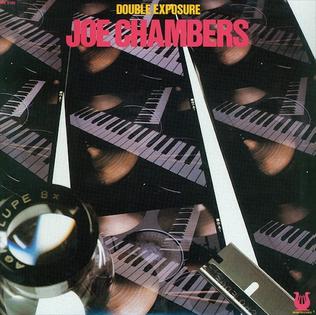 The Chambers/ Larry Young duets are a surprise. Organist Larry Young was a special musician, virtually born to the music. His father, Larry Young Sr., owned nightclubs and was a professional organist who taught his son piano basics. Young was comfortable with modal pieces and he also could rock: in his short life (1940-78), he recorded with, for instance, the fusion bands of Miles Davis, Woody Shaw, vocalist Etta Jones, and guitarist Grant Green, In the early ’70s, he was a key member of John McLaughlin’s Mahavishnu Orchestra and Tony Williams’s Lifetime. He was also on guitarist Grant Green’s most satisfying album, Street of Dreams. More surprisingly, he played on a single track with Johnny Hodges, the legendary alto saxophonist from Duke Ellington’s orchestra.
Young seemed to point to a new future for jazz organ, which, in the hands of its most famous practitioner, Jimmy Smith, was typically used for funk. Young’s approach was lush, suggestive, and could venture far outside of boppish chord sequences. As a leader, he made a series of albums for Blue Note, the most famous including Into Somethin’ and Unity, the latter with avant-garde saxophonist Sam Rivers. I am also a fan of his Mother Ship, which featured another short-lived giant, Lee Morgan. (His Blue Note recordings were collected by Mosaic Records on a six-disc set. It’s well worth looking for.)
On Double Exposure, Young takes second billing to drummer Joe Chambers, who seemed to burst on the scene in 1964. In seven months that year the percussionist recorded with Freddie Hubbard (Breaking Point), Andrew Hill (Andrew!), and Donald Byrd. In the next year or so, he performed on some of the most essential records of the era: Archie Shepp’s Fire Music, Bobby Hutcherson’s Dialogue, Sam Rivers’s Contours, and Wayne Shorter’s The All-Seeing Eye. With one exception, Double Exposure is a series of duets. Chambers plays a solo piano version of “After the Rain,” which Coltrane brought back to the repertoire in his 1963 recording.
Although he is best known as a drummer, Double Exposure opens with Chambers playing piano on his sweetly lyrical composition, “Hello to the Wind.” I am not sure how “Rock Pile” was named: it opens with a tense, almost abrasive organ, playing a riff that seems to break down rather than expand. “Message from Mars” is an uptempo Young piece. Because of his early demise, there has never been enough Larry Young to hear. Double Exposure is valuable on its own, but also because it adds to the available productions from a major figure. I’m a fan.
Michael Ullman studied classical clarinet and was educated at Harvard, the University of Chicago, and the U. of Michigan, from which he received a PhD in English. The author or co-author of two books on jazz, he has written on jazz and classical music for the Atlantic Monthly, New Republic, High Fidelity, Stereophile, Boston Phoenix, Boston Globe, and other venues. His articles on Dickens, Joyce, Kipling, and others have appeared in academic journals. For over 30 years, he has written a bimonthly jazz column for Fanfare Magazine, for which he also reviews classical music. He is emeritus at Tufts University, where he taught mostly modernist writers in the English Department and jazz and blues history in the Music Department.
Tagged: "Cosmos Nucleus", "Double Exposure", Bola Sete, Carlos Garnett, Joe Chambers, Larry Young