
Theater Commentary: Theater for Young Audiences — What Role Can It Play In Saving Our Democracy?
By Joan Lancourt
Meeting today’s challenge—harnessing the performing arts to prepare the next generation to sustain democracy—requires broader collaboration not only with schools and community partners but among TYA companies themselves.
That our democracy is rapidly slipping away is no longer just a theoretical issue. The debate now centers on how—and why—we became embroiled in this catastrophe, and what to do about it next. I came across a revealing statistic in the Ash Center for Democratic Governance and Innovation’s report on the 2024 Presidential Election: 73% of Gen Z respondents interviewed said they did not believe democracy was important. How did this happen?
Part of the problem lies in the parade of pedagogical tools fading in and out of fashion: the false promise of No Child Left Behind, pervasive cuts in school budgets, endless arguments about what version of history to teach, eliminating civics, teaching to the test, and the banning of “dangerous” books. Clearly, we urgently need a serious reassessment about how we teach our children the value of democratic participation. How could schools do a better job instilling these lessons—about democracy, its core values, and why sustained civic engagement matters?
During the mid-1930s and early 1940s—when fascism and racism ran rampant—Junior Programs, Inc., one of the first professional performing arts companies to create productions specifically designed for young audiences developed a theatrical model for teaching young people about the merits of democracy. Remarkably successful—even in what we now call red states— they used the performing arts as a catalyst to prepare young people for active citizenship in a democracy. Though not a cut-and-paste fix today, its dramaturgical pillars offer strong lessons for contemporary children’s theater: making democracy explicit, age-appropriate productions on social justice themes that celebrate the joys of diversity, affirmation of young people’s civic agency, and, above all, deep partnerships with local schools and communities.
Somewhat to my surprise, even a limited review of current TYA theaters suggests such efforts are already underway. In various ways, five Greater Boston–area professional TYA companies—Adam Theater (AT), Company One (C1), Puppet Showplace Theater (PST), Theatre Espresso (TE), and Wheelock Family Theatre (WFT)—use stagecraft not only to entertain young audiences but also to plant seeds of democratic values: cultivating empathy for those different from us, fostering positive views of racial and ethnic diversity, and sparking civic responsibility through an engagement with their communities on challenging issues. Talking with their artistic directors reinforced my impression.
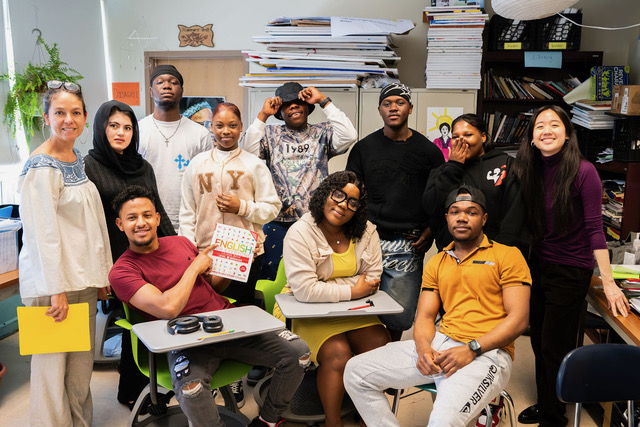
Some of the students in Company One in-school residences. Photo: Annielly Camargo
Company One (C1), while not formally a TYA theater, has an audience demographic that regularly includes older teens and young adults. The company uses its productions to catalyze a strong set of immersive educational experiences for youthful audiences. According to Shawn LaCount, C1’s artistic director, their mission has always been to “build community at the intersection of art and social change.” Although the company does not explicitly mention democracy, this is no mere slogan.
Over the years, C1 has championed artists and playwrights of color and chosen social-justice-themed plays that explore concerns that communities of color and immigrants have struggled with, in the past and in the present.
The company’s theme for the current season is “By the People For the People,” and Mark Vanderzee, C1’s Director of Education, and Raqael Duarte, C1’s Associate Director of Education, make it clear that everything they do focuses on developing and nurturing the “five skills of empathy, community building, agency, critical consciousness, and social justice.” For them, empathy rooted in the awareness of one’s own identity and gifts—combined with recognizing the identity and gifts of others, creates the paradigm shift that spurs concrete action (agency) toward social justice.
Their short (one-day) and long (semester- or year-long) in-school residencies begin by listening to a school’s needs. The company then applies what it calls its Changemaker Framework. For each public production, they host weekday student matinees plus professional development sessions for educators eager to build anti-racist classrooms. C1’s teaching artists “co-plan and role-model” lessons with school staff, offering curriculum guides, pedagogical materials, and recommendations for studying contemporary plays by playwrights of color that mirror students’ diverse populations—scripts that “better reflect their student populations.”
LaCount notes that a dedicated Connectivity Department aligns production choices with community needs. Staff regularly engage in difficult conversations about the historical and ongoing erasure of communities of color and Native Americans, with pre- and post-show activities featuring members of these groups. Their new play development centers on these marginalized voices, amplifying their stories with the goal of reaching a wider audience. Upcoming shows—You Are Cordially Invited to the End of the World! and A New Era—tackle urgent issues for marginalized communities (climate crisis, Black women’s activism), while C1 encourages audiences to take action via its many community partners.

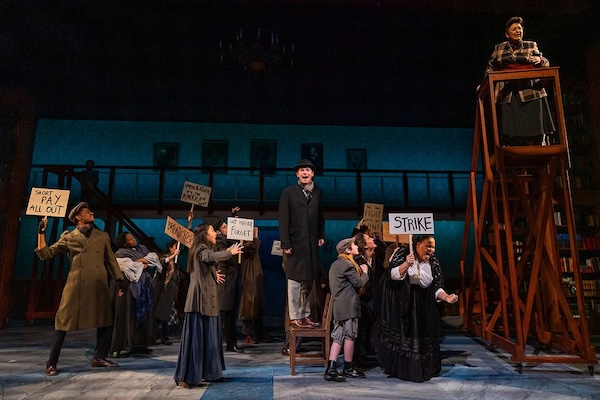
A scene from Theatre Espresso’s production of Children of the Bread and Roses Strike. Photo: courtesy of the artist
Forgoing public performances, Theatre Espresso (TE) performs primarily in schools, libraries, courthouses, and museums. Their repertoire of plays about key moments in American history is intentionally designed to be both complex and interactive. TE’s intent is to present historical figures as living, feeling human beings. Artistic director Shelley Bolman and managing director Kortney Adams view the dramatic arts as a potent teaching modality. This means TE does more than offer a social justice lens on difficult issues, connecting historical events to present-day concerns. The company also welcomes young audiences to literally “step into the characters,” giving them a chance to share how they felt and what they would have done in a similar situation. Most importantly, audience members are asked: What did they learn? An accompanying workshop lets kids step into a role and even alter how a scene unfolds.
The TE repertoire, purposefully aligned with Massachusetts state curriculum standards, includes plays such as The Trial of Anthony Burns, which examines how political favoritism and economic sanctions influenced the enforcement of the Fugitive Slave Law in pre-Civil War Free States. Afterward, audience members are asked to consider questions such as “What were the responsibilities of a state judge when upholding a controversial federal law in 1854?” The play Justice at War recounts the incarceration of Japanese Americans in WWII camps; students reflect on how ethnicity or social class affects the administration of justice. In Nine Who Dared: Crisis in Little Rock, they explore the question: “How can civic engagement help challenge social injustice?” TE’s fusion of youthful agency and civic questions reflects its commitment to nurturing the skills needed to sustain democracy. In Children of the Bread and Roses Strike, students ponder how workers from diverse ethnic backgrounds overcame their differences to unite and improve conditions in the Lawrence mills.
TE also provides detailed study guides for each play with thought-provoking questions about the subject matter. The company also offers workshops for teachers interested in using drama as a pedagogical tool in their own day-to-day teaching.
Wheelock Family Theatre (WFT) attracts an intentionally intergenerational audience. The organization is committed to using the “transformative power of theatre as a catalyst for individual growth, community-building, and innovating new ways of thinking.” The stories WFT tells are often appropriate for children as young as three—think the upcoming production of Charlotte’s Web—and introduce youngsters to such foundational concepts as family and friendship. Designed to foster shows that inspire intergenerational conversations, WFT productions also emphasize the development of essential social skills; by doing this, WFT is part of a nationwide TYA trend that supports youthful mental health as well as social and emotional learning. For example, Roald Dahl’s Matilda the Musical explored the many forms of bullying—verbal, physical, and emotional—with its protagonist calling out the injustice of such behavior and encouraging others to combat these abuses and restore the community’s well-being.
When selecting their plays, WFT’s executive director Nick Vargas believes it is “the five-to-twelve-year-olds who need Wheelock the most.” Accordingly, he searches for stories in which young characters confront life’s many challenges. His recent production of Annie fits this category, with the title heroine overcoming all manner of obstacles in her search for her birth family. Developed in partnership with Emerson College’s Master’s Program in Theatre Education, the post-show Educational Guide provided detailed exercises that encouraged front-line teachers to engage students by having them tell stories about their own families, as well as “found families,” and to examine the times they showed hope, resilience, and persistence.
A scene from the Wheelock Family Theatre’s 2019 production of Ragtime. Photo: courtesy of the artist
Set during turn-of-the-20th-century New York, WFT’s 2019 musical Ragtime wove together the lives of a Harlem musician, a Jewish immigrant, and an upper-class white woman. In the spirit of using the performing arts as a catalyst for teaching history, an accompanying Educational Guide provided an inspiring example of how to bring the play’s social context to life for today’s young audiences. In preparation for seeing the show, the Guide provided front-line teachers with a two-page history of the Progressive Era with dozens of links to topics including labor, settlement houses, Elizabeth Cady Stanton, Standard Oil, Upton Sinclair, the Anthracite Coal Strike, immigration, Reconstruction, Jim Crow laws, W.E.B. Du Bois, and dozens of other key people and events of the period. There were also links to ragtime music, the Cakewalk, and works by Scott Joplin.
The Guide also addressed the difficult issue of the play’s racist language head-on—providing links to resources on the “N” word as well as other derogatory labels used in the musical. There was also a set of discussion questions related to race and media, gender relationships then and now, and the study of unlikely friendships. This background material was followed by a set of specific activities—writing a campaign speech using language to unify diverse positions, creating a newscast that examines events in the play, and performing a skit that explores a scene from the point of view of a single character. The aim was to enable students to engage knowledgeably with the core issues at play in Ragtime—immigration, racism, and antisemitism.
In keeping with WFT’s commitment to addressing issues of equity, last season’s musical, The Prom, was a welcome nod to a pressing issue for tweens and teens: the realities of being queer in a conservative town. The show used humor, plot twists, and music to dramatize Emma’s struggle to come to terms with her desire to take her girlfriend to the prom. WFT’s preparation for the production included drawing on crucial partnerships with local organizations, such as the Boston Alliance of Gay and Lesbian Youth and the Massachusetts Commission on LGBTQ Youth.

A scene from the January 2026 production of the Library Lion featuring the title beast. Photo: Nile Scott Studio
The Adam Theater (AT) may be Boston’s new kid on the block, but it hit the ground running with a sparkling production of Library Lion. On one level, the piece explores why rules matter—and when it’s right to break them. On another, it celebrates libraries as portals into an endless stream of fascinating worlds. While the magnificent, larger-than-life lion puppet from the Jim Henson Creature Shop drew much of the attention, AT artistic director Ran Bechor was quick to emphasize that the puppeteers were integral to the performance. He wanted young audiences not only to be transported by the story but also to witness “how we make theater—to build the image in front of the kids.” Maintaining this dual awareness, he said, is essential because “we’re all living in two worlds all the time.” For Bechor, theater succeeds when it allows audiences to connect empathy for the conflicts on stage with the conflicts in their own lives.
Bechor sees the company’s mission as posing “the big questions about life, justice, and freedom,” not to preach or prescribe, but to offer “hope and the possibility of change.” That possibility, he believes, is what keeps hope alive. AT’s upcoming production, The Flood (premiering fall 2026), will continue this exploration of dual worlds. Drawing from the myth of Noah’s Ark, it tells the story of a boy navigating the emotional deluge of his parents’ divorce—learning, with a friend’s help, to build his own ark and find stability amid upheaval.
From the outset, AT has forged strong relationships with the City of Boston, 35 Boston-area schools, and numerous teacher and parent groups. The company also shows a keen sense of site-specific resonance, premiering Library Lion at the Boston Public Library before moving it to the Calderwood Pavilion for a run of public performances and school matinees in early 2025, and again in January 2026.
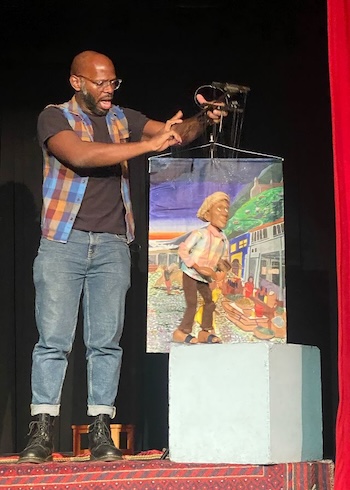
Emmanuel Elpenord performing Jokes with Josue at Puppet Showplace Theater in November 2025, with the Uncle Josue puppet. The creation of Jokes with Josue was supported by PST’s Creative Residency for Black Puppeteers.
AT’s “star” may have been a larger-than-life puppet, but Brookline’s Puppet Showplace Theater (PST) offers a jewel-box performance space featuring rows of child-sized benches in front of the small stage. The lobby is filled with a plethora of puppets in all sizes and shapes for hands-on, post-show play.
Puppetry—an ancient, universal art—has been embraced across cultures and eras. Its appeal spans generations, captivating adults and children alike. There’s an intimacy to the craft, a touch of alchemy in bringing inanimate objects to life. The movement, texture, and rhythm of puppetry have a visceral, sensory pull. Veronica Barron, PST’s artistic director, describes the puppets as “being right there with you.” Historically, puppetry has also served as a vehicle for satire and social critique, offering a way to explore difficult subjects with humor and grace.
PST features a different puppet company every weekend, 45 weeks a year. For many families, attending has become part of their weekend rhythm, giving staff the chance to know the children personally and engage them in open-ended, post-show play with a wide range of puppet types. Programs are tailored to age and developmental level—depending on how well kids can follow a storyline or grasp ambiguity. Around age nine, Barron notes, children begin wanting to tell their own stories. Although parents often stop bringing their older kids, PST now runs a Junior Counselor Program for 12-to-14-year-olds, who mentor younger audiences as they experiment with puppetry.
When asked how puppet shows can teach children about democracy or social concerns—especially when many feature folk tales like Sleeping Beauty, Rapunzel, or Peter Rabbit—Barron points to PST’s growing slate of culturally inclusive programming. The theater stages celebrations of Lunar New Year, Diwali, and Hanukkah, giving audiences a vivid glimpse into other traditions. In recent years, PST has focused on representing communities not yet seen on its stages, launching an incubator for new works by artists of color and forming partnerships with Haitian puppeteers and organizations such as the Toussaint Louverture Center, Mattahunt Elementary School, and local Haitian dance studios. They also feature performers who work in Spanish, French, and Russian, as well as culturally specific styles such as South Indian shadow puppetry and Japanese Bunraku. Clearly, PST is planting the right seeds.
Anyone who’s seen a production from these five theaters knows their entertainment value is undeniable. But they’re offering far more than that. The need for young audiences to see themselves on stage has made multicultural casting the norm, while access for all remains a priority—reflected in low-cost, free, or pay-what-you-can tickets and consistent attention to physical accessibility. Their productions spark genuine respect and curiosity about cultures beyond one’s own, and their partnerships with K–12 schools continue to set an admirable example.
Yet much more remains to be done!
Junior Programs, Inc. was a pioneer of the principle that “more could be done.” The organization made its contribution to democracy explicit, winning broad support from non-theatrical constituencies. It sought innovation even in adversity, championing youthful agency and civic responsibility. Its learning model linked the arts directly to democratic values: each production catalyzed a suite of K–12 curriculum modules that not only enriched drama, dance, and music programs but enabled teachers of history, social studies, language arts, science, economics, and even physical education and shop to broaden students’ engagement by integrating a play’s democratic themes into their own pedagogy. This interdisciplinary approach helped students explore cultural diversity and democracy from multiple perspectives, ensuring that even those uninterested in the performing arts per se could still engage deeply with the ideas on stage. Junior Programs achieved this through partnerships with leading universities that viewed these curriculum development efforts as part of their own civic duty to strengthen the nation’s democratic experiment.
Meeting today’s challenge—harnessing the performing arts to prepare the next generation to sustain democracy—requires broader collaboration not only with schools and community partners, but among Greater Boston’s TYA theaters themselves. For funders, what lies beyond the capacity of a single company may be possible through collaboration, especially one that builds on the distinctive strengths of each theater. We owe it to our children—and to our endangered democracy—to explore every such possibility.
Joan Lancourt, Ph.D., is the author of More Than Entertainment: Democracy and the Performing Arts Junior Programs, Inc. (1936-1943), Pioneers of Theater for Young Audiences. The book, a carefully detailed documentation of Junior Programs’ seven years of successful productions for children, and their legacy and lessons for today’s TYA theaters and practitioners, was published in January 2025. It has been nominated for the American Alliance for Theatre and Education’s Book of the Year Award.
Tagged: Adam Theater, Company One, Junior Programs Inc, Puppet Showplace Theater, Theater for Young Audiences, Theatre Espresso
2 Comments
Leave a Comment
Remarkable. I am currently giving a great deal of attention to the role of the arts in democracy.
Thank you for this.
Theater, Independent Film, Literature — these are the things that teach people empathy, to understand what people not like you experience. This is the bedrock of democracy. It’s no surprise that attendance is down at live theater and independent films, and it was recently reported that only 16% of people read for pleasure.
I am proud that the Boston Public Library has partnered with two of the theater companies mentioned in this article to present full theatrical productions for free at the library. Adam Theater’s Library Lion was mentioned above, and Company One’s Your Are cordially Welcome to the End of the World opens at the BPL this weekend. It’s the sixth full production mounted by Company One at the BPL.
Michael Colford
Director of Library Services, Boston Public Library