Film Review: “Good Luck, Have Fun, Don’t Die” — A Satire Too Stuck in the Now to Save the Future
By Steve Erikson
The film urges the audience to take action against AI, but it is too symptomatic of today’s paralysis to be of as much help as it would like to be.
Good Luck, Have Fun, Don’t Die, directed by Gore Verbinski. Screening at AMC Boston Common 19, Assembly Row in Somerville, Kendall Square Cinema, and other New England moviehouses beginning on February 10.
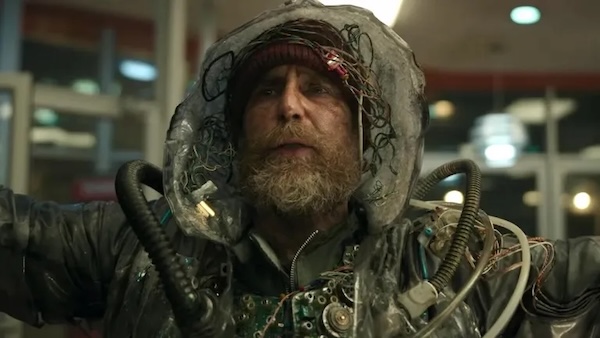
Sam Rockwell in Good Luck, Have Fun, Don’t Die. Photo: Briarcliff Entertainment
Gore Verbinski’s first film since 2017, Good Luck, Have Fun, Don’t Die takes a “15-minutes-into-the-future” stance. It combines real, current problems (smartphone addiction, school shootings) with fanciful extrapolations (cloned children, giant cats roaming through the streets as though they were Godzilla). Despite the film’s inclination toward over-the-top comedy, however, it never stops feeling like a lecture.
Garbed in plastic, tubes, and a hat covered in wires, a dirty, bearded man (Sam Rockwell) strides into a restaurant and shouts, “Social media has robbed you of your dignity.” The customers, almost all of whom are staring into their phones, understandably ignore him. But as he keeps speaking, claiming he’s a time traveler from an apocalyptic future, we learn this is his 117th trip to the past, returning to the restaurant in order to gather a ragtag army whose mission is to prevent a nine-year-old boy from creating an AI god. Despite his eccentricities, the guy manages to entice a small group of diners to go along with him. Then the film flashes back to their lives over the past few days, each section illustrating a bedeviling problem with technology as their struggle moves forward in the present.
Inevitably, the flashbacks resemble shorter Black Mirror episodes. Each dramatizes a character responding to an insultingly bizarre situation that everyone else treats as perfectly normal. Ingrid (Haley Lu Richardson) entertains at children’s parties, dressed as a princess, but she’s had a lifelong problem; she becomes sick after she is exposed to Wi-Fi and smartphones. Mark (Michael Peña) is a high school teacher whose class is interrupted by a massacre. Following her son’s murder during that killing spree, Susan (Juno Temple) is offered the opportunity to have her kid cloned. A trio of affectless women urge her to visit a salesman whose patter isn’t very reassuring. He offers a large discount for the service — if Susan will allow her “new” son to deliver an ad once a day. Ingrid’s boyfriend tries a VR headset and immediately becomes addicted — to the point that he wants to give up their relationship, indeed to abandon real life itself, and live inside an alternative existence forever.
These sections hit home because they evoke real pain. The problem is that the rest of Good Luck, Have Fun, Don’t Die treats smartphone addiction as if it were a magical force with no connection to the desperation that drives other kinds of dependency, l ike economic inequality. Mark’s students are portrayed as brain-rotted zombies, reacting to his lecture on Anna Karenina by asking, “Is it YA?” and “Did they make a movie of it?” The characters speak to each other with an affectless tone, as if their emotions have been numbed. On the other hand, Ingrid’s boyfriend justifies his desire to vanish into VR by telling her he finds the inevitable horrors of life too difficult to take.
Quack theology is quickly forming around AI. A short search on YouTube will turn up people who believe they’re interacting with gods or paranormal entities via Grok, among others. If a large, powerful group of people buy into these delusions — that they are hobnobbing with the transcendent — do they attain some form of reality? Or at least some efficacy in social reality? The future from which Rockwell’s character comes has been destroyed by AI, which has achieved independence from human control. This grotesque situation has led to the death of half of humanity, while the other half is imprisoned in a “Brave New” universe of endless entertainment.
Good Luck, Have Fun, Don’t Die leaves no doubt that its message comes from the hearts of Verbinski and screenwriter Matthew Robinson. The catch is that its warning is steeped in a condescending “hey kids, put down your phones and touch grass” attitude. Young people are depicted as deluded zombies; the end of meaningful human life comes about through the actions of a child. The film ridicules people whose eyeballs are glued to their smartphones, but it leaves the profit-hungry corporations who invented this technology largely untouched. (Their traces are evident in the bar codes on clones’ necks.) The villain here is AI itself. That speaks to power’s ability to conceal itself behind an uplifting mask, but it’s not wholly accurate. Tech bros are not shy about proclaiming how they are able to act — with feckless impunity — like the film’s killer cat. They are just going about “disrupting,” to use one of their favorite words. It’s far more troubling that we know much, if not most, of what they’re doing but can’t fight what is happening or where it might lead.
The film’s sincerity is undeniable, but the difficulty of satirizing a present that already feels outrageously out of control remains. The story never transcends its huge debt to past science fiction — this is not a new vision for our perilous moment. In truth, Verbinski doesn’t come close to the hellish conceptions of online life created by Japanese directors such as Satoshi Kon, Mamoru Oshii, and Kiyoshi Kurosawa. Good Luck, Have Fun, Don’t Die remains trapped at a slight distance from the present, urging the audience to action but remaining too symptomatic of today’s paralysis to be of as much help as it would like to be.
Steve Erickson writes about film and music for Gay City News, Slant Magazine, the Nashville Scene, Trouser Press, and other outlets. He also produces electronic music under the tag callinamagician. His latest album, Bells and Whistles, was released in January 2024, and is available to stream here. He presents a biweekly freeform radio show, Radio Not Radio, featuring an eclectic selection of music from around the world.
Tagged: "Good Luck Have Fun Don’t Die", Gore Verbinski, Haley Lu Richardson, Michael Peña, Sam Rockwell