
Book Review: Unraveling Identity and Memory in Alois Hotschnig’s “My Mother’s Silver Fox”
By Roberta Silman
My Mother’s Silver Fox is a welcome addition to literature about the repercussions of the Second World War, especially its dark side — the cruelty and chilling efficiency of the SS program called Lebensborn and its aftermath.
My Mother’s Silver Fox by Alois Hotschnig. Translated by Tess Lewis. Seagull, 144 Pages, $25.
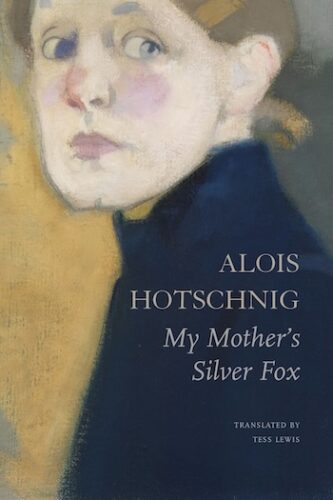
Alois Hotschnig is a 66-year-old Austrian writer, author of several books of fiction and memoir, better known in Europe than here in the United States, and often compared to Thomas Bernhard and Franz Kafka. He came to my attention by way of our own Arts Fuse contributor, Tess Lewis, who has translated his two earlier books, Maybe This Time (2011) and Ludwig’s Room (2014). In this latest work, which has the enchanting title My Mother’s Silver Fox, Lewis has brought us a mesmerizing work that explores the themes of identity and memory and yearning.
It also has a more specific focus. When interviewed, Hotschnig said, “Even as a child I was acutely aware of the various forces of marginalization and exclusion around me . . .And I realized that such narrowness is not determined by a particular region or location. It is quite simply a narrowness of mind, a phenomenon that exists across and beyond borders. It is against this that I write.” So this slender novel which explores a narrator searching for his place in the world becomes relevant to us in the United States as we find ourselves witnessing what it means when “narrowness of mind” tries to prevail.
This is a novel about one man’s search for identity. At sixty, Heinz Fitz has finally met his real father, yet this man, Anton Halbsleben, claims no paternity, insisting that Heinz “was the child of a Russian who drowned.” Thus begins this slender volume, which was so compelling I ended up reading it in one sitting. It is a story so tangled with snippets of history and hopes and dreams and references to other works of literature that we and Heinz are never quite sure where we are. Yet that is Hotschnig’s point. Can we ever know it all?
In 1942 — when it looked as if Hitler was going to win the Second World War — Heinz was born to Gerd Horvold, a Norwegian nurse who fell in love with a wounded Austrian soldier. After learning she was pregnant, Anton brought her back to Austria with him so that she could give birth there. There is also a piece of paper, folded and unfolded many times, that indicates that Gerd and Anton may have been participants in the SS-Lebensborn program, a Nazi initiative started by Himmler to “purify the Aryan race,” which extended all through the war to captured countries and landed the babies in specially designated orphanages.
After Heinz’s birth in Hohenems, a small town in the Vorarlberg section of Austria, he was taken from his mother, who was unstable, suffering from epilepsy and perhaps also mentally ill. He has no memories from those early years, but begins to remember when she came back into his life in 1946 after she found him through the Red Cross. They lived on their own for a time — the best time of his childhood — and then they landed in the house of an older Jewish couple who had hid during the war and whose other boarder introduced Gerd to the man who became Heinz’s stepfather.
But life with Gerd, still subjects to fits and crazy notions, is uncertain and at times frightening. She asks, more than once, whether they might have switched him at birth with some other little boy, whether they might have led her to a stranger’s child—how could anyone ever know? And after she is married to Fritz, the abusive butcher with whom she has more children, Heinz’s life becomes even harder; at school he is mocked for having a crazy mother, he retreats into an obsession with Dracula, and has to endure the coarseness of life under Fritz’s roof, a place where people say things in the early 1950’s like:
You know, Heinz, way too few Jews were killed. And this, this sentence came out of their mouths as if they were talking about lunch. Not just my stepfather, many of them talked like this. And at some point, when you’re twelve, thirteen . . . at fourteen I’d internalized it all so thoroughly, that I believed anyone with a different skin color didn’t belong here. Finding the sore spot and pounding on it, we had a lot of practice in that my friends and I.
So, in this circuitous narrative which at times reads like a fairy tale, at other times like a horror story, we see Heinz searching for a sense of stability, normalcy, something he realizes he will never find within his immediate circle. His life, his internal life, his soul, for want of a better word, begins to find some peace when he starts to work in a nearby factory at fifteen and meets Herbert and Herbert’s father Franz, then, also through Herbert, Christl Singer.
Wherever I went, Christl Singer went too. Through her I was whole for the first time. With her I was whole. Until then everything about me was half. A half-brother. With a half-sister. A stepfather and a mother who said I wasn’t hers.
But it ends when he goes to acting school in Wiesbaden and she refuses to join him. And then he understands that he must make his way alone, as an actor.
Yet it is through Franz, who knew his father, that Heinz also begins to untangle some of the strands of his life. And, after his stepfather dies, he and his mother “come to life” and with the help of people who knew her story he begins to construct hers. From here on the novel becomes less ruminative, more active, filled with clues to this one who knew that one, and visits to doctors and clinics and archivists. But, at the center of this circuitous tale is his mother, described by one observer:
For me she was an apparition, like I’d never seen before . . . Even now, I see her standing there. Imposing, tall, a very beautiful woman. And I remember the silver fox fur she wore. Fox fur had just come into fashion. When they went to church, it was winter at the time, women would drape a fox around them. That’s why it made such an impression on me, seeing the tall woman with a beautiful fur coat.
Beautiful, crazy, yet generous and loving, especially towards strangers at the end of her life. That’s when we learn of her attachment to a family of Turkish immigrants, “her only support,” after Heinz and her other children have gone off to live their own lives. And finally, there are letters, loving letters, from Anton and his family which turn the story on its head, which prove that instead of mistrust and conniving and rejection, there was a real welcome for Gerd when she came to Austria, pregnant with our Heinz. At the end, he tells us,
So much remains open …If what my mother says in the letters is true, then I’ll have to live with this second half of the truth the way I’ve lived with the first half until now, knowing that a whole truth won’t come from it.
So, his journey has transformed Heinz. And us. And even if nothing is absolutely resolved, the journey has been worth taking. My Mother’s Silver Fox is a welcome addition to literature about the repercussions of the Second World War, especially its dark side — the cruelty and chilling efficiency of the SS program called Lebensborn and its aftermath. But the way it delves into the power of memory reminds me of the work of Walter Benjamin, which is high praise, indeed. Hotschnig’s prose, so splendidly translated by Lewis, has that quality of intimacy that only the best literary works possess.
Roberta Silman is the author of five novels, two short story collections, and two children’s books. Her second collection of stories, called Heart-work, was just published. Her most recent novels, Secrets and Shadows and Summer Lightning, are available on Amazon in paperback and ebook and as audio books from Alison Larkin Presents. Secrets and Shadows (Arts Fuse review) is in its second printing and was chosen as one of the best Indie Books of 2018 by Kirkus. A recipient of fellowships from the Guggenheim Foundation and the National Endowment for the Arts, she has reviewed for The New York Times and Boston Globe, and writes regularly for The Arts Fuse. More about her can be found at robertasilman.com, and she can also be reached at [email protected].