
Musician Remembrance: Homage to Bob Weir of the Grateful Dead
By Scott McLennan
Bob Weir protected the integrity and idealism of the Grateful Dead’s music, playing the band’s songs year after year with a sense of wonder that he never lost touch with.
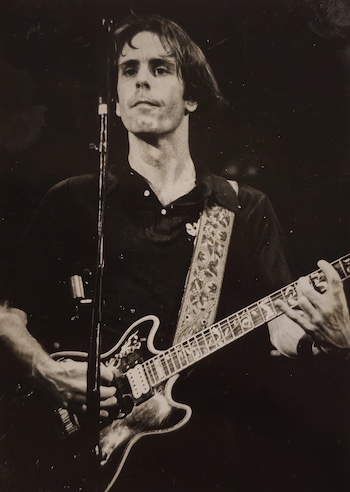
Bob Weir with the Grateful Dead at the Providence Civic Center in 1983. Photo: Paul Robicheau
Bob Weir is dead. His family announced on January 10 that the legendary musician succumbed to underlying lung issues following treatment for cancer that was diagnosed in July. He was 78 years old.
Dammit, Weir, you really are the master of “Didn’t see that coming.”
I will miss Weir’s unique approach to playing rhythm guitar, especially when he performed in the Grateful Dead alongside Jerry Garcia’s mighty and majestic lead work. I will miss Weir’s songs, from the over-the-top romanticism of “Black-Throated Wind” to the spectral invocations of “Estimated Prophet” to indispensable tunes such as “The Other One,” “Playing in the Band,” “Cassidy,” “Sugar Magnolia,” “Lost Sailor,” and “Saint of Circumstance,” which became central texts in a language a whole bunch of us learned to preserve our sanity (or to open the hatch to escape from sanity).
But, most of all, I will miss Weir’s artistic fearlessness and sense of adventure. On and off stage, he struck me as a person who didn’t believe much in rehearsals; it was always showtime for him (just that sometimes you play for silver, sometimes you play for life).
It took me a while to fully appreciate Weir’s most endearing quality. He was “the kid” in the Grateful Dead — just 16 when he started making music with the older Garcia. So it was easy to miss how rich his contributions to that band were, given the towering presence of Garcia and bassist Phil Lesh. And, after Garcia’s death in 1995, I occasionally lamented (all right, criticized) how Weir and other surviving members of the Grateful Dead essentially ceased to create new work. Instead, they formed several different bands that revisited the songbook and repertoire that had been created during the time of Garcia.
That said, Weir shaped the curiosity and appetite for exploration that was central to the Grateful Dead’s art. He continuously refined and personalized those characteristics in his solo bands and the post-Garcia projects he participated in with other members of the Grateful Dead, including The Other Ones, The Dead, Furthur, and Dead & Company.
Weir’s eclecticism was unmissable early on. Over his long and fruitful career, he embraced rustic cowboy songs and slick pop with equal enthusiasm. He formed Bobby and the Midnites with jazz greats Alphonso Johnson and Billy Cobham. His final iteration of a Grateful Dead ensemble — Dead & Company — was created with John Mayer, a most unlikely successor to Garcia but someone with whom Weir developed a genuine musical chemistry. In 2022, Weir debuted a symphonic program of his music and brought together his Wolf Bros ensemble with the National Symphony Orchestra. In 2024, he led Dead & Company through a 30-show residency at the high-tech Sphere in Las Vegas, and did a similar multishow run at the venue last year.
Weir was the perfect foil for virtuosos because he himself was not one. Instead, he was a talented and creative musician and, perhaps most importantly, a tireless worker and explorer. He was not necessarily the kind of player through whose fingers divine inspiration flowed.
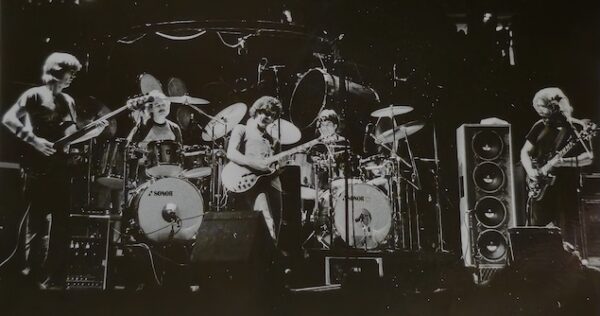
Bob Weir centering the Grateful Dead at the Hartford Civic Center in 1984. Photo: Paul Robicheau
Being a Bob Weir fan meant watching him learn to play slide guitar via solos on blues songs that had been brought into the Grateful Dead repertoire. After a few years, he was pretty good at it.
Weir was a rhythm guitar player like no other. He picked out notes and formed chords that filled spaces in songs that more conventional musicians wouldn’t have noticed.
Weir often mentioned in interviews that his style was not shaped by other guitarists but by jazz piano great McCoy Tyner.
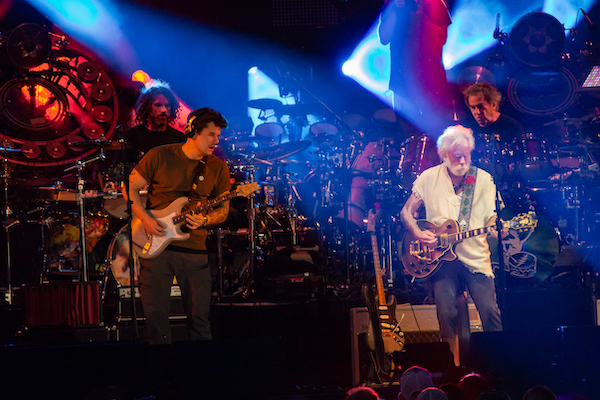
Dead & Company at the Fenway in 2023. L to R: Jay Lane, John Mayer, Bob Weir, and Mickey Hart. Photo: Sam McLennan
Still, being a formidable rhythm player didn’t stop Weir from becoming the lead guitar player in a few of his bands, most notably The Wolf Bros, a combo he formed with drummer Jay Lane and bassist Don Was. Weir brought that trio to Boston in 2018, and the Wolf Bros played a crazy, topsy-turvy show at the Wang, deploying songs most of us in the theater had heard hundreds of times, just not like this.
But worker-bee Weir kept refining and developing Wolf Bros, building it out to a 10-piece juggernaut complete with strings, horns, keys, and pedal steel. This iteration of Wolf Bros launched a 2022 tour from the Palace Theater in Waterbury, Connecticut, with a concert that culminated in a colossal version of the Grateful Dead’s “Terrapin Station” suite — a song most of us in the theater knew, but had never heard live like that.
The Grateful Dead was not simply a band — it became a cultural icon. The group’s iconography is as present in our day-to-day business as any other major corporate logo. The band that once represented the counterculture has somehow become a respectable institution, honored and celebrated by an industry it once had a tense relationship with, praised by leaders of a government that once harassed (and busted) members of the Grateful Dead and the band’s fans.
Weir did not necessarily engineer this lucrative expansion of Grateful Dead Nation. And, while he most certainly aided and abetted the commercial ascent of the Grateful Dead, he more significantly protected the integrity and idealism of the group’s music, playing the band’s songs year after year with a sense of wonder that he never lost touch with.
Scott McLennan covered music for the Worcester Telegram & Gazette from 1993 to 2008. He then contributed music reviews and features to The Boston Globe, Providence Journal, Portland Press Herald, and WGBH, as well as to The Arts Fuse. He also operated the NE Metal blog to provide in-depth coverage of the region’s heavy metal scene.
“Ace” is a fantastic Dead studio album, and “Kingfish” is an underrated gem.
RIP Mr. Weir…and thank you!
Great records, and I would add the first Bobby and the Midnights record to the list. That second Midnights record, not so much 😀