
Theater Review: The Limits of “Wonder”
By Martin Copenhaver
Wonder aspires to make us more empathetic and to help us “choose kind.”
Wonder Music and Lyrics by A Great Big World (Ian Axel & Chad King). Book by Sarah Ruhl. Music Supervision by Nadia DiGiallonardo. Choreography by Katie Spelman. Directed by Taibi Magar. Based on the novel Wonder by R.J. Palacio and the Lionsgate and Mandeville film Wonder. Staged by the American Repertory Theater at the Loeb Drama Center, Cambridge, through February 8.
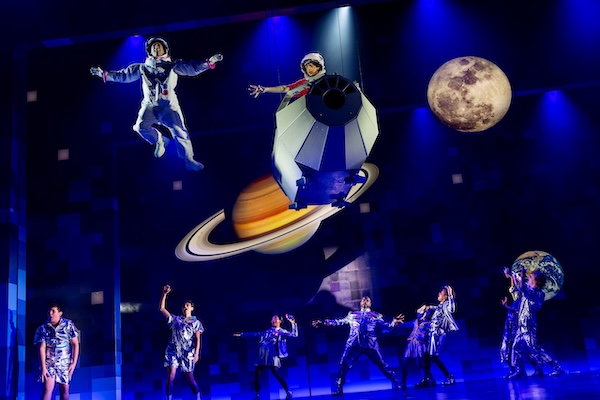
Nathan Salstone, Garrett McNally, and members of the cast of Wonder. Photo: Hawver and Hall
The musical Wonder follows Auggie Pullman and his family as he enters the seventh grade at a local school after spending his early years being homeschooled. That can be a perilous transition for any kid, as anyone who has survived locker-room taunts and school cafeteria slights can attest. For Auggie, however, the challenge is multiplied because he was born with a facial difference. A persistent question hangs over Auggie and those who love him: Can he be an ordinary kid when his face is anything but ordinary?
Auggie wears a space helmet, which allows him not only to cover his face, but also to fantasize about escaping the world to float freely in space. When he goes to school, however, he must leave the helmet behind and literally “face” the world. The principal of the school assigns a small group of students to befriend Auggie, but with little success. Auggie’s worst fears are realized. He is bullied and teased. Over time Jack, one of the students charged with befriending Auggie, is able to see beyond Auggie’s difference and become his actual friend. There are bumps in that relationship, as well, but the acceptance of another human being is transformative. Although Wonder is billed as a show about empathy, it is also a meditation on friendship.
Wonder started as an acclaimed novel by R.J. Palacio, published in 2012, that has sold more than 16 million copies and has been translated into over 50 languages. Then came the hit movie version in 2017, starring Owen Wilson and Julia Roberts as Auggie’s parents. In most respects, the new musical adheres closely to the film.
Playwright Sarah Ruhl and director Taibi Magar decided to depart from the film version in one key respect: In the film, Auggie is played by Jacob Tremblay, a young actor who was made-up to look like a boy with a facial difference. For the musical, they conducted a national search for someone with an actual facial difference to play the role of Auggie. Their determination paid off. Garrett McNally, who plays Auggie in the performance I saw, is excellent (in other performances, the role is played by Max Voehl). The fact that both of the young actors have facial differences—rather than an illusory difference made possible by extensive make-up—adds a measure of poignancy to their performance.
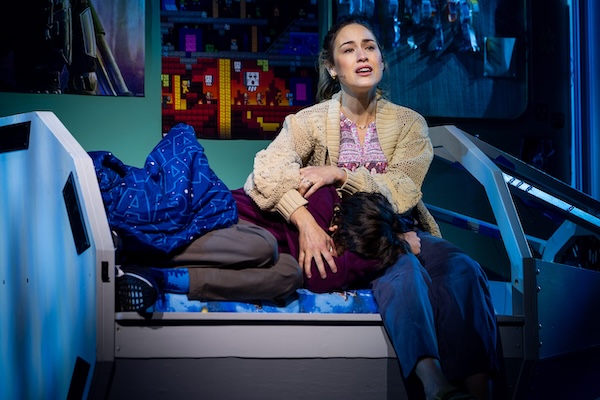
Alison Luff and Garrett McNally in the A.R.T. production of Wonder. Photo: Hawver and Hall
The ensemble of young actors playing the students brings an exuberant energy to their performances. Donovan Louis Bazemore, as the empathetic Jack, is a stand-out.
One of the more compelling sub-themes of the story is the complex mix of feelings Auggie’s sister, Via, has toward Auggie. She is a devoted and protective sister, a true ally, and yet she also chafes at the way the family seems to rotate around him, like planets around the sun. Kaylin Hedges, as Via, communicates this ambivalence well. Even more outstanding is the performance of Paravi, who plays Via’s estranged best friend, Miranda, who harbors ambivalent feelings about Via’s family because her own family is falling apart.
Ruhl added a character not found in the book or the film, an imaginary friend and alter ego, Moon Boy (played by Nathan Salstone), who wears a space suit and helmet. He and Auggie share the first scene as they both float in space. It is arresting as a kind of visual, as well as musical, overture to what follows. Moon Boy’s frequent appearances after the initial scene—silent and decidedly earthbound—are not nearly as effective and, at times, are merely distracting.
The scenic and lighting designs (by Matt Saunders and Bradley King, respectively) are both beautiful and evocative, helping the story move from intimate family scenes to scenes on a much larger scale (even the much, much larger scale of outer space). The lighting includes patterns that can evoke a starry night sky or the pixels of a computer screen (Auggie is a fan of the computer game, Minecraft).
The music and lyrics, by the duo known as A Great Big World (Ian Axel & Chad King), are something of a mixed bag. Both of Auggie’s parents are given solos that are particularly affecting. In an early scene, when Auggie’s mother, Isabel (a superb Alison Luff) sings to Auggie, “You are Beautiful,” it is not maudlin, but rather a touching love song in the spirit of a lullaby. Bookending Luff’s song, near the end of the show, Auggie’s father, Nate (Javier Muñoz) has his own opportunity to express tender love for his son through the song, “Moon Boy.” (Yes, it’s the same name as the imaginary friend who, gratefully, is nowhere to be found during that scene. The “Moon Boy” of the song is Auggie.) These gentle, hushed songs are the most moving in the score.
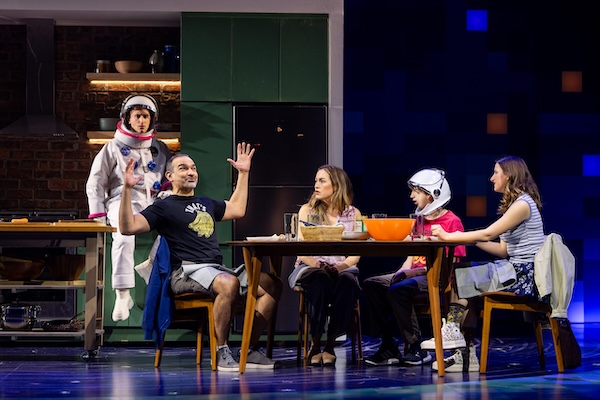
Nathan Salstone, Javier Muñoz, Alison Luff, Garrett McNally, and Kaylin Hedges in the A.R.T. production of Wonder. Photo: Hawver and Hall
By contrast, the younger cast members largely are given songs with an upbeat tempo, which is a good fit for a story that intends to be, well, upbeat. The lyrics of some of the songs can sound like bumper sticker slogans set to music (“Choose Kind,” “Change the Way We See.”) They reify the script’s subtler themes and seem intent on making sure the audience takes away the right message from what they are seeing.
John Keats famously disparaged poetry that “has a palpable design upon us.” Of course, the same could be said of a musical, and there is no doubt that Wonder has a “palpable design upon us.” It aspires to make us more empathetic (Ruhl describes the show as “an empathy machine”) and to help us “choose kind.” The script and lyrics say as much. Wonder wears its ambitions on its sleeve.
Of course, if a theatrical piece has designs on us, you could do worse than fostering empathy and kindness. Living at such a time, such virtues are in preciously short supply and displaying them can seem almost radical. But Wonder does not travel very far in its exploration of kindness. We are in need—desperate need—of theatrical pieces that courageously explore more challenging themes and prompt more provocative mottos (how about, “choose outrage?”). We could also use theatrical pieces that follow the larger implications of the themes evinced in Wonder. For instance, what would it mean to “choose kindness” in Gaza or to “change the way we see” at an ICE detention center? It would be unfair to expect a show like Wonder to take up such questions, but it is not unfair to expect a theatre company to do so within the scope of their offerings.
A recent New York Times article (As Regional Theaters Struggle, Some Defy the Odds, December 15, 2025) included a quote from Kirsten Coury, the artistic director of Gulfshore Playhouse, a theater in Naples, Florida that consistently packs them in. Coury said her mantra is, “up and known.” That is, she chooses shows that are upbeat and well-known. That certainly describes Wonder, an upbeat show based on a well-known book and movie. My hope is that this is not an indication that the A.R.T. will make it a practice to follow Coury’s motto. We need more.
Martin B. Copenhaver lives in Woodstock, Vermont, and Cambridge, Massachusetts. He is the author of nine books, but he is particularly proud of his Bolognese sauce, which was once written up in a national magazine.
Tagged: "Wonder", Alison Luff, Chad King, Donovan Louis Bazemore, Garrett McNally, Ian Axel, Javier Muñoz, Kaylin Hedges, Nathan Salstone, Sarah-Ruhl
2 Comments
Leave a Comment

Martin,
Indeed, we do need more!
A growing theme in Theater for Young Audiences (TYA) is focused on plays that speak to the growing mental health crises in the K-12 population. A new and growing TYA theme is on offerings that promote ‘kindness,’ that advocate for being a ‘good’ person, and that condemn bullying. The are using theater to make it OK for a youngster or teen to ask for help when they feel overwhelmed or afraid. All this is good, even very good –– AND it is insufficient.
It fails to address a key ingredient of mental health (for youth and adults), their sense of agency, the sense that their own actions, in conjunction with others, can make a real difference –– in your family, in school, and in the larger social order. Being good as an individual is simply not enough: creating a ‘good’ society REQUIRES civic action. And as editor Bill Marx now points out in every issue of the Arts Fuse, we are in desperate need of the performing arts (TYA and adult) to use its unique ability not only to reflect on our current reality, but to provide narratives that add civic action to the equation of ‘goodness.’
If we are truly committed to kindness and goodness, we must take action in our civic spaces to reclaim, revive and restore our democracy. If democracy is to be more than words on paper, sustaining it requires that everyone be able to exercise not only their individual empathy for others, but their civic responsibility to take action to change the social structures and infrastructures that can make the world a better place for all. There is nothing ‘upbeat’ about living in a dictatorship, a form of government that clearly does not promote kindness, goodness or mental health. And right now, in today’s context, offering only half the equation (individual goodness and kindness) is beginning to feel not only like a diversion, but a collusion with the forces that are tearing our society apart. We desperately need kindness and empathy –– for everyone, even for those with whom we disagree –– but we also desperately and absolutely need more civic dialogue, strategizing and above all collective civic action to stop the theft of our democracy.
The best description I’ve read of Wonder is that it’s “inspiration porn.” My disabled son had to read the book in school and was traumatized by it. He was afraid that because he couldn’t walk, he would be eliminated somehow. The “feel-good” vibe oozing through the book’s syrupy prose is strictly for those whose biceps bulge from patting themselves on the back. Its depictions of extreme bullying harken back to 19th-century sensation melodramas, which filled theaters with gasping voyeurs. Wonder asks audiences to sing their hearts out in celebration of a child who is “different,” while beyond the theater, masked thugs drag children from their beds.