Book Review: “Unfinished” Argues for AI as an Artistic Partner — But at What Cost?
By Steve Provizer
Unfinished supplies a thoughtful analysis of the relationship between music, musicians, and AI.
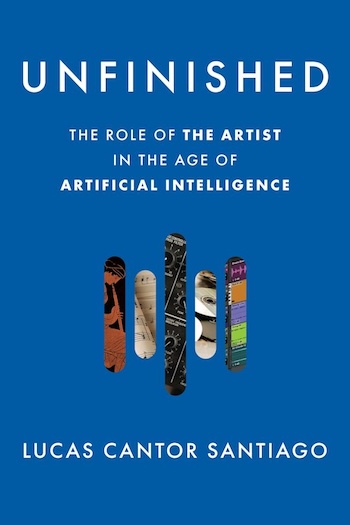
Unfinished: The Role of the Artist in the Age of Artificial Intelligence by Lucas Cantor Santiago. Bloomsbury, 256 pages, $29.95
 Each day finds AI perceived as a fait accompli. It has already become far too powerful a force to be ignored by artists in any medium. Most creatives are, I would guess, ambivalent. But there are artists, such as pianist Marcus Roberts and composer Lucas Cantor Santiago, who have found AI to be indispensable in their work.
Santiago has written a book that tackles what has become a controversial subject — if not head-on, then pretty close. Unfinished: The Role of the Artist in the Age of Artificial Intelligence is a thoughtful analysis of the relationship between music, musicians, and AI. Unfinished is part practical, part historical, and part philosophical. The book is largely intended for musicians, but it will be an interesting read for any artist.
Santiago’s foundational thesis is that music and technology have always been in close relationship: “The way music sounds in the real world has always been the result of the process used to create it. And that process has always involved some kind of technology.” He describes the disruption posed by various technologies, going back to the fabrication of the first flutes. In the West there was the invention of musical notation, which superseded oral transmission. He cites how frightened people initially were by the phonograph. He found an 1882 headline about a “mechanical brain” in the New York Times. Other examples: electrification made the banjo’s natural volume less useful, and the rise of crooning came in tandem with the amplification of sound by microphones.
Santiago argues there is always a period of readjustment necessary when a new technology is introduced. Tech moves in a loop, he says; there’s a period when we think we lose control and then we catch up. He looks at the five periods of extinction on the earth as an analogy, saying that music also goes through cycles of creation, proliferation, and extinction.
A second important part of his argument is his assertion of the artificial quality of our music. He points to Pythagoras’s discovery that there is a mathematical relationship between pitch and the length of a resonating string. We have rejected this natural relationship in favor of a 12-step tempered scale that calls for considerable sonic compromise. We in the West accept this adjustment without question (early music enthusiasts excepted) because the approach allows us to produce the kind of music we want, even though it’s not really in tune — not “natural.”
Santiago goes on to make a very strong case for the usefulness of AI in his own work, writing music for films as well as cinematic trailers. He describes the indispensable resources it puts at his command: the sophisticated computer hookups that make this work faster, because it puts an enormous range of raw musical material directly into the hands of composers like himself.
The apotheosis of his relationship with AI came along when, to promote its new phone, Huawei Corporation hired him to collaborate with AI on a Huawei phone to complete Schubert’s Unfinished Symphony. Throughout the book, Santiago goes out of his way to avoid jargon. And he is successful. Still, his explanation of how he actually utilized AI in that process is a little thin. Perhaps it is because he was afraid that a deeper, more technical explanation would lose readers. In any case, from what he tells us, Santiago trained AI on Schubert’s music and then asked it to generate melodies. He chose from among the melodic material it offered and, with the help of an orchestrator, created two movements to finish Schubert’s symphony. Given this description, I would not give much credit to AI, and suggest that Santiago did a decent job, albeit with some anachronistic cinematic overtones. If you want to listen to the results, you can find them starting at 24:34.
I can accept that our music is, to some extent, based on artificial premises. I can also buy the premise that technology and music have always been tied together. Where I diverge from Unfinished is that Santiago believes that music and technology are not only tied together, but are — in some fundamental way — the same. After all, technology is made by man.
The problem with that thesis is that it is generally admitted that AI is a technology like no other, with a destructive potential far beyond earlier technologies, such as the phonograph or the MP3 file. Santiago thinks hard on this question, but he isn’t really prepared to deal with the downside repercussions of AI head-on. AI is not just a useful tool — it is much more than that.
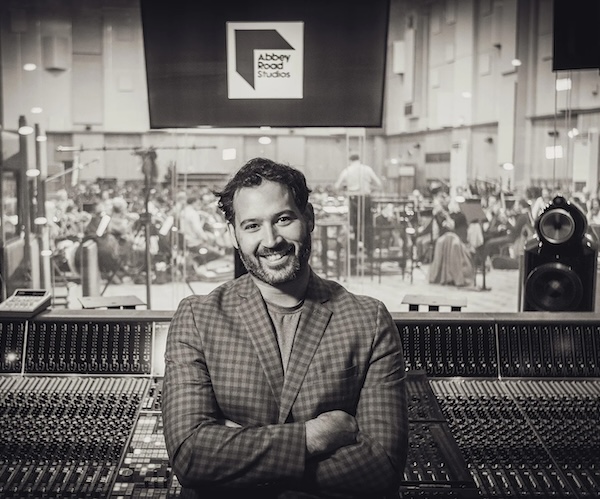
Composer Lucas Cantor Santiago. Photo: Courtesy of the artist
The question of individual “wisdom” is key to his notion of how AI will be constrained and human creativity protected. He cites the pushback against the implementation of writing over oral transmission: “Memorizing is heavy cognitive work,” he writes, “while writing is more durable and less costly … At first glance, it feels like [AI] will threaten my job as a composer, or even threaten all human creativity. If what I sell is the product, then anything that makes a similar product through a more efficient process is competition. But what I sell is the culmination of a process I’ve developed over half a lifetime, and it’s unique to me.”
He continues: “With each technological advance, we must decide whether the wisdom it costs, if it costs any, is worth the wisdom it bestows.” He admits that making these calibrations is enormously difficult: “… we use a subconscious calculation to assess whether use of a given technology feels as though it saves more time than it costs.” In other words, his notion of “wisdom” seems to be made up of balancing the demands of creativity with a time/cost–benefit analysis.
Does he think AI can achieve consciousness? Here Santiago hedges his bets. On the one hand, he says he’s open to it. On the other, “… the belief that the essence of our thoughts can be reduced to the firing of neurons is just a metaphor masquerading as a fact.” These metaphors posit the “little man” inside the mind, he says, but it says nothing about the nature of consciousness. “Somewhere from that journey from molecule to man, consciousness emerges.” That last contention, of course, is highly debatable. That is the way many people see it; there are those who believe that consciousness precedes molecules. No need to go down that rabbit hole — except to posit that where one stands on the question of what scientists call the “Hard Problem” of consciousness may very well correlate to how you feel about the innocuousness of AI.
Santiago is ambivalent: “Artificial Intelligence is nothing less, and nothing more, than a prosthetic for the human mind. It will enhance art the way writing enhanced memory, printing enhanced literature, and recording enhanced music.” However, he also writes that “distribution technology [which must include algorithms] has democratized access to music, but also seems to have a strong bias toward leading artistic products down the path of ubiquitous mediocrity.”
I credit the author for the hard work and undoubted talent that earned him a position of privilege in the world of music. But his place in the food chain should be underlined — he is writing from a rarefied height. Santiago is well positioned to take advantage of AI, while most musicians and composers are sure to suffer a loss of income because of the flood of cheaper, AI-generated music that streamers will draw on to fill up playlists. Streaming royalties for the majority of musicians will also suffer because algorithms favor popular tracks and major labels (the latter pay for that positioning).
On the positive side, for readers interested in music and literary history, there’s a lot of good material here. Santiago’s done his research, touching on interesting ideas from Plato, Pythagoras, Hildegard von Bingen, Gutenberg, Abelard and Heloise, Wagner, Elmo Hope, and Leonard Cohen’s song “Hallelujah.”
“Some of the music I write would have been unthinkable to composers a hundred years ago, impossible to imagine,” writes Santiago. “Like it or not, novelty is progress.” Tricky word, that, progress. Speed and novelty may be accepted as desirable values in scientific and medical research — they are not for most practitioners of the arts.
Steve Provizer writes on a range of subjects, most often the arts. He is a musician and blogs about jazz here.
Tagged: "Unfinished", AI, Lucas Cantor Santiago, Music