
Film Review: “The Housemaid” — A Twisty Gothic Thriller with a Feminist Edge
By Tim Jackson
A satisfying, occasionally cringe-worthy Gothic thriller, whose sharp satire of social mores contains a feminist message that’s hard to miss.
Housemaid, directed by Paul Feig. Screening at Alamo, AMC, Showcase Theaters, and Kendall Square Cinema
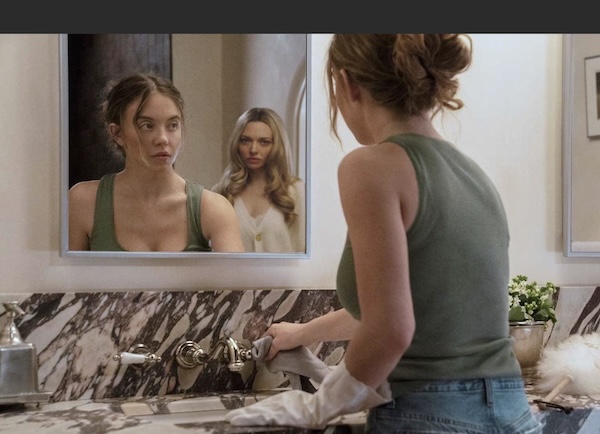
Sydney Sweeney and Amanda Seyfried in a scene from The Housemaid. Photo: Lionsgate
When I read Frieda McFadden’s pulpy bestseller The Housemaid, it was easy to imagine it as a movie. The book is a brisk, shameless thriller, its plot inviting laughter as it takes increasingly outrageous turns. The film adaptation, directed by Paul Feig (Freaks and Geeks, Bridesmaids, Ghostbusters), is faithful to that antic spirit. Dueling protagonists Amanda Seyfried and Sydney Sweeney are terrific playing characters whose relationship becomes a warped battle of wills — blonde innocence turning into lethal aggression propelled by sexual intrigue, manipulation, and a desire to dominate. Feig, who has made some brutally funny comedies, builds up the suspense but keeps an eye out for comic possibilities. Rebecca Sonnenshine’s screenplay is an overtly dark farce about bourgeois hypocrisy, class, and privilege; it pushes at the story’s increasingly horrific elements until our amusement turns into uncomfortable, nervous laughter.
Sydney Sweeney is Millie Calloway, a woman who lives in her car and washes up in public restrooms. Burdened with a troubled past, she’s down on her luck and on parole (we eventually discover why). Desperate for a job, she interviews for a housemaid position with an overly charming housewife, Seyfried’s Nina Winchester. Though doubting Millie is qualified, she quickly (and unexpectedly) hires her for what is a relatively plush job — it is a live-in position, and Millie gets her own cell phone. As they say, when something seems too good to be true, it usually is. The two women look like blonde doppelgängers with psyches to match — each has a dark side waiting to bubble over. Nina’s behavior soon becomes demanding and abusive, and in response, Millie tries desperately to maintain passive obedience. She needs the job; she needs a place to live.
A further problem arrives in the form of Nina’s husband, Andrew. He is a hunk, and the sexual intrigue starts early. Played by Brandon Sklenar, Andrew has a 100-watt grin, enormous charm, patience, and a purring, seductive voice. Andrew has inherited his father’s successful data business, so the Winchesters want for nothing. He puts up with Nina’s unreasonable tirades, and he isn’t flirty with his housemaid. But there is sexual heat simmering under the surface. It doesn’t help that Millie has been celibate for years, and that Andrew is gorgeous and approachable.
No spoilers here: there is nothing in what I have written that can’t be discerned in the first 20 minutes. After that, The Housemaid takes unexpected narrative twists that are enormously satisfying. The couple’s daughter epitomizes the archetype of spoiled brat. Indiana Elle, in her first film role as Cecelia, is a sufficiently sour bad seed, one who is comfortable making unreasonable demands. “I can’t drink out of that glass. It’s dirty,” she says to Millie. “Juice is a privilege.” Those last words are a stark clue to the household’s dysfunction. Other ominous characters appear. Andrew’s pale and icy mother, played by a nearly unrecognizable Elizabeth Perkins, comes in bearing precious heirloom plates. In the tradition of Chekhov’s gun, those plates must eventually shatter. A taciturn Italian groundskeeper, Enzo, played by Michele Morrone, casts sinister glances Millie’s way. When approached, he denies that he can speak English. Meanwhile, a gaggle of visiting PTA ladies chat idly about trivialities — until Nina leaves the room. After that, their civility curdles into back-biting gossip, and the revelation of embarrassing secrets.
Both Millie’s and Nina’s points of view structure the film. Scripter Sonnenshine has smoothly integrated each perspective, while managing to keep many of the book’s best scenes intact. Much of the pleasure here comes from guessing where a scene is headed — until it takes a diabolically crooked shift. Throughout The Housemaid, Feig draws on horror tropes, less for cheap thrills than as a way to play with the audience’s ingrained expectations of the genre. Nina pops up suddenly behind someone’s back; there are ominous flashes of lightning and thunder during heated erotic scenes. The Winchesters’ mini-mansion has the air of a manse in a Gothic novel — the setting becomes one more troubling character in the tale.
None of the genre gamesmanship would work without Sweeney and Seyfried. The former has had a strong year. As the female boxer in Christy, Sweeney embodied a steel resolve set against daunting physical challenges. In Eden, she epitomized maternal patience and determination. The role of Millie draws on the qualities of both of these roles, heightened by Sweeney’s considerable sex appeal. The actress has fashioned a powerful opponent to go head-to-head with Seyfried’s deranged sweetness.
Longtime Feig collaborator Theodore Shapiro provides the score, to which the director has added unexpected pop songs to trigger sudden emotional shifts or ironic distance. Kelly Clarkson’s “Since You’ve Been Gone” or Linda Ronstadt’s version of the Stones’ “Tumbling Dice” are amusing counterpoints to the intense conflict. Ronstadt’s version of Roy Orbison’s “Blue Bayou” drops in at a particularly horrific moment.
The Housemaid‘s ending is the only significant alteration the movie makes to the book. But that is fine, because the florid material is in good hands. Sweeney, Seyfried, and author Frieda McFadden are the producers and, with Feig at the helm, they have delivered a satisfying, occasionally cringe-worthy Gothic thriller, whose sharp satire of social mores contains a feminist message that’s hard to miss.
Tim Jackson was an assistant professor of Digital Film and Video for 20 years. His music career in Boston began in the 1970s and includes some 20 groups, recordings, national and international tours, and contributions to film soundtracks. He studied theater and English as an undergraduate, and has also worked helter-skelter as an actor and member of SAG and AFTRA since the 1980s. He has directed three feature documentaries: Chaos and Order: Making American Theater about the American Repertory Theater; Radical Jesters, which profiles the practices of 11 interventionist artists and agit-prop performance groups; When Things Go Wrong: The Robin Lane Story. And two short films: Joan Walsh Anglund: Life in Story and Poem and The American Gurner. He is a member of the Boston Society of Film Critics. You can read more of his work on his blog.
.
3 Comments
Leave a Comment

I absolutely agree. So many poor reviews which over-analyse (“journalists” who have spent too long trying to show how clever they are). Excellent film with excellent performances.
Appreciate your review ! I look forward to viewing the film.
Love your opening summary. Perfect, succinct and beautifully worded. –
Thank you