
Concert Review: The Dream Syndicate — Doing Impressive Justice to Its Past
By Paul Robicheau
Wednesday’s show proved that The Dream Syndicate more than honors both its past and present with passion and precision.
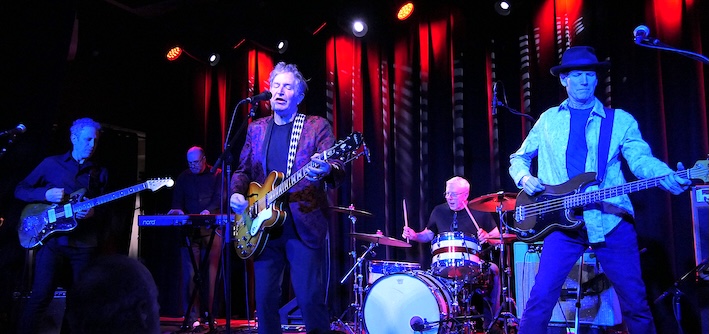
The Dream Syndicate at Crystal Ballroom. Photo: Paul Robicheau
“Nice to be back at the Orpheum Theatre,” Steve Wynn joked in the middle of The Dream Syndicate performing its entire 1984 album Medicine Show before a two-thirds-full Crystal Ballroom on Wednesday. “Lost track of time. Sorry about that.”
It’s been 41 years since The Dream Syndicate did play Boston’s Orpheum behind that second album, opening for R.E.M. – and nodding to their Velvet Underground inspirations when Wynn joined Michael Stipe in covering “There She Goes Again.”
But Medicine Show marked a volatile heyday for The Dream Syndicate. The group labored over that major-label debut for months with a big-league producer. Wynn increasingly hit the bottle and clashed with guitarist Karl Precoda, who warmed to arena-rock dreams. And the album’s polished, heavier sound alienated some fans of its 1982 debut The Days of Wine and Roses, a lo-fi lean, punk-infused landmark out of L.A.’s Paisley Underground. Amid that pressure pot of differing personalities and expectations, Wynn broke up the band three years after its first rehearsals.
Of course, that’s not the end of the story. Wynn didn’t take long to resurrect the group with a new lead guitarist and bang out two more albums until a hiatus from 1988 to 2012, when the current lineup took flight. And Wednesday’s show proved that the band more than honors both its past and present with passion and precision.
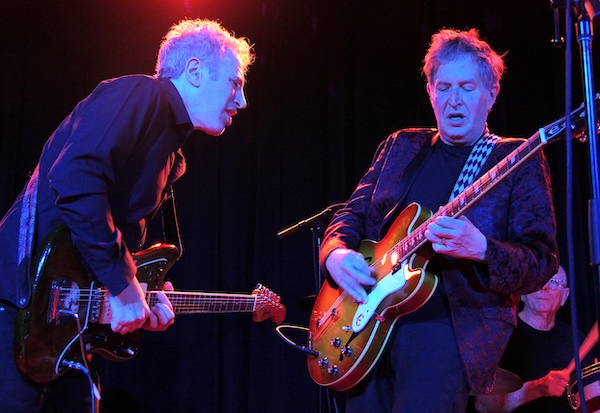
Jason Victor and Steve Wynn of The Dream Syndicate at Crystal Ballroom. Photo: Paul Robicheau
Great live bands tend to musically and physically project the complementary roles of each member. New-millennium addition Jason Victor’s injections of fiery finesse dovetailed with the group’s now neatly honed chops, guiding solos as a dive-bombing guitar foil to Wynn, who proved calm, cool, and collected in his paisley smoking jacket, even when casting exhortations at the mic. Longtime bassist Mark Walton has grown as a seasoned player with his own presence, his lanky body lending an angular emphasis. And original drummer Dennis Duck, while rudimentary in approach, maintained a solid backbeat with deceptive strokes that smacked his drum heads as if he wielded a club. For a bonus, local guest Josh Kantor — known for manning the organ at Fenway Park — contributed piano-dominant icing on an electronic keyboard in the background (Kantor additionally plays with Wynn and R.E.M.’s Peter Buck and Mike Mills in the Baseball Project, a group that pays lyrical homage to the sport).
Medicine Show stands, in hindsight, as the band’s most incendiary outing, despite its initial mixed reviews, long out of print until its tracks were freed from record-company hell for a newly expanded reissue. Yet, before its second-set showcase on Wednesday, the band likewise slayed with a first set of material from its past dozen years, with six of eight songs hailing from 2017’s stunning comeback How Did I Find Myself Here?
Duck’s thumping floor tom propelled “Out of My Head” under Victor’s howling lead guitar. “Like Mary” and the gritty “80 West” mined low-key moods, while “How Did I Find Myself Here?” rode atop the near-funky cushion of Walton’s thick bass lines and Duck chopping out ghost notes on his snare. Then an extended “Glide” capped the set, Victor’s hooky riff humming over an accelerating beat as Wynn sang, “I may never get higher. I just glide.” True high-gliding came from dual guitars gnashing in the tradition of Television and Neil Young’s Crazy Horse.
If The Dream Syndicate’s sound/formula conveyed some sameness, it was only rock ‘n’ roll, as the Rolling Stones once sang, kicked to transcendent levels through fluid dynamics, particularly once the Medicine Show set kicked in.
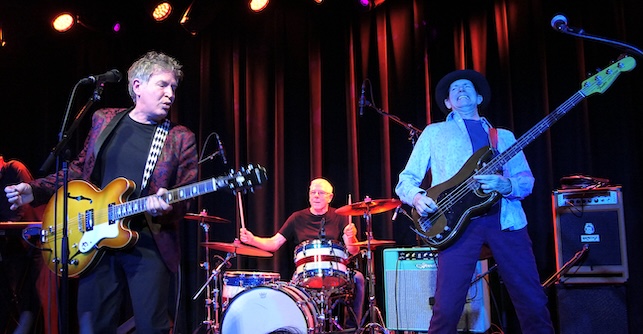
Steve Wynn, Dennis Duck, and Mark Walton of The Dream Syndicate at Crystal Ballroom. Photo: Paul Robicheau
Wynn lashed into the chords of lead track “Still Holding on to You” while Victor was still adjusting his pedal board before locking into form, adding runs up and down his guitar neck in the Precoda-penned “Bullet with My Name on It” like a gunslinger. The band reshuffled the order of tracks and truly elevated the spirit of the album across the set’s back half, alternating slow and fast numbers. They gave the title track an extra-slow treatment, from the vocals down to the brooding bass over a swinging beat. They then uncorked a ferocious romp through “Armed with an Empty Gun” before turning to the hushed rural menace of “Merrittville,” its Springsteen-esque edges painted by Kantor’s piano tones.
Of course, it all led to “John Coltrane Stereo Blues,” the freewheeling 10-minute binge where Wynn channels his best Jim Morrison as a character making moves on a date with the assurance “It’s gonna be all right.” Originally improvised in the studio, it was the only Medicine Ball track that band members recorded together. “Let’s jam!” Wynn cried at the outset, and the group gave a whiplash snap to the song’s accent points before the guitarists literally faced off. They laced harmonized lines before Wynn slashed chords against Victor’s trilling bursts of noisy, bouncing notes. At one point, Wynn repeated the melody of Coltrane’s “A Love Supreme” while Walton took a seat and closed his eyes in concentration as deep as his deftly fingered bass strings. “A man works hard all day. He can do what he wants to… at night!” Wynn declared, before it all cranked back to a finale.
Fans of The Days of Wine and Roses, which was performed in full on a previous tour, were treated at the encore with “Tell Me When It’s Over” (emerging from a Kantor piano interlude that echoed the way the song began a 1984 concert at Chicago’s Aragon Ballroom on the Medicine Ball reissue) and “That’s What You Always Say,” where Wynn served up a chaotic cluster in his own solo. But a four-chord rendition of Eric Clapton’s “Let it Rain” seemed anticlimactic, despite the day’s apt weather and Victor’s scraping high-frets solo. Some fans might have preferred another gem from The Days of Wine and Roses such as “Halloween.” But this was a night that showcased heights the nascent Dream Syndicate was yet to scale.
Paul Robicheau served more than 20 years as contributing editor for music at the Improper Bostonian in addition to writing and photography for The Boston Globe, Rolling Stone, and many other publications. He was also the founding arts editor of Boston Metro.
Tagged: "Medicine Show", Jason Victor, Mark Walton, Steve Wynn, The Days of Wine and Roses