
Visual Arts Review: “Revolution! 250 Years of Art + Activism in Boston” — The Trials and Tribulations of Democracy
By Lauren Kaufmann
It’s as if the curators of this BPL exhibit are warning us that the future of our democracy depends on our paying attention.
Revolution! 250 Years of Art + Activism in Boston at The Boston Public Library (Central Branch) on view until April 21, 2026
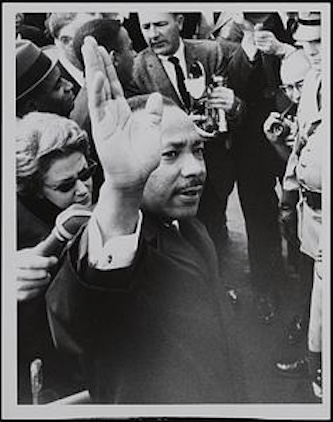
Martin Luther King, Jr., Freedom Rally, Boston Common, April 23, 1965, Creator unknown.
Photo: courtesy of the Boston Public Library
Revolution! 250 Years of Art + Activism in Boston is a visual survey of some of the volatile moments and movements that have shaped the city’s history. It also mirrors the trials and tribulations of our ever-expanding — and contracting — democracy. Through paintings, prints, photographs, and archival documents, the exhibition offers insights into some of the notable people and memorable events that have made Boston one of the country’s most progressive cities.
The exhibition sets out to answer two critical questions about the evolution of democracy. To whom were the promises in the Declaration of Independence made? How are people working today to make sure those promises are kept?
As we approach the 250th anniversary of the signing of the Declaration of Independence, now is a good time to take stock of how far we’ve come. This timely exhibition examines the conditions of our democracy at a time when the current administration is, bit by bit, dismantling its egalitarian foundations. Through a variety of artwork and documents, all from the Boston Public Library’s permanent collection, the exhibition presents some of the key passages in American history, and Boston’s role in them.
The show proffers an unconventional look, and that fits the subject matter perfectly. The artwork and objects are displayed on plywood panels attached to scaffolding. In the introductory panel, the curators explain that the design motif is a metaphor for our democracy, which they say is “unfinished and ever evolving.” A red ribbon runs behind the text panels, reminiscent of Boston’s famous Freedom Trail, and the texts are printed out on large sheets of white paper. In some cases, the paper is wrinkled, where the glue hasn’t been smoothed out. The handmade look imparts a sense of urgency to the issues at hand. It’s as if the curators are warning us that the future of our democracy depends on our paying attention. It’s time to focus now on what happened in the past in order to understand what is truly at stake.
The exhibition has an edgy look, but many of the works of art are established pieces, reminders that the BPL stands as one of Boston’s preeminent cultural institutions. The library has an impressive collection of artwork — more than 120,000 prints and drawings, as well as thousands of paintings and sculptures. Some of the work in the exhibition is familiar, although some of the lesser-known content is just as powerful.
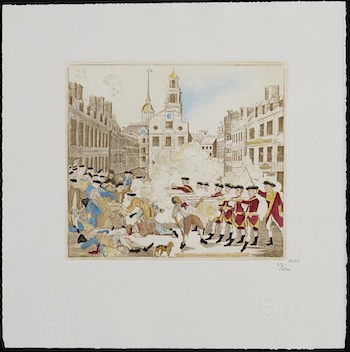
Bob Tomolillo, Boston Massacre Reboot, 2020. Photo: courtesy of the Boston Public Library
Paul Revere’s famous engraving of the Boston Massacre is included, an image that played a key role in turning popular opinion against the British. Crispus Attucks, a whaler and sailor of African and Native American descent, was killed in the Boston Massacre, becoming the first American casualty of the Revolutionary War. Revere’s engraving failed to identify Attucks’s race. In an update on Revere’s work, Boston Massacre Reboot, 2020, Bob Tomolillo places Attucks at the center of the image — and clarifies his racial identity.
Washington at Dorchester Heights, 1852, an enormous portrait by Emanuel Leutze, shows Washington looking out at Boston in 1776, when the city was occupied by the British. The battle at Dorchester Heights was a turning point in the Revolutionary War; Washington brought in cannons from New York, and without firing a single shot, forced the British to retreat, ending the British siege of the city. Washington’s leadership was key in winning the war, but his legacy remains mixed. As the label notes, Washington enslaved more than 300 Black men, women, and children. He devoted himself to the cause of liberty, but omitted people of color.
Joseph-Siffrede Duplessis’s Portrait of Benjamin Franklin, 1799, establishes Franklin’s importance, as well as his wealth and status. Franklin’s deft diplomacy with France played a crucial role in the US becoming independent of Britain. What’s equally intriguing are two nearby prints of Native chiefs, who traveled to England in 1710 to request protection from French colonizers. Although Indigenous people suffered devastating losses at the hands of the colonists, their cultural beliefs had a positive effect on the settlers. The text explains that the version of the US Constitution Ben Franklin had a hand in drafting was influenced by the Haudenosaunee Confederacy, an alliance of Indigenous nations in North America. Both documents emphasize unity and peace, and the need for people to have the freedom to pursue their own destiny.
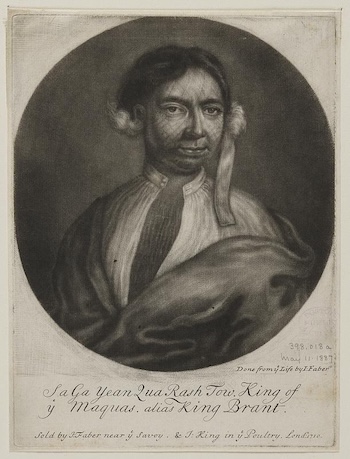
Sa Ga Yean Qua Rash Tow, King of Ye Maquas. Alias King Brant, 1710, John Faber. Photo: courtesy of the Boston Public Library
Throughout the exhibit, there are numerous black-and-white engravings of historic events, and there’s a lovely color postcard — Reading of the Declaration of Independence from the Old State House, July 18, 1776, which dates from 1930-45.
The exhibit also addresses some of the global reverberations of the American Revolution. In 1871, France’s Third Republic was founded, spreading ideas about freedom to French colonies, including Saint-Domingue (now Haiti). In 1791, Toussaint L’Ouverture led a revolt, which resulted in the establishment of the Republic of Haiti in 1804. The exhibit includes a stunning print by Jacob Lawrence, The Life of Toussaint L’Ouverture: The Opener, 1997.
The battle over slavery is an ongoing theme of the exhibit. Two prints by contemporary artist Steve Locke, Homage to the Auction Block A, 2022, and Homage to the Auction Block B, 2022, depict the foundations of the auction blocks located at Merchant’s Row, behind Faneuil Hall. As an artist-in-residence with the City of Boston in 2018, Locke proposed a memorial to remember this chapter of the city’s history. Unfortunately, the artist’s idea never became a reality.
The mixed legacy of Faneuil Hall is addressed. Although Peter Faneuil built Faneuil Hall in 1742 with money that he earned by trafficking kidnapped Africans, the iconic building was known as the “Cradle of Liberty.” In the early 1800s, Faneuil Hall was the site of meetings and rallies organized by abolitionists. An engraving, Rocking Slaves in Faneuil Hall, pictures the confusion generated by the Fugitive Slave Law, passed in 1850. After a man named Shadrach was arrested in Boston, he was rescued by abolitionists, and then fled to Canada. In thought bubbles scattered across the piece, onlookers cheer for Shadrach and decry the legislation.
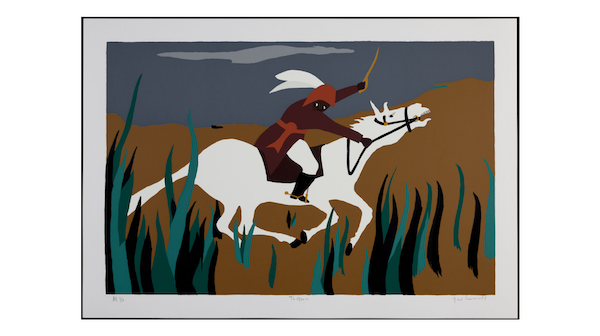
Jacob Lawrence, The Life of Toussaint L’Ouverture: The Opener, 1997. Photo: courtesy of the Boston Public Library
There are photographs of civil rights marches, pro-choice rallies, gay pride parades, and antiwar demonstrations. There’s a 1965 picture of marchers making their way down Huntington Avenue to a freedom rally on Boston Common. The late Dr. Martin Luther King Jr. led the crowd of nearly 20,000. In another photograph, Malcolm X is being interviewed on WBZ Radio in 1964.
There are a number of impressive contemporary pieces. One of the most striking is Out of Order, Fortification of Dorchester Heights, 2025, by quiltmaker Michael Thorpe. In his response to Washington at Dorchester Heights, the artist has made a quilted version of the painting, but he very intentionally placed the squares out of order. The jigsaw effect evokes how our understanding of the past is often scrambled, often by forces with nondemocratic agendas. Thorpe will periodically return to the BPL to rearrange the squares, an action that suggests that, at this point in time, our vision of history, and democracy, are in flux.
Lauren Kaufmann has worked in the museum field for the past 14 years and has curated a number of exhibitions.
Tagged: "Revolution! 250 Years of Art + Activism in Boston", Boston, Rebellion, art
4 Comments
Leave a Comment
Thank you Lauren for alerting us to this incredible exhibit. Your articles are as inspiring as the art you highlight.
Thanks, Jane. It is an incredible exhibit, and I hope that word spreads, and many people get to the BPL to see it.
Many thanks for this supportive commentary on a project that speaks to these dangerous times as it stands up for Boston’s historic espousal of democracy. Here’s to progressive shows that are well-timed, unconventional and “FREE-TO-ALL” (the words inscribed above the entrance to the BPL’s Copley Square entrance). Mark Feeney’s equally enthusiastic review in the Globe included good photographs of the installation. The BPL website names the five curators, three advisors and exhibition coordinator who worked on the exhibition, which was designed by C&G Partners, New York.
Thanks, Trevor. We are lucky to have the BPL, where we can check out all manner of books, attend programs, and see wonderful exhibits–all for free!