
Arts Remembrance: In Memoriam — Tom Stoppard
One of the great playwrights of the 20th century, Tom Stoppard wrote to entertain, but with intellectual rigor.
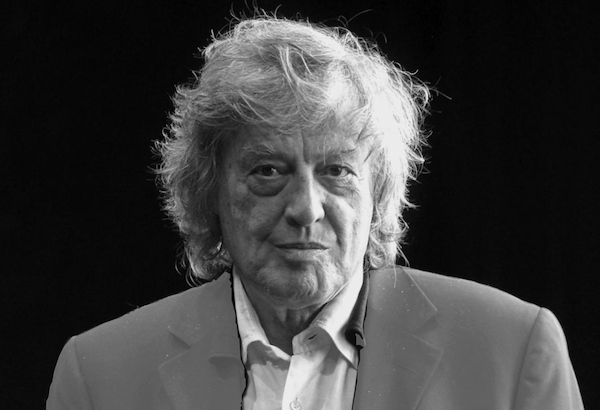
The late Tom Stoppard. Photo: WikiCommon
Sir Tom Stoppard died last Saturday at the age of 88. One of the great playwrights of the 20th century, his work reflected a distinctive talent — he wrote to entertain, but with intellectual rigor. Stoppard was erudite and wickedly observant, though rarely pompous. He could cleverly deflate his own self-worth. In 1976 he said, “The spiritual advantage is that success gives you an identity and it’s nice to be relieved of that search.” After reading about himself in a Who’s Who of 20th Century Literature, the dramatist said with hilarious false modesty: “I’m ‘currently fashionable’ but not that good intellectually. That is true. I know just enough to make a good impression in most conversations but I operate at my upper limit. The iceberg is all tip.”
Stoppard was glamorous and debonair, with a wild shock of unruly curly hair, but he was privately introspective. Family was a grounding for him, but he maintained strong friendships with royalty, rock stars, and writers like Harold Pinter and Václav Havel. Effortlessly sociable and buoyed by curiosity, he could converse with anyone on a vast range of subjects: science, mathematics, language, history, and love. He was morally serious but not overtly political. His goal was to be engaging while rendering philosophical ideas into theatrical form. It made him a valued party guest.
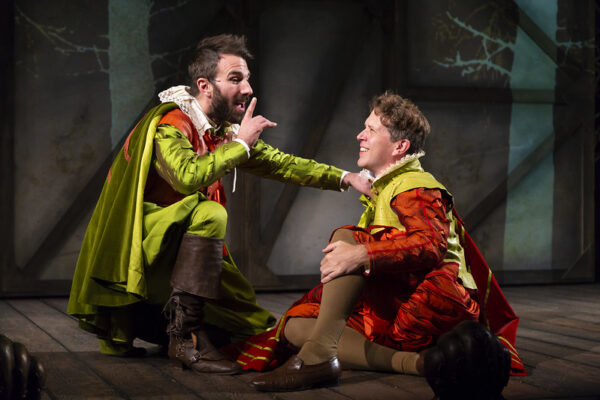
Alex Hurt and Jeremy Webb in the Huntington Theatre Company production of Rosencrantz & Guildenstern Are Dead. Photo: T. Charles Erickson.
His breakthrough drama, Rosencrantz and Guildenstern Are Dead, was first produced at the Edinburgh Festival in 1966. Of its success, Stoppard quoted the character Mike Campbell from The Sun Also Rises: “We went broke two ways: suddenly and slowly.” Nevertheless, the play went on to win great acclaim and won him his first Tony Award for Best Play in 1968. It later became a film, which he directed in 1990, starring Tim Roth and Gary Oldman.
I first saw his work with The Real Inspector Hound on a double bill with After Magritte in New York in 1972. The former is a farce in which two critics, Moon & Birdboot, watch an Agatha Christie mystery, complete with stock characters, clever wordplay, and wonderfully awful clichés. Soon, the two pompous critics enter the drama themselves, as the line between art and life dissolves. It was Pirandello meets Monty Python. The opening one-act, After Magritte, attempted to apply narrative logic to surrealistic stage images drawn from Magritte’s paintings. I had never seen theater quite like this before, and after that I was ready to see anything Stoppard wrote for the stage.
He did not like his writing overanalyzed or interpreted. Instead, Stoppard believed the language itself could do the work, even though his dialogue was often dense with references to philosophy, history, and science. The rapid-fire wordplay in Jumpers (1972) leaves you breathless. That production, which came to the Huntington Theatre Company in 1987, pairs language games with on-stage acrobats, one of Stoppard’s most breathtaking conceits. At its core, the script is a kind of philosophical treatise contained within a farcical whodunit. That play and others explore the threat of moral relativism in an apparently indifferent universe. Travesties (1974), produced at the Huntington in the mid-’90s, is a farce set in Vienna in 1917. There, the Dadaist Tristan Tzara, novelist James Joyce, and revolutionary Vladimir Lenin fight out their contradictory views on art and politics. This literary/political mashup won him his second Tony Award.
One of the best stage productions I’ve ever seen was the 1984 Broadway touring production of The Real Thing in Boston, which starred Jeremy Irons and Glenn Close. Directed by Mike Nichols, the evening was a revelation. Here Stoppard went deeper and more fearlessly into his ideas about art and the nature of love. The playwright had found, as one critic said, “the courage to abandon ironic distance.” It won him another Tony for Best Play.
The Invention of Love (1997) was called “over-informative and repetitious” by some critics, while others were moved by its wit and emotional resonance. Even though I was unfamiliar with the subject, the life and work of classical scholar and poet A.E. Housman, the words tumbled out with such eloquence that — no matter how much I understood or could infer from the dialogue — I left the theater feeling smarter and a little more awake to the capacities of language.
Along with writing plays, Stoppard wrote screenplays. Among those were Terry Gilliam’s Brazil (1985), Steven Spielberg’s Empire of the Sun (1987), and Shakespeare in Love (1998), for which he won an Oscar for Best Original Screenplay. Nevertheless, he was once quoted as saying, “Film writing is junk food … advanced technique in the service of arrested development.”
There are many of Stoppard’s plays I have yet to see. I never got to Arcadia at Lincoln Center in 1993, nor the nine-hour, three-part The Coast of Utopia, an epic trilogy on Russian intellectual history that premiered in 2002. The latter consists of three plays: “Voyage,” “Shipwreck,” and “Salvage.” It was reported to have had over 40 actors and 70 characters. The ambitious project was awarded seven Tony Awards in 2007.
I finally made it to New York for a production of Stoppard’s Rock and Roll in 2007. That play spans decades, blending Czech politics, ideas on freedom of speech, the media, and the power of rock music. The story takes place between 1968 and late 1989, during the Velvet Revolution, which peacefully ended four decades of communist rule. Stoppard’s friend, the playwright Václav Havel, became president of the Czech Republic after the Russian withdrawal. At the time, I had just visited the Czech Republic, where Milan Kahout, who now resides in Boston, was living. Kahout was one of the revolutionary performance artists at the time who helped facilitate the change of regime and remains committed to the power of art.
The Czech band Plastic People of the Universe, which used music to unite citizens against the communists, also featured in the play. I had seen them, a ragtag group of middle-aged rockers, perform at, of all places, the small now-defunct East Somerville City Club. The band, modeled after Frank Zappa’s Mothers of Invention, performed music that was just as dissonant and cutting as Zappa’s. Zappa performed in Prague in 1991 with the Czech rock band Pražský výběr at the “Adieu Soviet Army” concert, a historic farewell to Soviet troops in Czechoslovakia.
Stoppard was born in Czechoslovakia as Tomás Sträussler but the family escaped to Singapore when the Nazi threat loomed. After the Japanese attacked that city, his mother, Marta, fled to India with Tomás and his brother in late January 1942. His father stayed behind, serving as a Czech volunteer in the British Defense Corps. Stoppard was told in 1999 that his birth father had died on February 14 that year — when the Japanese bombed the overcrowded merchant ship he had boarded shortly after he joined the Corps.

The cast of Tom Stoppard’s Leopoldstadt staged by the Huntington Theatre. Photo: Liza Voll
In India, the future dramatist attended boarding schools. There his mother met Major Kenneth Stoppard. They would marry in 1945 and move to England in 1946. Tomás took his stepfather’s last name.
In 2020, with Stoppard now 83, I ordered tickets for Leopoldstadt in London, knowing it might well be his last play. He was finally writing about parts of his own life story. I prepared myself by reading Hermione Lee’s wonderfully researched biography Tom Stoppard: A Life. Covid waylaid the opportunity because the play was closed due to the pandemic. Still, I did see the production in New York on the second night of its run.
Some criticized the script as being emotionally cold, but for me it was fascinating to see Stoppard write autobiographically, depending less on irony and gamesmanship than feeling. Furthermore, he was tackling his Jewish identity. The play was a success when it was presented at the Huntington Theatre Company a few years ago (Arts Fuse review). In an interview, Stoppard told Christiane Amanpour, “It was somewhat just inward looking to keep talking about my own charmed life as if I had no history. That in the end, I have to say, is why the play was written. Everything upfront. I was just giving myself a history that I was never quite acknowledging.”
Stoppard’s plays and ideas, their examination of intriguing philosophical and intellectual questions, have accompanied me through five decades, reinvigorating my love for the art of the theater. Lee placed, at the beginning of her biography, a line spoken by Hannah Jarvis in Stoppard’s play Arcadia, and it strikes me as key — not only to Stoppard’s writing, but to his life:
It’s wanting to know that makes us matter. Otherwise we’re going out the way we came in.
— Tim Jackson
Whatever became of the moment when one first knew about death? There must have been one, a moment, in childhood, when it first occurred to you that you don’t go on forever. It must have been shattering, stamped into one’s memory. And yet I can’t remember it. It never occurred to me at all. — Rosencrantz and Guildenstern are Dead
“I feel overestimated,” Tom Stoppard told Time magazine back in 2007.
In fact, the multiple Tony- and Olivier-award winning playwright, who also picked up an Oscar for his Shakespeare in Love screenplay, is probably underappreciated.
Born Tomáš Sträussler in Zlin, Czechoslovakia, now the Czech Republic, his family escaped the day after Nazi occupation — a takeover that was made possible by the Munich Agreement, an effort of the West to placate Hitler. (A history worth reviewing in light of the current US “peace” proposal regarding the war in Ukraine).
As refugees, the future dramatist’s family escaped to Singapore, where his father perished when a ship he was on was bombed by the Japanese. From there, with his mother and brother, he escaped to India, where his mother met and married British Major Kenneth Stoppard. After the war, the family settled in Nottingham, where Stoppard said he became “an honorary Englishman.”
He left school at 17 to join the staff of a local newspaper. He’d been penning short radio plays and realized that writing was his passion. In 1958 the Bristol Evening World offered him a position that included writing theater reviews, which led to his prolific playwriting career.
Rosencrantz and Guildenstern are Dead was the hit of the 1966 Edinburgh Festival. An Old Vic production followed, and the first Broadway run of the play won Stoppard the first of his five Tony awards.
During his six-decade career he produced nearly 40 plays, radio scripts and television plays among them. He also served as a Hollywood script doctor and penned a number of screenplays, including Brazil, The Russia House, and Empire of the Sun.
Over the years, this magazine has frequently covered productions of Stoppard’s plays. Back in 2016, Ian Thal praised his dazzling Arcadia script in an equally dazzling Central Square Theater production, noting, “For Stoppard, the world winds up and then it winds down — and both actions are brought to vibrant life in this production.”
As we slowly started to emerge from Covid in 2021, literary critic Roberta Silman offered a loving tribute to Stoppard’s career. After reading his recently published “exhaustive and sometimes exhausting” biography, Hermione Lee’s Tom Stoppard: A Life, she paid homage to his most recent play to date, the autobiographical Leopoldstadt. Silman writes that Stoppard is “possessed of one of the most interesting and wide-ranging minds of his generation.”
Despite not being able to see the play performed on stage, the critic praised its depth and predicted that it will stand as one of the most powerful literary works of early 21st century: “As painful as it is to read and see, you will know that you are in the presence of a great work, more linear than Stoppard’s earlier plays, yet filled with such intelligence and compassion that it will be read and seen for years and years, and perhaps, over time, be regarded as Stoppard’s richest, most haunting drama.”
A little over a year later, Christopher Caggiano shared his review of the Broadway run of Leopoldstadt. He noted some flaws, but concluded that “somehow these issues don’t rob the play of its power, a slow burn that builds to a shattering denouement.”
Arts Fuse Editor Bill Marx was more critical of Stoppard’s nine-hour, Tony-winning trilogy, The Coast of Utopia, calling it “bloated” and writing that it left him “reeling from confusion and fatigue.”
In 2014, Thal wondered whether the artistic/political conservatism of The Real Thing was still relevant more than 20 years after it was written.
Likewise, Marx was uncertain that Stoppard’s first masterpiece Rosencrantz and Guildenstern Are Dead might not be holding up in its 2019 offering at the Huntington Theatre. He concluded:
So Rosencrantz is showing its age. And the ravages of time also reveal something about some of the reasons for Stoppard’s decades of success. In 1979 Ken Tynan, who as the Literary Manager of the National Theatre helped bring the play to the stage, wrote that the dramatist believes in “a universe in which everything is relative, yet in which moral absolutes exist.” On the one hand, this paradoxical conflict sparks a contentious, tragic-comic drama that skitters brilliantly about (and between) alternatives. On the other, this lordly overview smacks less of iconoclasm than having your cake and eating it too. After all, “moral absolutes” hover in the background, assuring audiences that any serious theatrical vertigo is temporary. Absurdity defanged.
There have also been Arts Fuse reviews of The Real Inspector Hound and Hapgood.
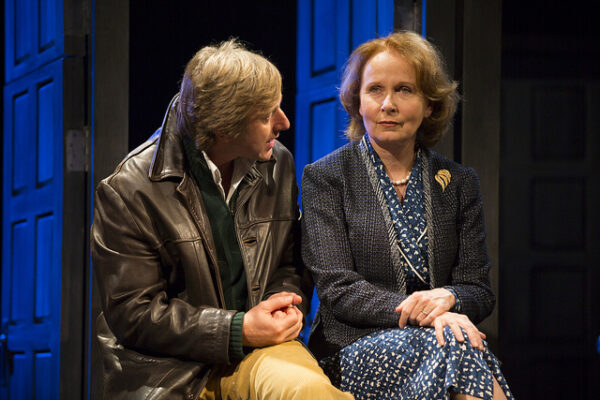
Jake Weber (Kerner) and Kate Burton (Hapgood) in the Williamstown Theatre Festival production of Hapgood. Photo: T Charles Erickson
My first encounter with Stoppard was when I was in college. I came across his ’70s script Dogg’s Hamlet, Cahoot’s Macbeth. At the time, I was learning about Shakespeare from a very stiff and over-pompous literature professor who approached nearly everything about the Bard with moth-eaten respect. Shakespeare, he seemed to reason, should be covered in protective plastic and preserved like the furniture in my grandmother’s living room. So, imagine my delight when I happened upon these couple of one-acts that hilariously turned Shakespeare’s masterpieces on their ears.
The Hamlet adaptation was written for the Almost Free Theatre in Soho for a performance on a double-decker bus. Cahoot’s Macbeth was inspired by the plight of his Czechoslovakian playwright friend, Pavel Kohout, who was devastated after the Prague Spring ended and theater performances were no longer permitted. In 1978 he wrote to Stoppard that they had created the underground LRT (Living Room Theater) and their premiere production would be Macbeth.
Stoppard’s freewheeling lampoons encouraged me to see that Shakespeare was energized by storytelling: serious, comical, profound, and absurd.
These scripts also served as inspirations: no space and no political movement can prevent those who are truly passionate about theater from putting on a show. Theater can — and should — happen anywhere.
— David Greenham
6 Comments
Leave a Comment
One of my favorite of the late Tom Stoppard’s plays, 1977’s Professional Fowl, is also one of his very best, but it is habitually overlooked by critics. Most likely because it was a television play. The script’s message is simple enough: moral theories devoid of moral action are feckless. But the crucial conflict is between two philosophers, a moral absolutist and a relativist, about whether or not to take a risky political action. One of the academics is asked to smuggle a thesis out of communist Czechoslovakia to the West. In Stoppard’s words, it is one of his rare scripts in which “a man {is] being educated by experience beyond the education he has received by thinking.”
He changed everything. I recall reading his early plays when I was in college (a theatre major) and also found an interview with him in VOGUE that I saved for one of my professors (the one who introduced me to Stoppard’s work).
It is notable that Stoppard put his late-in-life discovery of his Jewish roots in his last major work. It took him a lifetime to get there. In this quest he is not alone. I have known many from his generation (pre- and post- World War II) and my own who (“boomers” ) who chose to ignore that familial exploration altogether. (Technology has made it so much easier today than before, so there really isn’t an excuse to shrug one’s shoulders and say, “Gee…I don’t know…”)
In other words, they could pass without being known as a Jew, so why bother? They lived full lives in a society where they flourished. They didn’t need that connection. Stoppard was insanely successful as a writer — he was paid in excess of 2 million dollars for a re-writing job for one of the Indiana Jones films for Spielberg, for example — so a painful look back wasn’t necessary, Yet, even though it was an indulgence he could easily have avoided (and did for many years), he chose to go at it anyway. And, yes, like most of his other stage projects, he reaped the rewards, the awards, the high praise. It is impossible to look into a person’s heart, but one feels he was genuine in this quest. He is to be commended for displaying moral courage.
Thanks to Tim Jackson for this deep and comprehensive appreciation of Stoppard’s, ok, I’ll say it–genius. Surprised however that no one mentioned one of my favorite plays, The Hard Question. As for The Coast of Utopia, I never saw it staged, but read it twice straight through. Total immersion in that lost world of warring radical commitment. May there be drawers full of scripts waiting to be discovered.
I fell in love with Stoppard in college when I performed in The Real Inspector Hound. I loved the wordplay and the sense of absurdity. But, yes, it was refreshing to see Stoppard step away from ironic detachment and go deeper. Leopoldstadt was devastating. How anyone could call that play cold is beyond me. The last scene alone is rife with shattering emotion.
Thank you, Kai. I went with what I knew best and had an attachment to, well aware that there was much more that could have been praised. I do recommend Hermione Lee’s wonderful biography of Stoppard – 800 pages of background, history, and context with an appreciation for all his work, including the radio plays that were also unmentioned.