Opera Album Review: World-Premiere Recording of a Still Deliciously Daffy Italian Comic Opera from 1769
By Ralph P. Locke
Paisiello, one of the most successful opera composers in Mozart’s day, offers repeated delight and surprises in this entertainment, thanks to a splendid cast of mostly youngish singers.
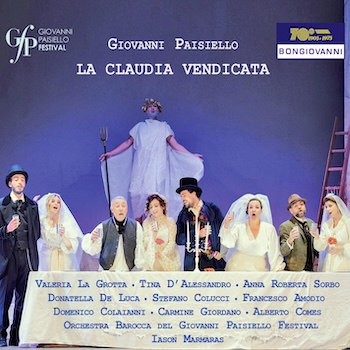
Giovanni Paisiello: La Claudia vendicata.
Valeria La Grotta (Carmosina), Tina D’Alessandro (Claudia), Anna Roberta Sorbo (Bianchina), Stefano Colucci (Don Camillo), Domenico Colaianni (Pulcinella), Carmine Giordano (Coviello), Francesco Amodio (Trafichino).
Orchestra Barocca del Giovanni Paisiello Festival, cond. Iason Marmaras.
Bongiovanni [2 CDs] 85 minutes.
 I’ve put the names of seven singers and characters in the header, but there are 10 — quite a large number for a work that takes less than an hour and a half. La Claudia vendicata is categorized as a farsa, and most of the characters speak Neapolitan dialect. Or, rather, they sing in Neapolitan. (As in nearly all Italian operas from the earliest to the most recent, there is no speaking.) Two who express themselves in proper Italian are the nobleman, Don Camillo, and the title character, Claudia, who are thus signaled to us as fated to end up together.
“Claudia Wins!” might be one possible rendering of the work’s title. The libretto was fashioned by Francesco Cerlone to make a shortish work that would be a kind of daffy pendant to, or intermezzo in, a longer comic opera, L’osteria di Marechiaro, which also used a libretto of his. (A setting by Giacomo Insanguine was performed in Naples in 1768 and the one heard here — by Paisiello — in 1769.)
This couple has to deal with some astonishing, folktale-like events before they and six other characters get paired up. Pulcinella (a male character, despite the “a” ending to his name) attempts suicide; Claudia discovers a jug in some fishing nets that contain a genie. It is the Mago, who sings on a single repeated pitch until he is released from the jug. The Mago supplies a wand that makes its holder invisible. The booklet-essay proposes, plausibly, that this genie comes out of the famous 1001 Nights tales invented and written down in Arabic-speaking lands centuries earlier.
Pulcinella and Claudia use the wand to make themselves invisible, and purposely create confusion by emitting words that are attributed to characters that are visible to each other. Next they (with the same wand, I suspect) send their resistant lovers, Carmosina (a fish vendor) and Don Claudio, into the crater of Mt. Vesuvius and transform Don Camillo’s servant Coviello into a donkey, who at one point is beaten. A stage photo from the staged performance (see below) shows that Coviello was simply given a donkey’s head, like Bottom in Shakespeare’s A Midsummer Night’s Dream, plus gloved paws.
Later Pulcinella and Claudia turn Carmosina and Don Claudio into marble statues (conveyed here by their singing inexpressively), to teach them a lesson one last time. The errant lovers admit their error and regain the ability to move (and to sing with vibrato). Coviello, this time, is transformed into a tall chamber clock that, like the statues, can communicate in very plain statements: in his case by stating “It’s one-thirty in the morning.” (An endnote in the booklet observes humorously that this work, despite all its implausible doings, maintains the classical “unity of time”: everything happens in a single, long day.) The work ends with a quartet in which the two main couples happily sing about how animals, in the natural world (the dove, nightingale, goldfinch, and donkey), are each happy to be mated to one of its own kind.
There is no overture: we are thrown into the Neapolitan atmosphere with a duet (in the style of a minor-mode siciliana) between the two main lower-class lovers, Carmosina and Pulcinella. Thereafter, the four main characters and some lesser ones are given short arias. There are also two trios: one of them a number performed for an onstage audience, to raise a little money, by the spurned Camilla with two members of a traveling theater company, Marioletta and Trafichino. There are also two quartets, plus a good deal of recitative to help set up each number. The orchestra is kept simple throughout — mostly strings, and occasionally oboes and horns.
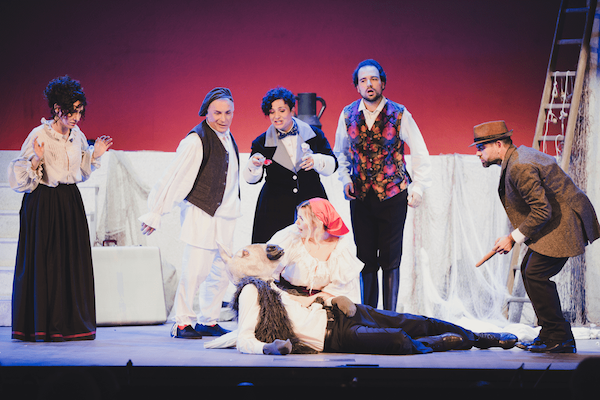
Scene from the production of La Claudia vendicata at the Festival Giovanni Paisiello (in Taranto, Italy), in which one character (the servant Coviello) is turned into a donkey, much like Bottom in Shakespeare’s A Midsummer Night’s Dream. Photo: Festival Giovanni Paisiello
The cast is entirely Italian, including some from various cities in southern Italy, which surely helps them put the Neapolitan texts across. (Carmosina once calls her beloved Polecenelluzzololuzzelo, which the booklet, I assume accurately, translates as “my dear little Pulcinella.”)
Their voices vary in richness, one of the best being contralto Tina D’Alessandro, in the title role. (She has appeared frequently as Santuzza in Cavalleria rusticana.) Nobody wobbles or shouts: rather, they concentrate on maintaining a solid core of tone and conveying the feeling of their character at that particular moment. A real relief these days!
Domenico Colaianni, as Pulcinella, is a little rough-edged, but that’s arguably in character. Eight years ago I greatly admired his assumption of the title role in a 19th-century Neapolitan-language comic opera, Nicola De Giosa’s Don Checco, and he’s still a vivid performer.
The orchestra sounds small but responsive. The stage production seems to have been extremely simple: I don’t hear any attempt at sound effects or even a dramatic pause as the scene shifts to Mt. Vesuvius. The stage directions call for erupting flames from not one but two craters, but all I hear is characters singing more recitative (about there being smoke and lava all around). More stage directions indicate that a table with food and chilled wine next appears (though, again, we hear no clinking of glasses or whatever) so Claudia and Pulcinella can enjoy themselves while watching their faithless lovers — who (in a lively and extended quartet) beg to be released from volcanic hell. The verbal pleasures in this number are many, as the two tortured characters are singing in two different dialects of Italian simultaneously, as are their smug torturers. The latter two reach linguistic agreement when they start laughing musically on the same syllable: repeated short ah-ah-ah-ahs. Paisiello’s motoric string accompaniment well conveys (in the absence of sound effects, as I said) the anxiety of the two who are experiencing all that heat and smoke.

Soprano Valeria La Grotta. Photo: courtesy of the artist
All in all, a lovely souvenir from the Giovanni Paisiello Festival in the Teatro Fusco (Taranto), recorded at a single performance on October 20, 2022. The two photos in the booklet help flesh out the characters as one listens.
As is often the case with Bongiovanni releases, there is something homegrown about this one. The English translations, uncredited, are sometimes approximate or lazy. We are told that the genie has “pampini” in his hair, which is meaningless in English. (Dictionaries define the word as “vine leaves” or “tendrils.”) And one sheet of the libretto (pp. 19-20) is missing some letters along both sides of its left edge. There is also no indication that the repeated donkey braying of “Pieta! Pieta!” we hear in CD2, track 9, comes from Coviello, who I imagine is being beaten by the traveling actor Trafichino. Finally, the otherwise helpful endnotes about allusions and other unusual wordings in the libretto are given in Italian only.
But we should to be grateful for getting to hear this opera at all, and to a certain Giuseppe Labadessa (who, I see online, got his training in composing and conducting in the Adriatic port city of Bari) for providing a workable score and parts so that the work could get performed. Listeners who are willing to make the effort to follow a text largely in Neapolitan will find much to enjoy in this previously unrecorded opera by one of the 18th century’s most prolific and skillful composers. Over the years I have reviewed three other Paisiello operas, and particularly recommend La grotta di Trofonio, a work whose libretto was likely one of the sources upon which da Ponte based the libretto for Così fan tutte — and Le gare generose, a comedy mixed with social criticism about Quakers and slavery in colonial Boston.
One more thought: Claudia Wins! (or however one might title it) could be a hoot if performed by the young singers of some university opera studio, or perhaps by a smallish local opera company. But it would have to be supplied with an imaginative English translation, to avoid the challenge of teaching singers to do Neapolitan dialect and the distancing effect of a supertitled translation. This work’s many witty interchanges need to be heard and enjoyed.
Ralph P. Locke is emeritus professor of musicology at the University of Rochester’s Eastman School of Music and Senior Editor of the Eastman Studies in Music book series (University of Rochester Press), which has published over 200 titles over the past thirty years. Six of his articles have won the ASCAP-Deems Taylor Award for excellence in writing about music. His most recent two books are Musical Exoticism: Images and Reflections and Music and the Exotic from the Renaissance to Mozart (both Cambridge University Press). Both are now available in paperback; the second, also as an e-book. Locke also contributes to American Record Guide and to the online arts-magazines New York Arts, Opera Today, The Boston Musical Intelligencer, and Classical Voice North America (the journal of the Music Critics Association of North America). His articles have appeared in major scholarly journals, in Oxford Music Online (Grove Dictionary), and in the program books of major opera houses, e.g., Santa Fe (New Mexico), Wexford (Ireland), Glyndebourne, Covent Garden, and the Bavarian State Opera (Munich). The present review first appeared in American Record Guide and is included here, lightly revised, by kind permission.
Tagged: "La Claudia vendicata", Bongiovanni, Carmine Giordano, Giovanni Paisiello, Iason Marmaras, Orchestra Barocca del Giovanni Paisiello Festival, Tina D’Alessandro