Theater Review: “Lizard Boy” — A Comic Book-Musical Quest that Celebrates Teenage Self-Acceptance
By Martin Copenhaver
The themes of Lizard Boy would land more squarely — and more powerfully — with a teenage audience than they can with those of us who can only recall such a time in our lives.
Lizard Boy: A New Musical, Book, music, and lyrics by Justin Huertas. Directed by Lyndsay Allyn Cox. Staged by SpeakEasy Stage Company at the Roberts Studio Theatre in the Stanford Calderwood Pavilion at the Boston Center for the Arts, 527 Tremont Street, Boston, through November 22.
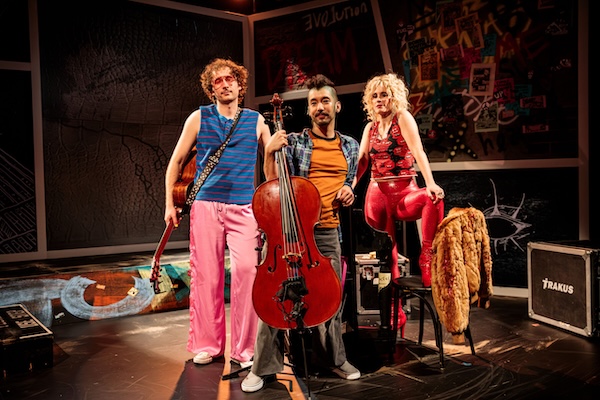
From left: Peter DiMaggio, Keiji Ishiguri, Chelsie Nectow in the Speakeasy Stage Company production of Lizard Boy. Photo: Benjamin Rose Photography
Lizard Boy is a comic book set to music. The characters are broadly drawn, the themes are anything but subtle, the dialogue is punchy but sometimes preachy, including declamations that make sure we are not missing the point. The scenes move and pivot quickly, reminiscent of the experience of flipping through the pages of a comic. All that is missing are the speech balloons and the occasional interjections of exclamations like, “Pow!” and “Zap!” to punctuate the action.
Justin Huertas, who wrote the book, lyrics, and music (he also starred in the original production of Lizard Boy in Seattle in 2015), would not find this description dismissive. He adores comics and testifies to the ways in which superheroes like the Power Rangers and X-Men were so much more than entertainment for him; they provided a meaning system that was formative: “These superheroes on TV and in comic books were the myths that taught me how to be a good person. These were my sacred texts.”
The hero of this story is Trevor (played by Keiji Ishiguri), whose life was forever changed by a bizarre and horrific incident when he was a young boy. He was a kindergartener on a playground when a winged dragon was shot down by soldiers, its blood sprayed on Trevor and four of his classmates, causing all of them to mutate in some way. In Trevor’s case, his body was suddenly covered with the green scales of a lizard. He is so ashamed of his appearance that he only ventures out of his home once a year, during the Monster Fest, an annual celebration of the dragon’s demise. It is only then that he can mingle with others because his deformity can seem like just another Monster Fest costume.
Like Kermit the Frog (who sings, “It’s not easy being green”), Trevor’s green life is not an easy one. He is, quite literally, uncomfortable in his own skin. Trevor reaches the depths of despond, so he turns to the dating app Grindr for some kind of connection. When a man named Cary shows up, clearly interested only in sex (not surprising, given that app’s focus), Trevor recoils. Cary (played by Peter DiMaggio) is apologetic and they agree to rewind and start again.
Together they go to a club to hear a punk rocker named Siren perform. Siren (played by Chelsie Nectow) is a primal force who, fittingly, bears the name of a mythic creature who is a dangerous temptress. Both Trevor and Cary are entranced. As it soon becomes clear, they are also in peril.
Lizard Boy was originally conceived as a one-person show and, in some respects, it still bears the marks of that origin. Trevor is the only character who is fully realized. Cary is a goofball in two dimensions. Siren hardly seems like a character at all. This may be inevitable; after all, mythic creatures are not known for nuanced character development.
In spite of these limitations in the script, the cast brings compelling energy to their roles. In an approach that has become increasingly common (particularly as practiced by director John Doyle in recent productions of Sondheim musicals), each of the actors in Lizard Boy plays a variety of musical instruments on stage, accompanying the songs and incorporated into the action. The score of Lizard Boy has been described as “indie rock,” but it is much more eclectic than that. The songs range from sweet ballads to heavy metal rages. The variety is underscored by the diversity of the instruments played: cello (Trevor’s go-to), guitar, piano, kazoo, toy xylophone, guitar case (used by Siren as a percussive instrument). The three singers harmonize beautifully. Nectow has a lovely voice, when she is not required to screech as Siren. Ishiguri’s solo work also is excellent, which is required by such a demanding role.
The climactic ending of the show is something of a hot mess because the characters scream at each other — mostly about who has power and who is trying to take that power away — the forces of good and evil locked in a cosmic battle to the death (and beyond), last minute plot twists and untwists disclosed at a dizzying pace. All the while, lights flash to underscore the chaos and to create a bit of its own. Finally, when the action stops and the lights go down, it comes as something of a relief.
Then, in an epilogue, Trevor steps forward and sings a ballad, “Eleventh Hour,” which sums up what the show has attempted to communicate: “Don’t forget what makes you different is your power… I hope you love exactly who you are today.” The song is a bit too on the nose, to be sure, but Ishiguri’s performance, marked by both sweetness and earnestness, adds a lovely coda to the show. Huertas is not afraid to be sentimental, which may be his superpower.
Lizard Boy is not based on one superhero; he is the product of playwright Huertas’s imagination. That is, there is no Lizard Boy comic that predates the show. The musical, however, has inspired two graphic novels: Tales of a Seventh Grade Lizard Boy (2022) and Lizard Boy 2 (2025), both by Jonathan Hill. I do not know how closely they adhere to the characters and themes of the play, but I did find it telling that both Lizard novels are recommended for readers 8-12 years old. That is not the right age range for audiences for Lizard Boy, but I do think its sweet spot audience would be teenagers who struggle with questions of identity. That might be particularly true of teenagers who struggle with their racial and sexual identity (as was the case with Huertas), but what teenager of any race or sexual orientation does not wrestle with issues of identity? I imagine the recurrent themes of Lizard Boy (you have to love yourself; everyone has a gift; it gets better) would land more squarely — and more powerfully — with a teenage audience than they can with those of us who can only recall such a time in our lives.
Martin B. Copenhaver is an author and former seminary president who likes to tell people that he once made a television commercial with Larry Bird. Because it’s true.
Tagged: "Lizard Boy", Chelsie Nectow, Justin Huertas, Keiji Ishiguri, Lyndsay Allyn Cox