
Film Review: “Chainsaw Man – The Movie: Reze Arc” — Or, How I Learned to Stop Worrying and Love the Bomb Girl
By Nicole Veneto
Besides Chainsaw Man’s abundant visual pleasures and uncompromising blend of ultra-violence and adolescent sexuality, one of its particular draws is that it’s a cinephile’s anime.
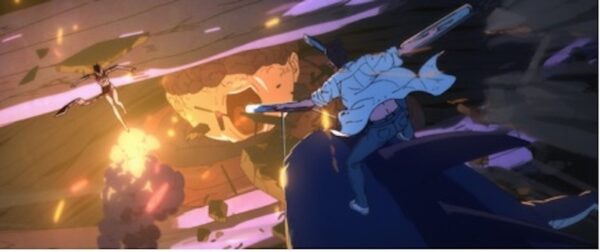
Chainsaw Man Denji and Bomb Girl Reze face off in the climax of Chainsaw Man – The Movie: Reze Arc. Photo: Sony Pictures
There used to be a stigma attached to watching anime. You were the weird kid who did the Naruto run in gym class, drew watery-eyed pretty boys in your notebooks, and danced to “Hare Hare Yukai” to promote your high school Anime Club. Or, you were considered a disgusting pervert who jerked it to tentacle porn in your mom’s basement. Being into anime was uncool at best and shameful at worst, an interest you should really grow out of once you stopped playing Pokémon at recess. (Nobody’s ever stopped playing Pokémon, but you get what I mean.)
Then, around the early 2010s, anime became not just cool, but mainstream. Thanks in no small part to advances in streaming and simulcasting, the days of relying on physical media (officially licensed or otherwise), remembering Cartoon Network’s schedule, or waiting until someone fansubbed the latest episode of Death Note became things of the past. Internet accessibility aside, anime’s movement from the countercultural margins to topping the US box office was the result of decades of cultural and economic exchange between America and post-War Japan. We’ve been exporting and consuming each other’s cultural products for so long that many American-made films, television, and video games bear a distinctly Japanese influence (and vice-versa).
One beneficiary of the recent anime boom that’s uniquely tailored to American sensibilities is Tatsuki Fujimoto’s Chainsaw Man, which is exactly what you think it is. Well, it’s a bit more complex than that: in an alternate universe where the Cold War wages on and human fears take physical form as Devils, destitute teen Denji scrapes by selling his organs and working for the Yakuza as a Devil Hunter with Pochita, the disempowered Chainsaw Devil. After an inevitable betrayal leaves Denji near death, Pochita offers a deal: become Denji’s heart in exchange for showing Pochita his dreams. Reborn as a human-devil hybrid, Denji is recruited into the war between humans and Devils by Public Safety official Makima. He is to serve in Special Division 4 with the vengeful Aki and the Cartman-esque blood fiend (a Devil inhabiting a dead human body) Power to hunt down and defeat the Gun Devil, who’s responsible for killing over a million people in five minutes, including Aki’s entire family.
Picking up where MAPPA’s 2022 anime leaves off, Chainsaw Man – The Movie: Reze Arc is a feature adaptation of the manga’s Bomb Girl storyline, wherein Denji is literally love bombed by the Bomb Devil Reze, a Soviet human-devil hybrid contracted by the Gun Devil to steal Denji’s heart. The hurdle of accessibility for non-fans is unavoidable, but as a film critic and a fan, I’m in a unique position to judge Reze Arc from both perspectives. My judgment is as follows: Reze Arc whips, it slaps, it rips like a chainsaw revved up on diesel fuel. I know I sound hyperbolic here, but I’m dead serious when I say Reze Arc is both 2025’s best animated feature and Sony’s finest superhero release since Spider-Man 2. No other film this year will give you a guy made out of chainsaws riding a shark into a typhoon in glorious IMAX quality. Have you bought your ticket yet?

Like all of us, Denji’s a big fan of the movies.(Photo: Sony Pictures)
I originally intended to use this review to analyze Reze Arc and Chainsaw Man itself as savvy criticisms of late-stage capitalism, a work that Max Kelly argues embodies what Mark Fisher called “capitalist realism.” At its core, Chainsaw Man is a story about exploitation and the ridiculous lengths we’re forced to go to preserve some kind of stability in a hyper-capitalist world where survival means making pacts with Devils. In its own twisted way, Chainsaw Man diagnoses how diseased our lives have become under neoliberal forces, manifesting in daily acts of violence we’re forced to accept as the system working as intended. Denji’s a perfect example of the exploited late-capitalist subject, having lived a life so impoverished that he’s more than willing to put life and chainsawed limb at risk for Public Safety if it means three meals a day and Makima’s affection.
That through-line of exploitation and capitalist realism is foundational to Reze Arc, but surprisingly, it didn’t end up being what I loved about it. Like Denji, I am also a deeply exploited late-capitalist subject who risks her sanity for a job I constantly suffer for — watching capeshit for my podcast. I don’t need to tell you how bad things are when it comes to superhero movies. The lackluster (if not dire) output from Marvel and DC is arguably why so many people are looking to anime for alternatives. Chainsaw Man broadly falls into the superhero genre, though its palpable sex and violence draw more from Go Nagai’s Devilman than Iron Man or Superman. In adapting Fujimoto’s manga, director Tatsuya Yoshihara and screenwriter Hiroshi Seko have rediscovered the tried-and-true formula of action spectacle plus character melodrama that used to make superhero films soar. Expertly paced, Reze Arc doesn’t waste a second of its 100 minute runtime, perfectly balancing the emotional weight of the Denji/Reze storyline with a B-plot about the growing relationship between Aki and the androgynous Angel Devil.
A recurring criticism that’s been made on my show is that, given how much computer-generated VFX work goes into Marvel movies, superhero flicks might as well be animated. Reze Arc makes the strongest case for this approach with the best animation you’ll see all year. I dread to think what MAPPA animators had to deal with during production, but unlike what Feige’s army of equally overworked and underpaid VFX artists produce, the quality of work on display in Reze Arc is breathtakingly detailed in every frame. The way the characters move, the nuances in their facial expressions and how the film translates Fujimoto’s original illustrations into moving images and switches up art styles in a single moment, it’s all head and shoulders above its contemporaries, Japanese or otherwise.
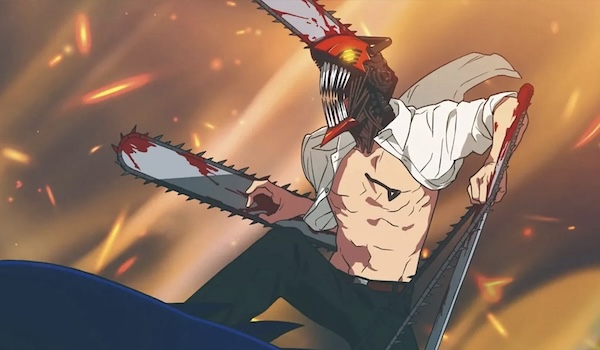
A scene featuring Chainsaw Man in Chainsaw Man – The Movie: Reze Arc. Photo: Sony Pictures
Besides Chainsaw Man’s abundant visual pleasures and uncompromising blend of ultra-violence and adolescent sexuality, one of its particular draws is that it’s a cinephile’s anime. Hooper and Raimi’s undeniable influence aside, Chainsaw Man’s references run the gamut from Tarantino worship and American blockbusters to Kiyoshi Kurosawa deep cuts and Un Chien Andalou. Reze Arc, however, presents the wildest array of high and low filmic culture I have ever seen. In the first thirty minutes, two characters are moved to tears by Grigory Chukhray’s Ballad of a Soldier. Another scene pays direct homage to Henry: Portrait of a Serial Killer. The opening credits recreate Muybridge’s The Horse in Motion. And if that all sounds too snobbish for you, don’t worry, the climax is Sharknado. Like Hideo Kojima before him, Tatsuki Fujimoto filters American and international pop culture through his own artistic lens, molding them into something wholly unique and emotionally affecting.
To reiterate, Reze Arc necessitates a level of familiarity with Chainsaw Man that more or less bars non-fans from going in blind. But isn’t a substantial amount of our media environment dependent on having seen a dozen or so films of narrative set-up to understand why your friendly neighborhood Spider-Man has access to drones now or how Tim Blake Nelson got to looking like this? I hope I’ve at least piqued your interest in Reze Arc and Chainsaw Man as something more than the weird new Japanese thing the kids are watching. Either way, Reze Arc offers a much needed reprieve from superhero-inspired mediocrity. If only Sony had realized anime’s true appeal instead of trying to turn Morbius memes into box office returns.
Nicole Veneto graduated from Brandeis University with an MA in Women’s, Gender, and Sexuality Studies, concentrating on feminist media studies. Her writing has been featured in MAI Feminism & Visual Culture, Film Matters Magazine, and Boston University’s Hoochie Reader. She’s the co-host of the podcast Marvelous! Or, the Death of Cinema. You can follow her on Letterboxd and her podcast on Twitter @MarvelousDeath.
3 Comments
Leave a Comment

Speaking of box office-Here’s what an industry publication says about this film: $17.25M domestic opening, $108M global, $4.1M budget. Sony/Crunchyroll’s R-rated anime surged way past $10M projections with an A CinemaScore and 99% audience score, pulling $3.4M in Thursday previews alone. That’s territory usually reserved for midsize Hollywood IP. Premium formats drove 43% of the gross (IMAX: 19%, PLF: 24%), with the film getting full tentpole rollout muscle across 361 IMAX screens. Its international run has it past $100M globally already—anime’s clearly big everywhere now.
Had to cut this for word limit reasons, but even with its level of popularity stateside, Chainsaw Man is playing in more marginal, classically cutting-edge territory both thematically and visually than its peers, especially shonen like Demon Slayer (couldn’t get past the nationalist undertones, dropped it after a couple episodes) and Jujitsu Kaisen. Chainsaw Man still feels countercultural in comparison, more like an 80s-90s OVA by Kawajiri. Nagai’s Devilman (especially Yuasa’s 2018 reimagining) is a huge influence, but there’s also a lot of ero-guro in the lineage Fujimoto is drawing from (thinking specifically of Suehiro Maruo). Going somewhat mainstream hasn’t diluted any of Chainsaw Man’a power to shock or push boundaries!
IDK if you’ve read Fujimoto’s previous series Fire Punch or not but in case you (or anyone here in the comments) hasn’t: even moreso than Chainsaw Man it leans HEAVILY into the scummy rotten vibes of 80s/90s OVAs, to the point that it is the kind of thing that I would never recommend to anyone unless they’re completely on board with that kind of tone. And much like CSM despite the surface level appearance it still packs plenty of emotional gut punches. Tread with caution given the nastiness and shock value, but it’s definitely worth a read for anyone who doesn’t mind it.