
Film Review: Del Toro’s “Frankenstein” — Creature Comfortless
By Peter Keough
The monster almost comes alive.
Frankenstein. Directed by Guillermo del Toro. At the Alamo Drafthouse Seaport, Kendall Square, Coolidge Corner, and West Newton.
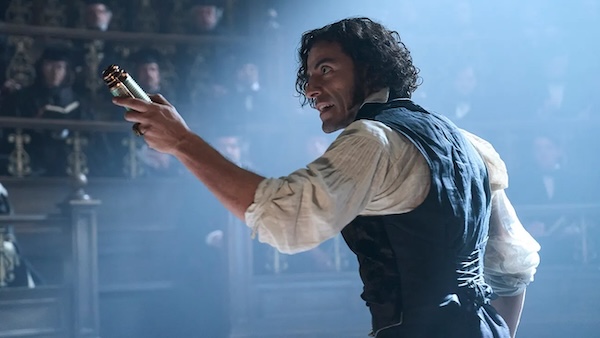
Oscar Isaac in Frankenstein. Photo: Ken Woroner/Netflix.
Like the little girl in The Spirit of the Beehive (1973) Guillermo del Toro saw James Whale’s Frankenstein as a child and it changed his life. “I saw the resurrection of the flesh, the immaculate conception, ecstasy, stigmata. Everything made sense,” he recalls in an interview with NPR. He decided then that the mad scientist’s creation would become his “personal avatar and…personal messiah.”
That image – of an innocent being forced to confront its isolation and its origins in a world of pain and cruelty – would shine through his best films, especially his masterpiece Pan’s Labyrinth (2006).
But not so much in his own remake of the original movie.
It is, like some other realizations of longtime cinema dreams, alternately magnificent, stunning, provocative, over-produced, exhausting, and fatuous.
To his credit, unlike most other adaptations of Mary Shelley’s 1818 novel (an exception of sorts being Kenneth Branagh’s 1994 version) del Toro tackles the novel’s multi-layered structure. Like the book, the film begins near the end – in this case, as the title card reads, “The Furthermost North, 1857.” Like the ill-fated Shackleton expedition, the Royal Danish ship Horizon has become trapped in the ice in its attempt to reach the Pole. The mutinous stirrings of the crew are interrupted by a distant explosion and they discover on the scene a wounded Victor Frankenstein (Oscar Isaac – in a dashing, Byronesque, hammy performance).
A terrifying bellowing in the distance signals the approach of a Grendel-like revenant who, in his pursuit of Frankenstein, dispatches a half dozen of the crew before the Captain cries out in a perhaps unintentionally comic moment “Bring to me the blunderbuss!” It blasts the creature off the deck but, Terminator-like, he keeps coming. With the last round the Captain blows a hole in ice, which cracks open up and swallows the monster up.
Meanwhile, the much battered Victor tells his tale (you’d think he’d pick up the pace after the crew spots the creature, still alive and mad as hell, circling outside). This version differs significantly from the Shelley original and the imagery switches from the stark frozen landscapes of a Caspar David Friedrich canvas to the vividly hued opulence of a Versailles-like palace (which begs the question: what country is this and what period?) where Frankenstein is being raised by his stern, Napoleonic-garbed surgeon father (Charles Dance) and his red-gowned, angelic mother (Mia Goth). His draconian dad beats him with a switch when he muffs his anatomy lessons and his beloved mother dies giving birth to happy-go-lucky and feckless brother William (Felix Kammerer), who becomes his father’s favorite. With this Oedipally complex background, no wonder Victor wants to put an end to death by creating a humanoid creature out of the parts of executed criminals animated by pseudo-scientific steampunk technology.
For that purpose he has the good fortune to make the acquaintance of Henrich Harlander (Christoph Waltz), who is a fabulously wealthy arms merchant making a killing out of the Crimean War. He can offer Victor unlimited financing and an endless supply of cadavers. He also sets Victor up in a phallic-towered castle that is among the set designs that exceed in opulence, weirdness, and chthonic horror some of the best work of H.R. Giger and Anton Furst. I especially liked the giant marble sphincter in the upper laboratory, a feature which demonstrates the Chekhovian tenet that if you have a giant marble sphincter at the beginning of a film someone has to be expelled through it by the end.
But, more to the point, Harlander embodies del Toro’s theme of the death cult of capitalism, with oligarchs making fortunes through murder and destruction in order to finance technology that will provide them with eternal life. Making this point even more explicit is Elizabeth (played also by Mia Goth!), Harlander’s limpidly beautiful and radiantly attired (Klimt by way of Vermeer) niece and William’s fiancée, who scolds Victor on the subject. No wonder the two hit it off (William seems none the wiser), a bit of perverse hanky-panky that adds a Marxist twist to the film’s Freudian subtext. At this point, the film began to remind me of Yorgos Lanthimos’s adaptation of Alasdair Gray’s Poor Things (2023), another Frankenstein-like tale overwhelmed by overwrought visuals and under-thought ideas.
Speaking of Freud, what of the creature (Jacob Elordi)? Kind of a nice guy, actually, when you get to know him. I think this is the only film adaptation that allows the creature to tell his story, as Shelley does in the original. At first, since this reiteration takes place about an hour and a half in, one’s first response might be weariness. But it turns out to be well worth the wait, the only part with genuine pathos and terror, drawing most intensely on the primal response del Toro himself had as a child at his first viewing of the James Whale version.
Though towering and mutilated like other versions, this latest incarnation of the monster is oddly androgynous, initially pale and hairless like the reptilian assassin Feyd-Rautha in Dune: Part Two (2024). But he also boasts the strength of the Hulk or del Toro’s own Hell Boy and the regenerative capability of Wolverine. Abused by Victor (like father like son!) when he fails to master any words beyond “Victor,” he really earns his creator’s Oedipal ire when he learns a second word, “Elizabeth,” responding to the latter’s attentiveness and compassion. Abandoned, he (or “it” as Victor calls him – pronouns are an issue here too) finds companionship with an old blind man, learns to speak and read, recites “Ozymandias,” ponders Paradise Lost, recalls his father’s treachery, and seeks revenge.
Who can blame him? An animal lover, attuned to nature, eager to serve others, shocked at injustice, pain, life’s essential loneliness, and the null heart of existence, he’s just like us, only more so.
Peter Keough writes about film and other topics and has contributed to numerous publications. He had been the film editor of the Boston Phoenix from 1989 to its demise in 2013 and has edited three books on film, including Kathryn Bigelow: Interviews (University Press of Mississippi, 2013) and For Kids of All Ages: The National Society of Film Critics on Children’s Movies (Rowman & Littlefield, 2019).
Tagged: Frankenstein, Guillermo Del Toro, Jacob Elordi, Mary Shelley
Uh…so what did you think of it?
need stars? two-and-a half.
I see you are not a scholar of the novel. Those bits you sprinkled in are easy to research. Del Toro did what most leave out, Victor’s reasons for being such a sociopath. Plus he took pains to linger on the Creature’s most important relationship: the blind grandfather. This film is not for the cheap thrills horror fan, nor the dopamine spiking action film fan. This is a thoughtful film about humanity and the lack of it in our world.
The strict father does not come from the novel, it was invented by del Toro.
And I really did think he turned it into an action film. He created fight scenes in the Antarctic, with hunters, with wolves, with William ‘s guests, which were not fun the novel.
It felt like the real reason he made the movie is that he wanted a monster which was both bad ass and completely justified.
The novel paints the violence as a tragedy which Frankenstein could have avoided but does not absolve the monster. And it’s a horror story not a gothic action one like the movie.
True about the father, But then Shelley preceded Freud by about a century. And also about the super-heroization of the characters and action scenes (Victor holds up well down to one Ahab-like leg after being repeatedly tossed about and bounced off walls like a cartoon character). But it’s in taking up the monster’s pov and adapting the novel’s interconnected narrative structure from that de Toro is most faithful to the original.
Review was was oddly written with no clear summary of how the critic felt. Final paragraph should summarize thoughts on the film instead of opining on what the creature felt. Is the movie any good? I surely can’t tell from this article
So “It is, like some other realizations of longtime cinema dreams, alternately magnificent, stunning, provocative, over-produced, exhausting, and fatuous” doesn’t work for you?
That’s the introduction, which is meant to tell the reader what to expect as you read onwards. The reviewer then proceeds to for the most part just sum up the story without a conclusion. If this were for a grade they would not receive full credit for missing key parts of the essay format. Simply saying in one sentence some vague and contradictory descriptions of the film without any receipts is just poor execution.
In other words, this review has very sloppy writing that fails to competently showcase why the work was “alternately magnificent, stunning, provocative, over-produced, exhausting, and fatuous” as the reviewer stated in their introduction.
I thought it was a work of art. And it was all I could do from containing myself. I was choked up.
Did you forget to finish writing your review?
As a film ADDICT since age 14 im now 65 I have noticed a wide opinion of films
Critics have always been over critical or non direct and of course opinionated. Imdb and the internet only made it worse. Just watch a film and try to let the director show you his vision. So often we buy into others opinions . Movies can be summed up simply. WERE you NOT entertained?? If you were then it did its job if it took you into the films world then its even a larger success.
My favorites might not be yours who cares . My top films are Wizard of Oz , The Thing (80s) Nosferatu BOTH versions , Mimic, tombstone, Titanic, Terminator 2, home alone 1&2, what dreams may come, Split, The Machinist, HITCHCOCK, life of Pi just to name a few!!
I too noted that this movie version (Apparently through the MAGIC of the heretofore uncredited Powers of The “Lymphatic System” in the human body) turns Mary Wollstonecraft Shelley’s “Creature” into a SuperHero-Strong AntiHero figure… not sure that I remember ANY of those details actually being a part of the Novel.