Film Review: Kelly Reichardt’s “The Mastermind” Turns Art Theft into Existential Drift
By Steve Erickson
“The Mastermind” points to the impossibility of trying to live as though the outside world and its politics don’t exist.
The Mastermind, directed by Kelly Reichardt. Begins screening at the Coolidge Corner Theatre and AMC Boston Common on October 24
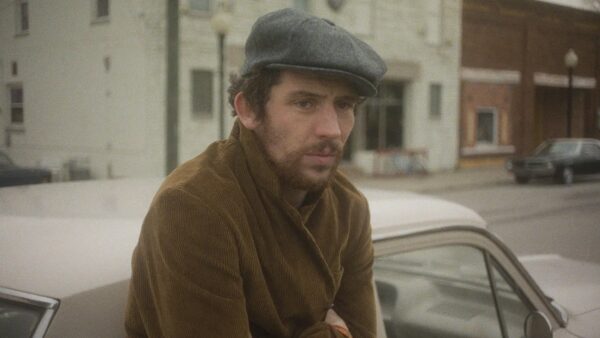
Josh O’Connor in The Mastermind. Photo: Mastermind Movie Inc
Set in Massachusetts in 1970, The Mastermind engineers a quiet rebellion for its protagonist, J.B. Mooney (Josh O’Connor). At first glance, J.B. has nothing in common with other young people of his time. Turning on, tuning in, and dropping out are the last things on his mind, though he’s unsatisfied with his family life. News reports about the Vietnam War constantly play in the background, but J.B. doesn’t pay attention to them. If he has an opinion on the war, he never speaks up about it.
J.B. brings his wife (Alana Haim) and two young sons to the Framingham Museum of Art for an outing. He’s blithely unconcerned with the art. Though everything looks innocent, he’s really there to make plans to steal four works by abstract painter Arthur Dove. (The museum is fictional, but Reichardt was inspired by a number of similar thefts.) Unable to find work as a carpenter, and reliant on his mother’s loans, J.B. figures that art theft may be his best chance to make a living. He and his accomplices make it out of the door with the pictures, but the group falls apart so quickly that the chaos becomes comic. J.B. is forced to ask for a favor from his father, a judge, so that he can go on the run and stay out of jail.
The Mastermind is a spiritual sequel to Kelly Reichardt’s 2013 Night Moves, in which the members of a hard-line environmentalist group break apart after blowing up a pipeline. The art robbery serves much the same purpose here. The events that follow send J.B. on the road but, as in Reichardt’s Old Joy, the trip’s pretty well stripped of any pleasure.
Reichardt points to Jean-Pierre Melville’s heist films as a source for The Mastermind. Melville’s distinctive robbery narratives stand at the crossroads between American film noir and the European art film of the ’60s. They are strangely minimalist, despite their genre trappings. Still, they retain the glamour of his Hollywood models: through his eyes, Alain Delon, Lino Ventura, and Jean-Pierre Belmondo looked even more chic. But, though aspects of Melville’s approach are in The Mastermind, Reichardt also looks back at the realism of New Hollywood. Most of all, she is not afraid to cast movie stars as ordinary working-class people, stripping away the performers’ charisma and sex appeal by upping their quotient of grubbiness. If they were in their 30s now, Dustin Hoffman or Elliott Gould might step in as J.B.
The locations of The Mastermind are an endless suburban backwater. Cincinnati is the biggest city on the journey. Grainy cinematography magnifies the grit of these marginalized settings without making them ugly. Unlike so many period pieces, the proceedings here never resemble a Halloween party — not even when J.B. is caught up in an anti-Vietnam War protest populated by hippies. Reichardt avoids obvious fashion choices, and uses little rock music. The film’s meticulous care for detail comes through particularly strongly in the scenes set in bus stations and hotels.
O’Connor’s performance might have relied on his sex appeal. Luca Guadagnino’s Challengers spins around the erotic tension between him, Zendaya, and Mike Faist. In The Mastermind, he has tamped down on his allure. Like the character O’Connor plays in Alice Rohrwacher’s La Chimera, he’s a fairly ordinary man who plays little mind to his appearance.
As many heist thrillers do, The Mastermind includes several scenes detailing J.B.’s actions. As he hides the paintings in the loft of a barn, a pig watches him, squealing and rolling around in mud. Staying in a hotel, J.B. tries to create a false passport by cutting out an old photo with an X-ACTO knife. J.B. is preoccupied by what he needs to do to make his way to his plan’s next stage. Jazz musician Rob Mazurek’s score rambles along, frequently pared down to his Chicago Underground Duo bandmate Chad Taylor, who performs solo on drums.
The subtext of The Mastermind traces a man’s dissatisfaction with middle-class family life. (After the robbery, one of his sons opens up the car door to vomit.) His use of his mother as a virtual ATM is mirrored by his even crueler treatment of an elderly woman. But, if he grasps just how alienated he is, it’s only on a subconscious level. Reichardt doesn’t supply an easy explanation for why his life, to him, feels so emptied out. The film’s critique is partly aimed at men’s Jack Kerouac-style mythologies of freedom, so often lived out at women’s expense. The ideal of the liberated male, usually bonding in free-roving groups, was common in the period the film is set. The Mastermind also points to the impossibility of trying to live as though the outside world and its politics don’t exist. The story slowly reveals how easily these ideas of escape can be turned into an excuse to treat others who get in your way like garbage, capped by an ironic surprise saved for the finale.
Steve Erickson writes about film and music for Gay City News, Slant Magazine, the Nashville Scene, Trouser Press, and other outlets. He also produces electronic music under the tag callinamagician. His latest album, Bells and Whistles, was released in January 2024, and is available to stream here. He presents a biweekly freeform radio show, Radio Not Radio, featuring an eclectic selection of music from around the world.
Tagged: "The Mastermind", Alaina Haim, Bill Camp, Hope Davis, Josh O'Connor