
Film Review: Dispatch From the New York Festival — “After the Hunt”
By Erica Abeel
After the Hunt churns up issues that feel several years behind the curve (hello 2007 and Harvey Weinstein).
After the Hunt, directed by Luca Guadagnino
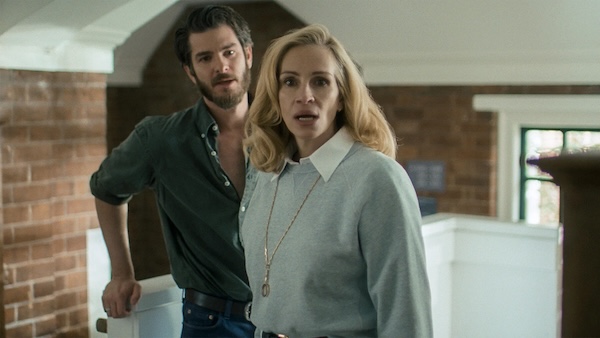
Andrew Garfield and Julia Roberts in After the Hunt. Photo: Yannis Drakoulidi/ Amazon MGM Studios
The characters in Luca Guadagnino’s After the Hunt feel more like a collection of figures signifying thorny issues than believable people. When the film bowed at this summer’s Venice Film Festival, its star, Julia Roberts, got her standing O, but viewers remained troubled by the murky messaging around #MeToo and cancel culture. You have to wonder why the film snagged the prestigious opening slot at this year’s New York Film Festival.
After the Hunt churns up issues that feel several years behind the curve (hello 2007 and Harvey Weinstein). With a conspiratorial wink at the viewer, the film’s opening titles are in black and white and the same font used by Woody Allen, listing the cast alphabetically and even borrowing his trademark jazzy score. It feels pointlessly provocative. The film’s over-busy plot suggests that a female PhD student at Yale who claims a prof assaulted her was perhaps overstating things. Hey, maybe you can’t believe hysterical women after all. Somewhere in the turgid script seethes a festering tale of male outrage over #MeToo at its peak — a subject not without dramatic potential. But that story would require taking a position and Guadagnino seems to want it every which way (in the process debasing Jean Renoir’s sublime comment “Everyone has their reasons.”) After the Hunt feels contrived chiefly to provoke conversation among the chattering classes.
The film opens with a soiree thrown by Yale philosophy prof Alma Imhoff (Julia Roberts) and her shrink husband (Michael Stuhlbarg). The guests include Alma’s colleague Hank (Andrew Garfield), who is touchy-feely around Alma in a way that raises alarms. Also on hand is Maggie (Ayo Edebiri), a promising PhD student and Alma’s mentee, who is Black, nonbinary with a trans partner, daughter of a billionaire donor to Yale, and “exploiting the cultural moment,” as someone says, even in a bastion of white male patriarchy. Oh, and did I mention she may also be hot for Alma? First-time screenwriter Nora Garrett has loaded Maggie with so many signifiers it’s a wonder she doesn’t collapse under their weight. She’s a bot concocted by group-think, not a credible character. (Maggie’s real life counterpart would likely be freaked that her field was about to be axed from the curriculum.) On top of all that, Edebiri’s innate likability is undercut when, in search of a john at the party, she snoops in a cabinet and discovers a news clip exposing Alma’s hidden past. She pockets it.
The set decorator for Alma’s living room might have been inspired by the funky burnished interiors of Woody Allen’s Hannah and Her Sisters. The camera waltzes about and dives in with in-your-face close-ups to cue viewers that we’re watching Art. The conversation is equally high falutin’, peppered with references to Hegel, Kant, virtue ethics, teleological (huh?) Heidegger! White cis men! As someone who has spent much time in academe, I remember the talk being more often about how to avoid committee meetings and the gift of teaching some wonderful students.
Comes the inciting incident: a liquored-up Hank leaves the party with Maggie and there’s a nightcap in her apartment. The next morning, Alma (affectedly pronounced Ahl-ma) finds Maggie huddled and shaken at the door of her apartment. The previous night Hank “crossed a line,” Maggie says, and assaulted her. She insists that Alma, who has reliably supported university women, take her side. But, in Hank’s version of the evening Maggie is retaliating because he knows she’s plagiarized her dissertation. So we’re back in the land of her word against his — though Maggie and Hank both seem a bit sus.
Guadagnino also appears to be referencing Claudine Gay, the Black woman president of Harvard forced to step down, also accused of plagiarism. (Frankly, in the age of AI it’s a less than vital issue.) Welcome to the tick-off-boxes school of filmmaking.
Hank gets fired and Alma’s tenure bid is threatened by her habit of swiping prescription pads from a campus therapist (Chloe Sevigny) to medicate a mysterious illness. In a late third act scene — set in Alma’s secret pied-à-terre — Hank resurfaces and tries to renew their old liaison, displaying a violent streak that further damages his credibility re Maggie. A clunky reveal from a hospital bed exposes the dark episode from Alma’s past that mirrors the crises in the present, but by this time we’ve ceased to care.
The actors are game professionals. Roberts is fun to watch, especially when she’s silent, her face reflecting her dilemmas and compromised past better than language. The usually excellent Garfield, all but leaping out of his unbuttoned shirt, cobbles together a fellow who might have gotten off the train to New Haven by mistake. Gifted young actor Edebiri shines through her misconceived character. Stuhlbarg amuses himself as Alma’s unloved husband. But Chloe Sevigny as campus shrink should sue the production for sticking her with the ugliest hairstyle of the year (a nod to the dowdiness of academe?).
The overkill of Hunt betrays the director’s insecurity about his ability to comment cogently on today’s culture. Key to its premise — but way implausible — is that Hank, on the verge of getting tenure, an academic’s promised land, would risk it all by hitting on a student. (How times have changed. In my alma mater it was considered cool to have an affair with a prof.) It also occurred to me that the film’s portrayal of campus life reveals a crypto, MAGA-ish conservatism. There are funny lines sprinkled in mocking the righteous earnestness of students who “nurse every blip of victimization” and “seek out” causes to be angry at. (Maybe with good reason.) The integrity of academic life may be endangered, but Guadagnino degrades it further, portraying the university as a playground for woke posturing by entitled kids.
One thing Guadagnino and scriptwriter Garrett got right: the center of Alma’s life is not problematic men, but, rather, her academic ambitions. And while Hunt is a misfire, I’ve enjoyed some of this filmmaker’s previous work. There’s the way he sees everything as sex. The way food is foreplay in I Am Love with Tilda Swinton and the hot chef. The way his camera celebrates men’s bodies: Armie Hammer’s ankles in that softcore tease Call Me by Your Name; Josh O’Connor, towel placed just so, in the sauna in Challengers. The way Guadagnino frames a tennis match as erotic combat. And dared to take on William Burroughs’s Queer. He’s also one of our most music-savvy filmmakers. I Am Love burst on the scene with the thrilling John Adams on the soundtrack. And of course Ravel’s Une Barque sur l’Ocean will ever belong to Elio and Oliver. In After the Hunt, though, the blurps and honks of the score by Trent Reznor and Atticus Ross function too often to goose a flagging narrative.
Occasionally, something authentic-sounding rises to the surface of this over-programmed film. After a reporter approaches Maggie, Alma warns her that if she presses charges she’ll become “radioactive … the system is run by white men…. Take the long view.” Maggie responds: “He just gets to get away with it? Am I not owed, allowed to speak out about it?” Alma: “you want vengeance, not justice.” We could have used more such moments.
Erica Abeel is a novelist, critic, and former professor at CUNY. Among her novels are Wild Girls, named a Notable Book by Oprah Magazine and now available on Audible; and The Commune, a comic satire on the launch of Second Wave Feminism that Kirkus called “a joyous literary romp with hidden depth.” Her forthcoming novel reimagines characters from Ingmar Bergman’s Smiles of a Summer Night.