
Concert Review: Junction Trio Journeys Through the Demanding Sonic Terrain of John Zorn
By John Tamilio III
The Junction Trio offered the coolest show in town — an afternoon of experimental music that highlighted their virtuosity as individual players and as a unit.
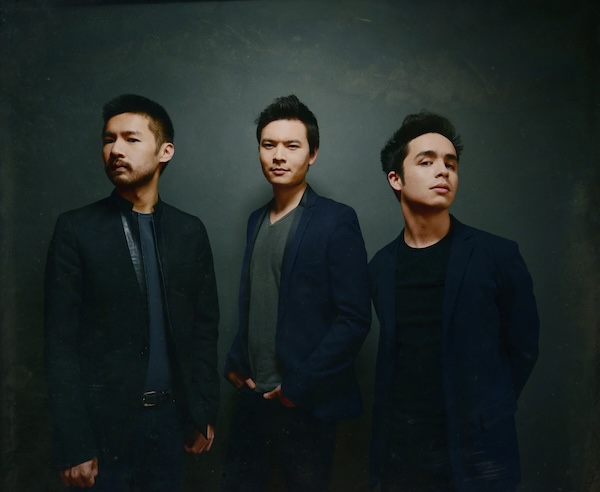
The Junction Trio. Photo: courtesy of the artist
Patrons on all four levels of Calderwood Hall at the Isabella Stewart Gardner Museum were treated to a dazzlingly stimulating concert on September 21, when the Junction Trio performed five selections written for the group by composer John Zorn, an avant-garde musician hailed by Rolling Stone as “one of the most influential musicians of our time.” Written to highlight the trio’s virtuosity, these works interweave classical textures with improvisational jazz. They lived up to their description in the program: Zorn is a “superb composer of fierce and evocative classical music.” George Steel, the museum’s Abrams Curator of Music, claimed in his introduction to the performance that this was “the coolest show in town today.” He may well have been right.
Junction Trio features Conrad Tao on piano, Stefan Jackiw on violin, and Jay Campbell on cello. The group’s first two offerings (the Boston premiere of “Philosophical Investigations I” and “II”) contained, as did all of the afternoon’s compositions, discordant crashes countered by harmonic lulls. Between these polarities, the trio meandered through strange sonic terrain. Like a philosophical inquiry that ends in alarming perplexity, the music would suddenly seem to panic: notes jumped up the full scale of the piano keyboard while the cello simulated a siren.
Along with these sirens, the trio intimated the sounds of everything from spine-chilling creaking doors to reassuring bird calls. The result was a pensive, yet exuberant, tapestry of intermingled sounds. It was fitting that this concert was held in a museum; the emotions evoked resonated with the paintings of Edvard Munch, Leonora Carrington, and René Magritte. At other times, the deafening, cacophonous, atonal crashes on the piano functioned like jump-scares in horror films.
As a professor of philosophy — one with a penchant for the dialectic — I am sensitive to the ways in which meaning is unearthed via juxtaposition. Moments of well-tempered, melodic passages quickly devolving into chaos suggested that the overarching meaning of these “philosophical investigations” was more about appreciating the power of method (and its execution) than the rewards of traditional musical expression.
After a quick breather (the performance lasted an hour without an intermission), the trio was joined by Jorge Roeder on upright bass and Ches Smith on drums. Smith ignited “I Am Your Labyrinth” with a serpentine rumble of drums. He feverishly switched between drumsticks, mallets, and brushes multiple times mid-song, highlighting the composition’s experimental energies. Steel mentioned that these two additional players would improvise over Zorn’s compositions. Because of the pieces’ eclectic nature, it was difficult to discern when the improvisations occurred. Smith took full advantage of his four-piece kit, even playing the shell of his kick drum. This frenzied creativity was mirrored by Tao, who, at various intervals, would mute or strum the Steinway strings by hand. Likewise, Roeder painted an almost surreal, atmospheric impression by creating a stretched-rubber-band effect by manipulating his instrument’s strings.
Early in “Labyrinth,” the (now) quintet cloaked a bossa nova beat with “organized” chaos. The musicians’ attack was tight, at first accentuating the restraint of the pace and then becoming loud, expressive, and exuberant. This selection, along with the first two numbers, was being performed in Boston for the first time.
“Labyrinth” was the only number that featured these additional rhythmic musicians. The world premiere of “But Doth Suffer a Sea-Change,” inspired by a line from William Shakespeare’s The Tempest, followed. The trio embarked on an excursion not unlike portions of “Philosophical Investigations.” Trilling climbs segued into a delicate dance that summoned fear out of stillness. Plucked staccato notes from the string players marked decisive turns in the composition.
During “Sea-Change,” I became acutely aware of Jackiw’s command of the violin. It seemed to be an extension of his slim body. His quick, vivacious, and adroit technique dramatized the see-sawing of “Sea-Change” perfectly: his meticulously skipped half-steps accented the ascending and descending flourishes of the music. Undergirded by Campbell, the trio fused steel and elasticity. The performance perfectly encapsulated the dichotomous spirit of Zorn’s compositions. The music was foreboding yet pacifying, intelligent yet unstable, anticipative yet terrifying.
The final selection boasted a great title for a musical composition: “Notes on the Assumption of Mystical Solidarity Approaching Nine Neological Approximations Illuminating the Eternal Return of the Same.” It could be the name of a Dream Theater album, but the title is a reference to Friedrich Nietzsche, an allusion to what philosopher David Rowe claims is the German philosopher’s “tension between the cosmological and the anthropological reading of the eternal recurrence,” the concept that a life lived forever would mire us in an infinite loop.
One wonders what that life would look and feel like. Here it is possible to imagine what it would sound like: a continuous 7/8 time climb that is transformed into Western saloon music before it trips back into a rapid, robust, yet somehow melancholic rhythm. A succession of quibbling, quicksilver jingle-jangles brought “Eternal Return of the Same” to a close with a rapid punch.
So yes, I think Junction Trio offered the coolest show in town — one that highlighted their virtuosity as individual players and as a unit. The musicians’ extraordinary command of their instruments is undeniable — it is breathtaking to behold. Not all of their repertoire is as abstract as the set played at the Isabella Stewart Gardner Museum. Their skill is also evident in their performances of works by traditional composers such as Beethoven, Schumann, and Ravel. The only drawback to watching this performance of Zorn’s experimental music was that, as a critic, I found myself scribbling furiously in my notepad, more quickly than I normally do. I was afraid I would miss something, and that would not be cool.
John Tamilio III, Ph.D., is the Pastor of the Congregational Church of Canton, a professor of Philosophy at Salem State University, and a professional guitarist who plays solo acoustic and for the Boston-based classic rock band 3D. His playing has been applauded by David Brown (Simon & Garfunkel, Billy Joel), Jack Sonni (Dire Straits), and Carter Allen (WZLX). An aficionado of classical music, particularly the Baroque era, Tamilio’s publications are vast, covering not only music, philosophy, and theology, but the poetry of T.S. Eliot as well. He resides in Beverly with his wife Cynthia.
Tagged: Isabella-Stewart-Gardner-Museum, John Zorn, Junction Trio