Concert Review: Do the Reggae Tour — Two Icons, One Uplifting Night
By Scott McLennan
The cross-generational Do the Reggae Tour suggested that reggae’s creative trek is far from over.
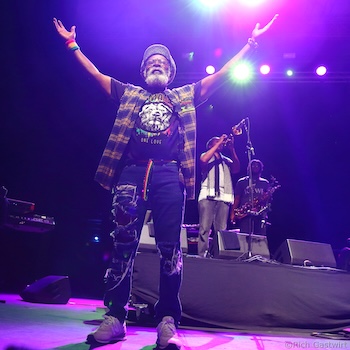
Burning Spear performing in the Do the Reggae Tour. Photo: Rich Gastwirt
The Do the Reggae Tour brings together a revered elder and a leading emissary to demonstrate the continuing power of Jamaica’s greatest musical export. Burning Spear, now 80, and Ziggy Marley, who picked up the mantle of his legendary father and successfully ran with it, brought their expansive and moving show to Leader Bank Pavilion in Boston on September 25.
Spear and Marley were not pushing new material; instead, both drew from their respective deep wells.
The animated and feisty Spear reminded the crowd that he began his musical journey in 1969, and he crafted an hourlong set that noted various stops along the entire journey. He and the seven-piece Burning Band opened with “Door Peep,” one of Spear’s early signature tunes, giving it a meditative workout that swirled around the tune’s invocation to “give thanks and praise.” Spear also took the first of his several conga solos during the song.
Though Spear claimed he was retiring in 2016, he has not only kept up a fairly active concert schedule, but he also released the studio album No Destroyer in 2023, from which he pulled the song “Jamaica” into his concert repertoire.
Spear seamlessly mixes and matches the songs in his musical evolution into a signature blend of groove and chant. Songs circle the themes of Rastafarian spiritualism as well as the fight against oppression. The Burning Band adds texture to the messages, peppering in horn solos, feedback-laced guitar jams, and rock-steady rhythms. But it is Spear himself, singing with deep conviction and dancing with youthful joy, who remains the focal point of the show, its driving force.
Spear closed his set by running through some of his contributions to the canon of classic reggae, including “Call on You,” “Old Marcus Garvey,” and “African Postman.”
Ziggy Marley proved himself to be a natural performer and musician when he was a preteen. In 1979, he started fronting the Melody Makers — the band made up of him and his siblings. The group was launched in earnest not long after Bob Marley’s death in 1981. From that point on, Ziggy Marley has presented his father’s music alongside his own original material, which builds on the roots reggae cornerstones the Marley patriarch helped to lay down.
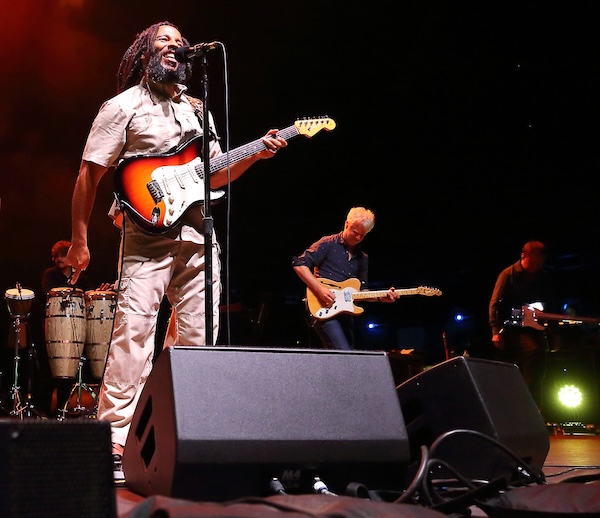
Ziggy Marley performing in the Do the Reggae Tour. Photo: Rich Gastwirt
Ziggy Marley has been performing such classic Bob Marley and The Wailers tracks as “Jammin’,” “Is This Love,” and “Get Up, Stand Up” for longer than his father did. He has remained true to the spirit of the music, as well as the arrangements of the original versions.
Such was the case when Ziggy Marley launched his set Thursday with the Bob Marley and the Wailers’ upbeat, spiritual “Three Little Birds.”
Bob Marley caught some critical flack when he started infusing pop sentiment into the revolutionary songbook he assembled with his band The Wailers. His eldest son has proven over the course of his own career the undeniable artistic merit of airing both the struggle and the celebration together under the reggae umbrella.
Marley and his nine-piece band paced their set carefully, starting at a high, happy place by stringing together “Beach in Hawaii,” “High on Life,” the Melody Makers’ “Tomorrow People,” and The Wailers’ “Positive Vibration.” The mix was uplifting, encouraging, and at times, sultry.
Then Marley shifted to a more militant stance, first declaring the necessity of having all people be free and then arguing the need for revolution whenever people cannot be liberated from oppression.
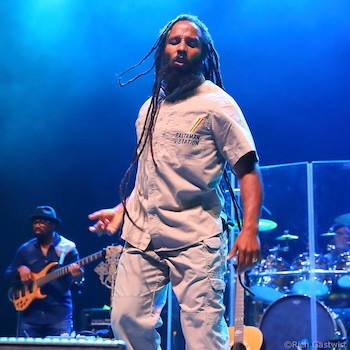
Ziggy Marley performing in the Do the Reggae Tour. Photo: Rich Gastwirt
In this segment, Marley started with his own “Be Free,” which turns the simplest of slogans — “Freedom is good for us” — into an inspiring raison d’être. He turned up the heat slowly as he worked through “Personal Revolution” and “See Dem Fake Leaders,” before launching into the full-scale call to arms boomed in a Wailers medley made up of “Get Up, Stand Up,” “War,” and “No More Trouble.”
With “We Are the People,” Marley brought us back to the world he wants to live in, one rooted in love and shared humanity. Marley’s effervescence lifted up his father’s anthems “One Love” and “Jammin’” (done complete, with the members of the band supplying rounds of solos) along with the originals “Circle of Peace” and the Melody Makers-era hit “Look Who’s Dancing.”
Marley’s encore reading of “Drive” by The Cars landed particularly well in that band’s hometown. Once again, Ziggy proved that an intersection of reggae and pop can be a very satisfying stop on a longer journey. The cross-generational Do the Reggae Tour suggested that reggae’s creative trek is far from over.
Scott McLennan covered music for the Worcester Telegram & Gazette from 1993 to 2008. He then contributed music reviews and features to The Boston Globe, Providence Journal, Portland Press Herald, and WGBH, as well as to The Arts Fuse. He also operated the NE Metal blog to provide in-depth coverage of the region’s heavy metal scene.