Festival Review: A Somewhat Soggy Seisiun at Suffolk Downs
By Paul Robicheau
The Pogues leaned on their instrumental breadth when they took the Suffolk Downs stage as an eleven-piece ensemble augmented at times by guest singers and a three-piece horn section.
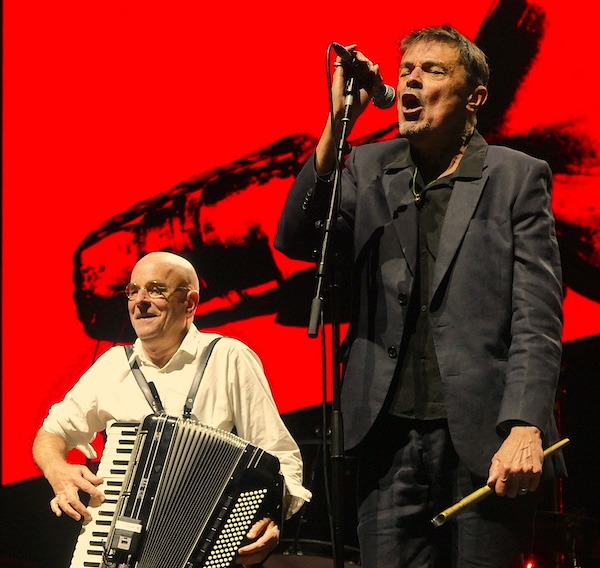
James Fearnley and Spider Stacy of the Pogues at Suffolk Downs. Photo: Paul Robicheau
After weeks of gorgeous weather, wouldn’t it figure that rain would mar the past weekend’s Irish-themed Seisiun – a successor to the late ’90s Fleadh fest that likewise hit Suffolk Downs – like a forecast from the British Isles.
A three-hour storm evacuation split Saturday’s first of two days of Seisiun, causing Boston’s own Celtic punk-rockers the Dropkick Murphys to go on late, the Hold Steady to shorten its set, and Stiff Little Fingers not to play at all. And Sunday wasn’t exactly dry through its first half, making one wonder if the blank stares on the faces of young Irish upstarts Just Mustard and Cardinals reflected post-punk attitude or chagrin at scant early attendance in the damp conditions.
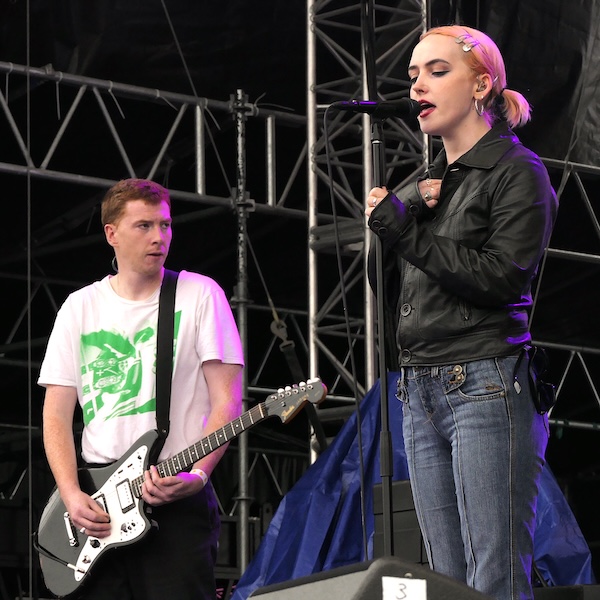
David Noonan and Katie Ball of Just Mustard at Suffolk Downs. Photo Paul Robicheau
Just Mustard could have used more mustard in the scraping guitar noises that iced the bassy anchor to Katie Bell’s detached vocals, while guitarist David Noonan’s shouted lead in “Deaf” sealed a clear Pixies comparison. Cardinals shared more dynamic depth around its odd blend of accordion and guitar (in the respective hands of brothers Finn and singer Euan Manning), peaking in the brooding/eruptive closer “If I Could Make You Care.”
Then, lo and behold, the weather over Suffolk Downs gradually cleared for Sunday’s triumphant return of the Pogues (the London group’s first local show in two decades) after the dependable Glen Hansard and the soul-searching Waterboys, though the emphasis there was on the searching.

Glen Hansard at Suffolk Downs. Photo: Paul Robicheau
“Hopefully the Waterboys are on that flight,” Hansard mused at one of the planes flying over the back edge of the East Boston racetrack into Logan Airport, saying he was forced to switch spots with the yet-to-arrive band. The low planes (which weren’t overly distracting amid the rocking music) became a running joke for Hansard, as he’d call out the names of the various airlines that glided by – often in the middle of song lyrics.
If anybody thought Hansard might have lost some of his edge through the crossover success of his Swell Season duo with ex-lover Marketa Irglova, they underestimated his instinctive zeal as a seasoned performer. Fronting a quartet, he began with an impassioned “Fitzcarraldo” by his old rock band the Frames, joined by a fiddler and whistle player that he’d invited from a mid-field step dancing stage sponsored by Canton’s Irish Cultural Centre. He later segued from an a cappella roll through the traditional “Rocky Road to Dublin” to the electric verve of another Frames number, “Revelate.”
Before “American Townland,” a song about war that name-drops Israel and Palestine in a call to “stop fighting for your gods,” Hansard told the growing audience that some of its lyrics were questioned in his visa renewal as not aligning with the U.S. president. “I’m a folk singer, I’m a jester,” he said. “I’m allowed to slag the king.” Marking the recent 80th birthday of countryman Van Morrison, Hansard ended with a roar through Morrison’s Them-era anthem “Gloria,” setting the stage for a hopeful Waterboys arrival.
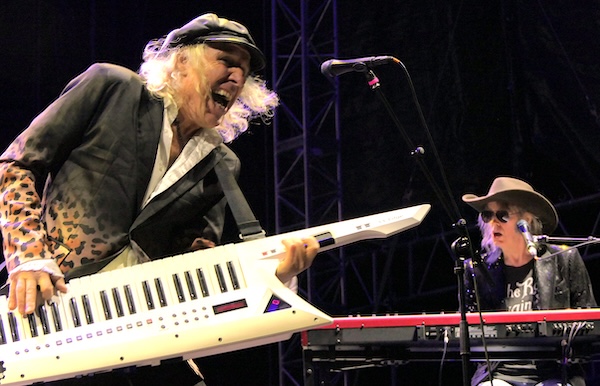
Brother Paul Brown with Mike Scott of the Waterboys. Photo: Paul Robicheau
The Waterboys proved more than worth the wait with an hour-long set built on mid-’80s classics (rather than a strange new album inspired by actor Dennis Hopper), leader Mike Scott looking a shade gaunt but bristling with energy. After an opening flourish of “Fisherman’s Blues,” when Scott found he couldn’t switch to electric guitar due to a technical glitch, he stuck to his acoustic, swinging “A Bang on the Ear” into an extended hootenanny.
Throughout the set, the Scottish singer rearranged his songs to let them breathe to the power and personality of the musicians and instruments in this colorful five-piece edition of the Waterboys. For “A Girl Named Johnny,” that meant letting organist Brother Paul Brown scamper around the stage, brandishing a keytar like a wayward guitar hero while Scott manned James Hallawell’s piano. And “This is the Sea” unfurled so beautifully, it nearly overshadowed “The Whole of the Moon,” which evolved into a singalong before Scott donned a working electric guitar to rock “Medicine Bow.”
Dissipating clouds revealed a glow of sunset colors, though expectations for the Pogues were tempered by the absence of poetic if hard-living frontman Shane MacGowan, who died in 2023. However, few people may remember the original Celtic punks’ expansion into other world-music styles in the late ’80s (or that MacGowan was kicked out in the early ’90s for his substance abuse issues, replaced for a spell by the Clash’s Joe Strummer).
So coming to the U.S. on the 40th anniversary of the seminal album Rum Sodomy & the Lash, the Pogues leaned on their instrumental breadth when they took the Suffolk Downs stage as an 11-piece ensemble augmented at times by guest singers and a three-piece horn section. And for a group that garnered a ramshackle reputation, it was startling how the moving pieces fit together so tightly, almost suggesting a professional theater production, with everybody dapperly dressed in black and white.
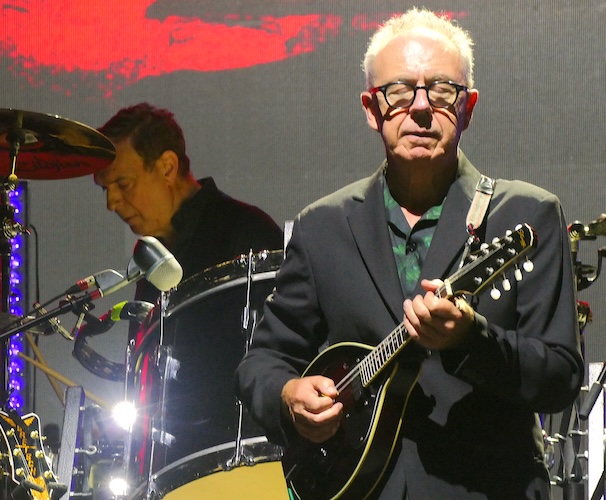
Jim Sclavunos and Jem Finer of the Pogues at Suffolk Downs. Photo: Paul Robicheau
At the core were original members Spider Stacy (wielding his tin whistle and taking the first lead vocal for a romping “The Sick Bed of Cuchulainn”), accordionist James Fearnley and multi-instrumentalist Jem Finer, who took turns on banjo, mandola, and the hand-cranked hurdy gurdy. But there were also ringers aboard in Pretenders guitarist James Walbourne and the Bad Seeds drummer Jim Sclavunos, whose arsenal included a mounted bass drum that he thumped with a mallet as the Celtic harp player Iona Zajac brought her lilting soprano to “I’m a Man Who Don’t Meet Every Day.”
Guest Lisa O’Neill brought her pointed, reedy voice to “Dirty Old Town” (Stacy teasing her after its lyric about kissing a girl) and “A Rainy Night in Soho” with mixed success. But Zajac sang a lovely rendition of standard “The Parting Glass,” which Stacy dedicated to MacGowan, in a duet with John Francis Flynn, who later slayed with a sparse, resonant “And the Band Played Waltzing Matilda.” Both O’Neill and Zajac joined Stacy for a romping “London Girl,” before curfew came calling for a true last dance, a communal dash through “Sally MacLennane,” cut by rat-ta-tat snare drum. “I’m sad to say, I must be on my way,” Stacy and company sang, and the assemblage both onstage and off walked away into the post-misty night.
Paul Robicheau served more than 20 years as contributing editor for music at the Improper Bostonian in addition to writing and photography for the Boston Globe, Rolling Stone, and many other publications. He was also the founding arts editor of Boston Metro.
Tagged: Cardinals, Dropkick Murphys, Pogues, Seisiún, Stiff Little Fingers