
Classical Album Review: The Complete Dunbar/Moore Sessions
By Jonathan Blumhofer
Baritone Will Liverman is emerging as a musician with a capital “M,” one whose thoroughgoing approach to the craft is singularly illuminating, inviting, and affecting.
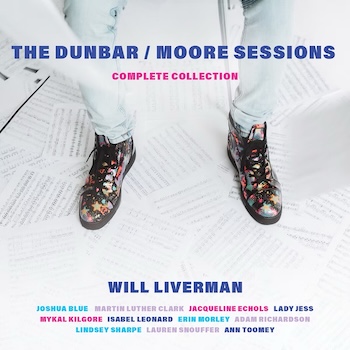 How is it that no major composer of art songs—Schubert, Schumann, Brahms, Fauré, Wolf, Strauss, Mahler, Britten, or Rorem, to name but a few—was also a singer? In pop music, it goes without saying that vocal acts have some hand in creating (or at least arranging) the music they perform. For better or worse, though, that situation rarely obtains in the classical realm.
But Will Liverman is out to change the status quo. He’s perhaps a surprising choice for the task, given, as is related in the liner notes for the baritone’s album The Complete Dunbar/Moore Sessions, an early aversion to lieder and no formal training as a composer. (Volume 1 of Dunbar/Moore came out in 2023, Vol. 2 earlier this year.) Yet the latter isn’t necessarily a hindrance—see the life and career of George Gershwin—and, as for the former, well, tastes can change.
Besides, the primary ingredients for writing a successful song are pretty straightforward: a thorough understanding of the instruments involved, a strong musical point of view, and good lyrics. In selected poems by Paul Laurence Dunbar and Alice Dunbar-Nelson, Liverman’s got the latter. As for the first two requirements, his background and experience as one of today’s most compelling and thoughtful singers ensures that his musical chops are up to the task.
More than that, in fact: his ear is attuned to all sorts of musical reference points, a fact attested to both by the songs’ allusions to myriad genres and the lineup of talent Liverman’s enlisted to sing and play on the recording. Among the last are the expected operatic voices—but also Broadway’s Mykal Kilgore and Beyoncé’s go-to violinist, Lady Jess. Liverman does double-duty as vocalist on some tracks and pianist on all of them.
Impressively, his writing for piano is never short on ideas; at its best, the part brings a Schumann-esque depth to the proceedings. There is, for instance, the rich, lovely utilization of accompanimental dissonance over the course of Dunbar’s “Life’s Tragedy.” A highlight of Liverman’s setting of Dunbar-Nelsons’ “If I Had Known” is its unexpectedly impassioned keyboard interlude. Meanwhile, the swaggering riffs in the powerhouse “Emancipation” call to mind an AME church service in full swing.
The vocal component in these sixteen numbers is, expectedly, assured though rarely predictable. For one thing, Liverman knows how to showcase the voice intelligibly across its full range. Unlike, say, in Beethoven, when high-tessitura writing happens in these numbers—and sometimes it arrives out of the blue—the vocal line never sounds strained and you can still make out the words.

Soprano Erin Morley and baritone Will Liverman. Photo: Facebook
Liverman’s also got an utterly natural sense of how to set a text. This tendency is demonstrated in various ways, from the ruminative “Farewell” (sung by soprano Erin Morley), with its shapely rhythmic and harmonic profile, to the stark contrasts of tone and mood found in “Love and the Butterfly” (which features Joshua Blue). “A Golden Day” fuses elements of folk song, hymnody, and jazz with an ease that flatters Lauren Snouffer’s voice as much as it calls to mind André Previn on a good day.
And, while a certain eclecticism is a hallmark of these songs, Liverman has ultimately staked out some distinctive compositional terrain in his settings. He’s a composer who clearly thinks about what he’s doing and why. Nods to musical theater and gospel music, say, are just that: never cheap, always thoughtfully abstracted. Individual moments—like the lightly tripping, R&B-worthy melismas in “The Lesson” (a radiant duet between Liverman and Martin Luther Clark) or the hints of fiddle music from Lady Jess in “Good-night”—stand out for their discretion and ingenuity. All of that aids the larger set in adding up to at least (if not more than) the sum of its parts.
In fact, Dunbar/Moore calls to mind another 20th-century African American poet, one I hope Liverman sets before long. “I, too, sing America,” Langston Hughes declared in 1926. Here, with a little help from his friends, Liverman’s fulfilling the injunction. Along the way, he’s emerging as a musician with a capital “M,” one whose thoroughgoing approach to the craft is singularly illuminating, inviting, and affecting.
Jonathan Blumhofer is a composer and violist who has been active in the greater Boston area since 2004. His music has received numerous awards and been performed by various ensembles, including the American Composers Orchestra, Kiev Philharmonic, Camerata Chicago, Xanthos Ensemble, and Juventas New Music Group. Since receiving his doctorate from Boston University in 2010, Jon has taught at Clark University, Worcester Polytechnic Institute, and online for the University of Phoenix, in addition to writing music criticism for the Worcester Telegram & Gazette.
Tagged: "The Complete Dunbar/Moore Sessions", Lexicon Classics