
Book Review: “Film Noir” — Taking an illuminating Walk on the Dark Side of Cinema
By Matt Hanson
Film noir’s penetrating, knowing diagnosis of, and response to, corruption and venality prepares us for the dank turpitude that lurks in places both highfalutin and hidden.
Film Noir by Alain Silver and James Ursini. Taschen Books, 648 pages, $25
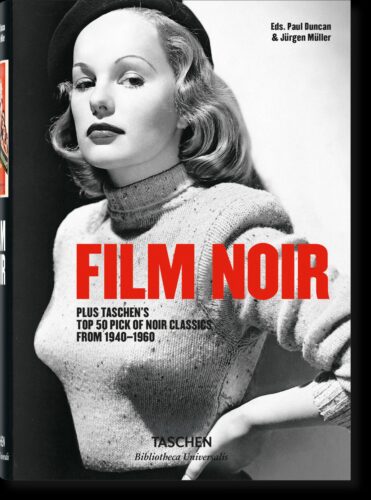 Given the consistently scandalous headlines these days, filled with proclamations that our institutions are steeped, both high and low in corruption — with corporations and their political pawns taking the lead — paranoia and fatalism fester in the increasingly polluted air we breathe. Maybe it’s the same as it ever was, at least if you take a look at classic movies for signs of the American collective unconscious. It seems that film noir is the genre that tells us most directly how rotten it all was and is.
So it might be a good time to refresh our understanding of noir’s crepuscular aesthetic, to take in the pools of shadow and bursts of harsh light the genre sheds on the human condition. Taschen Books, which has published many colorful and droll tomes about high quality cinema, has released a lovingly curated new collection of essays and images probing the depths of the noir canon. The volume also includes a solid list of top 50 titles well worth investigating.
Chapters group a selection of films under a particular noir trope, be it lovers on the run or the burden of the past. The reader can explore the group of films that relate to each topic, which is a clever way to present the topic to the newcomer. This is the kind of book you should give to a budding cinephile to show where the inspirations for so many of today’s dark and dirty films can be found.
On top of that, it’s a handsome volume, with plenty of information about the usual suspects—Sunset Boulevard, The Maltese Falcon, Double Indemnity, The Third Man, Kiss Me Deadly, and such. Original movie posters, with their aggressively pulpy textures, vie for attention with candid, behind-the-scenes snapshots of various actors and directors on set. The best of all: the vivid, crystalline film stills with their stiletto sharp contrast between light and dark. The visuals make a thematic point: noir’s interplay of light and darkness matches, and subtly comments on, the moral quandaries of the genre’s inevitably trapped characters.
Noir is nothing if not fatalistic, but it doesn’t always get to the same dead ends by the same routes. There’s more variety in terms of characterization than you might expect. Sure, there’s plenty of femme fatales and romantic suckers falling victim to the latter’s haughty charms. What we shouldn’t underestimate is noir’s sneaky romantic streak, the nearly inseparable, enticing ingredient in the cocktail. Cities tend to get a bad rap, and noir contributed to that image of decadence — but they do sure glitter beautifully in the right dusky light.
Some of the films included here feature sincerely loving couples, as in Gun Crazy (whose beret-clad heroine gets the cover treatment) or They Live By Night. F. Scott Fitzgerald (who had ambivalent feelings about Hollywood) would have appreciated Burt Lancaster’s hero in Criss Cross, victimized by his lovelorn idealism. And the charismatic way the great Robert Mitchum shrugs when says “Baby, I don’t care” in Out of the Past says everything about who he is, and how ironic the statement might ultimately turn out to be. Who said being in love means you have to play by the rules?
The noir woman isn’t always just a black widow, though they’re often certainly that. As the book’s essay on women in noir emphasizes, they are also endowed with real power and agency, which anticipates — and encourages — the generational shifts in gender roles to come. Even if men’s ability to run the world depends on curtailing female freedom and possibilities, there’s a lot women can and will do to strike back.
In the 21st century we’re much less worried about what is appropriate and anything you want to see is instantly available via a click, anytime, anywhere, instantly, and often for free. What can noir teach us in a compulsively exhibitionist era? That, in terms of transgression, its sexier, more disturbing, and ultimately more effective to be made to read between the lines. Even if the puritanical Hayes Code demanded the illicit be hidden. All those carefully poised cigarettes and guns and hats and high heels–all of which are given loving attention in the collection’s photography—are insinuating otherwise indecent intentions.
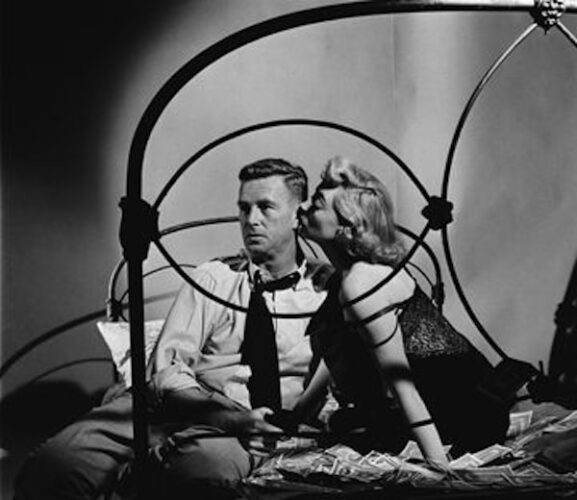
Sterling Hayden as Johnny Clay and Marie Windsor as Sherry Peatty in 1956’s The Killing. directed by Stanley Kubrick.
Naturally, there are several chapters revolving around various forms of criminality: focusing on “the perfect crime” and “the private eye” and “docu-noir” and the abstractly termed “darkness and corruption.” Then and now we don’t believe that the good guys will win anymore. In the ’40s, when noir was just starting to hit its stride, we were flush with out victory over fascism. With that triumph came a wariness about what made it happen in the first place. WWII was a noble cause, to be sure, and the profound suffering and sacrifice was powerfully acknowledged. What noir invites us to do is take a step back and ask some uncomfortable questions about the nihilism driving the conflict: what does the mass psychosis, war crimes, and organized murder say about the dark heart of mankind?
It is not surprising that many of the great directors who made these films (Billy Wilder, Otto Preminger, Robert Siodmak, Fritz Lang et al.) were emigres from fascist Germany. Wilder once sardonically cracked that the cynics ended up playing tennis in LA while the optimists died in the camps. Naturally these filmmakers drew from on the sour romantics of American literature, such as Raymond Chandler, Ernest Hemingway, James M. Cain, and Dashiell Hammett for source material. Also worth noting that a lot of noir cinema debunk the clichéd, pompous notion that the book is usually better than the film.
Grimy as it can be, noir is a paradox. It doesn’t soften the bleaker aspects of existence but exudes an undeniably glamorous quality. Mitchum, Lancaster, Bogart, and the underrated Sterling Hayden became icons because they were able to tap into a uniquely stylish stoicism. Vulnerable without becoming mere victims, these guys knew how to lose with a relaxed panache, to keep cool in a fervid world. The vision is of grace-under-mortality: these knock-around guys acknowledge that they’re screwed, that we’re all screwed, that we’ve always been screwed from the start — which doesn’t mean you can’t deliver a knowing wisecrack or two and look good doing it.
Nonchalance in the face of doom makes fated defeat poetic, sexy, even virtuous, in a slyly ironic way. Noir’s penetrating, knowing diagnosis of, and response to, corruption and venality prepares us for the dank turpitude that lurks in places highfalutin and hidden. This anything-but-innocent attitude might come in handy as we struggle to find a way to survive these ever darkening times.
Matt Hanson is a contributing editor at The Arts Fuse whose work has also appeared in The American Interest, The Baffler, The Guardian, The Millions, The New Yorker, The Smart Set, and elsewhere. A longtime resident of Boston, he now lives in New Orleans.
2 Comments
Leave a Comment
Is that really a “sincerely loving couple” in Gun Crazy? I don’t think so. Peggy Cummins is neither sincere nor loving. More accurately, the kids in They Live By Night are one of the VERY RARE sincerely loving couples in “film noir.” I would also argue with including Sterling Hayden among the actors exhibiting “stylish stoicism.” The Hayden I know is always exploding from the inside, a victim of his angry emotions.
There’s something about noir and you sure know it.
Regardless of whether you agree with the choices, I think this YouTuber feels and loves noir in the way you do. Thanks for a great read.
https://www.youtube.com/watch?v=VuRtpvPP2cQ