Television Review: “King of the Hill” — Nicely Rebooted
By Sarah Osman
The targets of King of the Hill’s satire have changed — as Texas culture has changed — but the relationships, and who the characters are at their core, have not.
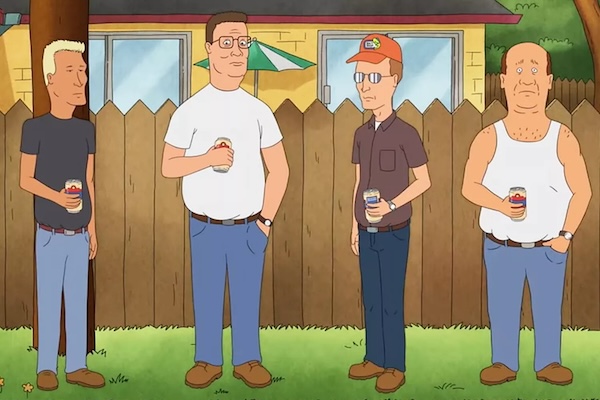
Boomhauer, Hank Hill, Dale, and Bill on King of the Hill. Photo: Hulu
No one was surprised when Michael Patrick King dropped the bombshell that the ill-fated Sex and the City reboot, And Just Like That, was canceled. The series was panned by many because of its shoehorned diversity, meandering plotlines, and phrases like “comedy concert” and “polysexual.” The biggest affront was how different the protagonists had become. Gone was the outspoken, straight-to-the-point Miranda; she was replaced by a pod person who claimed she was in a romcom. Charlotte had been reduced to a wide-eyed, shrieking Stepford wife, while Carrie wandered around in a perpetually aloof state (granted, if my husband died via a Peloton, I probably would too). And Just Like That quickly became a model for how not to do a reboot.
The new season of King of the Hill on Hulu is ying to And Just Like That‘s yang — it is how a reboot should be done. The satirical cartoon, which originally aired from 1997 to 2009, parodied Texan culture yet somehow managed to keep its heart intact. Every episode boiled down to Hank’s family doing something that embarrassed him or Hank humiliating himself somehow, but King of the Hill used that elemental hobby horse to cleverly address issues of gender, race, and class in the Lone Star State.
The reboot, or really the continuation, of King of the Hill still parodies Texas culture. Times may have moved along, and the characters have grown older, but they still behave in ways that reflect their familiar small-mindedness. Since we’ve last seen the Hills, Hank and Peggy have moved to Saudi Arabia, where Hank works on propane and propane accessories. Living in an Arab country hasn’t changed them that much because the old neighborhood was a Texas suburb. Peggy now tries to speak terrible Arabic instead of Spanish, and Hank actually likes soccer, an affection that turns into one of the season’s best running gags. Meanwhile, Bobby is now the chef of a German/Japanese fusion restaurant and has turned into a kind, though awkward, southern gentleman. The Hills’ neighbors are more or less the same; Boomhauer, now wrinklier, is the same mumbly guy with a mumbly stepson; Bill has let himself go, and Dale remains a conspiracy theorist. But his behavior has become much more concerning since Trump took office. The conspiracy theories in his Substack — suspicious of the government and the pandemic — are eagerly accepted by others in the show. On top of that, Dale is somehow voted mayor of Arlen for 36 hours! The Dales of the world are very real and dangerous — a fact the series doesn’t gloss over.
The new plots are relatively simple, but they are rooted in today’s world. Hank and Bobby become beer brewery rivals, while Hank is perplexed by craft breweries and the idea that beer has to tell a story. Bored with retirement, Hank jumps on a task-rabbit app to fix things, but soon learns that people don’t care much about his handyman skills. They just want him to listen to their chatter. Bobby is accused of cultural appropriation when he tries to find the proper Japanese charcoal to cook on — much to the chagrin of Hank (because it’s not propane).
But, to its credit, the show, much like the original series, has its heartfelt moments. After Hank tastes his son’s food and finds it delicious, he accepts why Bobby doesn’t use propane. The father-son duo set aside their beer brewery rivalry and discover that brewing together is a lot more fun. Peggy and Hank are given a few gentle comic moments, like when she decides he’s a bad boy for liking soccer. The characters react as you would expect them to, but their behavior now displays flickers of ongoing maturity. The targets of its satire have changed — as Texas culture has changed — but the relationships, and who the characters are at their core, haven’t. And that’s why there should be another season of King of the Hill — while And Just Like That justly fades away.
Sarah Mina Osman is based in Los Angeles. In addition to the Arts Fuse, her writing can be found in The Huffington Post, Success Magazine, Matador Network, HelloGiggles, Business Insider, and WatchMojo. She has an MFA in Creative Writing from the University of North Carolina Wilmington and is working on her first novel. She has a deep appreciation for sloths and tacos. You can keep up with her on Instagram @SarahMinaOsman and at Bluesky @sarahminaosman.bsky.social.