
Classical Album Reviews: Price & Dvorak Piano Quintets and Shostakovich Preludes & Fugues
By Jonathan Blumhofer
Pianist Yulianna Avdeeva’s recording of Dmitri Shostakovich’s Preludes & Fugues is a testament to that rarest of syntheses: a total identification of a musician with her repertoire. Pianist Marc-André Hamelin and the Takács Quartet release an album that, on so many levels, is simply a joy.
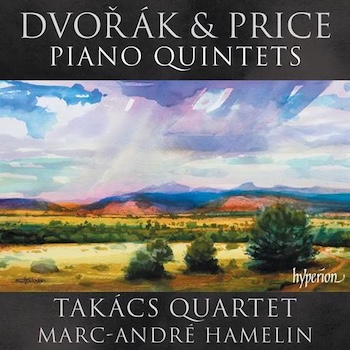
Marc-André Hamelin and the Takács Quartet make it look easy — and not just the music-making. Their 2020 release of Amy Beach’s Piano Quintet was both magnificently performed and an exemplary demonstration of musical missionary work: pairing the Beach with Elgar’s canonic A-minor Quintet highlighted the former’s considerable musical strengths as well as its stylistic individuality.
Now the pairing’s trying out the same recipe with Florence Price. Her A-minor Piano Quintet is, overall, less ambitious than Beach’s and Elgar’s —also, for that matter, the Dvorak’s A-major effort with which it’s paired here. Yet while its structure is a touch unbalanced (the big first movement isn’t counterweighted by anything of similar scope), much of Price’s writing charms the ear.
Like Beach, she had a true gift for tunes and that sensibility marks much of this 1936 score. The opening Allegro, with its sweeping melodies and touching chromatic turns sounds a bit like gospel music filtered through the model of Dvorak. The Andante, too, is devotional and pure. As in Price’s symphonies, the Quintet’s last two movements follow a Juba-Scherzo pattern. Though (as in her symphonies) the last takes on an insistent, dutiful quality, the Juba is a model of ingratiating, slightly bluesy spirit.
Hamelin and the Takács play it like, well, it’s Dvorak. Which is to say, theirs is a wonderfully clear, sensitive, and characterful traversal. Price’s virtuosic but thoroughly idiomatic writing fits the collective like a glove and it’s difficult to imagine a performance that exceeds this one for style or technique.
Much the same goes for the group’s account of Dvorak’s far-more-familiar Quintet (his No. 2). Indeed, this is a performance of huge contrasts. The first movement ranges from expansive and relaxed (some of its lyricism calls to mind a lazy summer afternoon) to vigorous and peppy.
In the Dumka, all sort of little details — the piano’s delicate mordants, the second violin’s perfectly coordinated mid-movement pizzicatos with the keyboard, the spirited-yet-utterly-controlled fugato textures in the Vivace — come to the fore. Those qualities also mark the latter movements.
Suffice it to say, this is a rendition of the Dvorak that is supremely thought through and prepared: there are layers of activity for the ear to focus upon that one doesn’t always encounter in this piece. Add to the mix the exceptional musicianship on offer in both works and you’ve got an album that, on so many levels, is simply a joy — and that’s not something that should be dismissed out-of-hand in our bitterly cynical and grim age.
 On the surface of it, Dmitri Shostakovich and J.S. Bach make for strange bedfellows. But look closer and some similarities emerge. Both worked creatively under strict masters. Both were compulsively prolific. Both moved easily between the popular and serious styles of their days. And both were true contrapuntalists.
That Shostakovich was one of the latter emerges with special brilliance in the op. 87 Preludes & Fugues he composed after sitting on a judging panel during the 1950 commemoration of the bicentennial of Bach’s death. As Bach did in The Well-Tempered Clavier, Shostakovich wrote one of each movement for all the major and minor keys.
If his cycle doesn’t loom so large in the canon as the earlier set, that’s not on account of its musical qualities. To be sure, only a relative handful of pianists have taken it up and few have surpassed Tatiana Nikolayeva, for whom Shostakovich wrote the music and whose 1990 recording is, for many, the gold standard.
But now it’s got some serious competition. In 2021, Igor Levit released a brilliant, thoughtful traversal and, this summer, Yulianna Avdeeva’s bringing her own insightful take to the collection.
Avdeeva’s is as notable for its impeccable command of the notes — voicings of even the thickest textures are always lucid — as for its moment-to-moment sense of character. These shifts can be stark, as in Avdeeva’s spunky and very playful (though not particularly acerbic) take on the G-major Fugue (No. 3), which is followed by her haunting, weighty (but hardly lugubrious) E-minor Prelude (No. 4).
Sometimes, too, they happen within a single set. Just listen to how the droll, snaky F#-minor Prelude cedes way to its plaintive Fugue-mate. Or how Avdeeva’s stately, well-shaped rendition of the G#-minor Prelude is contrasted with the knife-edge ferocity of her take on the bonkers G#-minor Fugue.
The chief reward of her approach is that, along the way, you begin to realize that Avdeeva’s account isn’t just showcasing a great artist celebrating her craft (though it does that), but it’s demonstrating much more about Shostakovich and his music. Though he has yet to get full credit for accomplishing as much, in op. 87 the Russian master managed to demonstrate that these archaic forms (but especially the fugue) could be, even in Soviet Russia in the middle of the 20th century, a repository for a great composer’s deepest expressive utterances.
That in Avdeeva’s hands this point and the music’s searing expressivity come across so readily — and with the directness of something much more familiar (say, The Well-Tempered Clavier) — is remarkable. It’s a testament to that rarest of syntheses: a total identification of a musician with her repertoire.
Jonathan Blumhofer is a composer and violist who has been active in the greater Boston area since 2004. His music has received numerous awards and been performed by various ensembles, including the American Composers Orchestra, Kiev Philharmonic, Camerata Chicago, Xanthos Ensemble, and Juventas New Music Group. Since receiving his doctorate from Boston University in 2010, Jon has taught at Clark University, Worcester Polytechnic Institute, and online for the University of Phoenix, in addition to writing music criticism for the Worcester Telegram & Gazette.
Tagged: Hyperion, Marc-Andre Hamelin, Pentatone, Takács Quartet, Tatiana Nikolayeva