
Opera Album Review: A Near-Forgotten Czech Opera Via a Vivid 1959 Recording Available in Stereo!
By Ralph P. Locke
The world-renowned tenor Ivo Židek leads a spirited cast, and reminds us how involving opera can be when sung by native speakers.
Štěpánka Štěpánová, Milada Šubrtová, Ivo Židek, Zdeněk Kroupa.
Prague National Theater Chorus and Orchestra, cond. František Škvor.
Supraphon LC00358—71 minutes.
To order or to try a track, click here, here, or here.
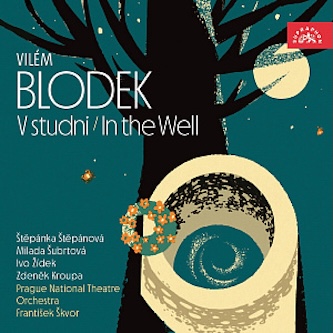 No, I have never heard of Vilém Blodek (1834–74) either — but what a delightful one-act comic opera he wrote in the mid-1860s! This recording, the second of four that have been made (all in Czechoslovakia or, later, the Czech Republic), comes from 1959. It was released in 1960 (internationally in 1962), and only in mono (on LP, of course; internationally, on the Artia label, in 1962). It is immediately notable for featuring Ivo Židek, one of the most renowned Czech singers of the LP era. Židek was a lyric tenor celebrated for his roles in Czech operas such as Smetana’s The Bartered Bride and Janáček’s Jenůfa. He also performed as Tamino in Mozart’s The Magic Flute and, later in his career, as the title figure in Britten’s Peter Grimes.
Blodek’s own life was a short, hardscrabble one. He spent his last four years in an insane asylum, possibly in part from overwork as a flute professor and as the hardworking composer of, among other things, incidental scores for many plays. He left the world a virtuosic flute concerto that has been recorded; two symphonies (some sources say three); an unfinished opera that was completed by others, decades later; plus this charming one-act opera, first performed in 1867, when he was 33. (For further details, see John Tyrell’s entry in www.OxfordMusicOnline.com.)
In the Well (V studni) holds a place in the history of Czech opera for being the first comic opera to be sung throughout. By contrast, Smetana’s The Bartered Bride originally had spoken dialogue; the fully sung version of that work dates from 1870. The skillful librettos of both the Smetana opera and the Blodek are by the renowned writer and political activist Karel Sabina.
Regardless of questions of priority, In the Well is a splendid little work that was performed hundreds of times in the Czech lands during the 19th century. It was also performed in such places as Zagreb, Ljubljana, St. Petersburg, Leipzig, and Vienna. I imagine that workable translations into German and other languages exist in libraries and theaters, waiting to be discovered — and used on stage (or in concert performances)!
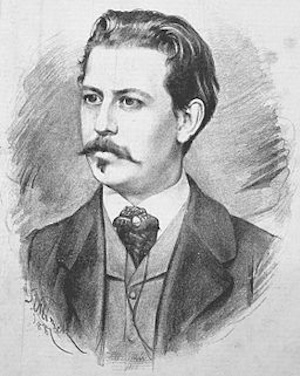
Composer Vilém Blodek. Photo: Wikimedia
The plot is based on a folk legend about a well (or more accurately a forest pool) in which a young woman or man can see the image of the person she or he will someday marry. Briefly: Lidunka is loved (or desired) by the rich widower Janek and also by the handsome young man whom she greatly prefers, Vojtech. The latter name is the Czech spelling of the name that, in German, would be given to the title character of Berg’s Wozzeck. But this Vojtech, unlike Wozzeck, is quite sane and savvy, if a little shy.
The town’s wise woman (or “witch”) Veruna advises Lidunka to consult the well. The overconfident (and overweight?) Janek climbs a tree to await Lidunka’s arrival, but the branch breaks and he falls into the water. While Vojtech and other townspeople watch from nearby, Lidunka peers into the deep water, only to see, horrified, the drenched and mud-covered widower scramble out. The two young lovers now sing a happy duet, and everyone celebrates.
There is no libretto in the booklet, but one (with a good translation) can be downloaded for free at www.supraphon.com. The other commercially available recording, conducted by Jan Stych and heartily welcomed by record critic Carl Bauman in American Record Guide (May/June 1996), contains a 70-page booklet, with libretto and multiple essays. (Bauman provides a fuller synopsis of the plot than what I have just given.) The Stych recording, which I have now listened to, is wonderful, and more vividly recorded. But this old-new one is just as stylish, if a bit studio-bound in manner. The very first recording (from 1949), conducted by Frantisek Dyk, is even dimmer in orchestral sound but shows much theatrical flair. (It’s on YouTube as are several excerpts from staged productions.) There is also another stereo recording (which I haven’t heard), made in 1982 and conducted by Jan Štych. This is one of those operas in which the roles will come across differently depending on the personality and acting skills of each singer.
No matter which recording you choose, you are likely to enjoy the melodious and engagingly orchestrated antics of a score that shows Blodek having absorbed some of the best features of comic operas of his day and a bit earlier, such as works by Weber, Lortzing, Nicolai, and Auber. At times, I heard some Mendelssohn (in the scampering fairy-like music for the St. John’s Eve celebration). There is little coloratura in the vocal lines (well, some for, predictably, the soprano Lidunka). The bumbling Janek has some sputtering repetitions of words, much like, say, Mozart’s Osmin or Rossini’s Don Bartolo.
The overture stitches together various folklike tunes from the work, occasionally submitting them to brief passages of development. I mean “folklike” in a very generic sense: squarely phrased melodies, often featuring a stamping rhythm based on notes of equal value, such as four quarter-notes in a row, after a two-eighth upbeat. The overture’s second melody, though, is one of several in the work that are quite intriguing and unpredictable metrically, suggesting an effort at reflecting more specifically Bohemian or Moravian song and dance traditions. (This particular melody will recur at the beginning of the chorus about St. John’s Eve, scene 7.)
There is a lyrical five-minute intermezzo for orchestra, written decades before Mascagni’s Cavalleria rusticana. It is entitled “Moonrise” and is performed while the sets are changed to move from the village to its outskirts, where the pool and tree are located and where the town’s young folk are heading to celebrate St. John’s Eve. Vaclav Neumann recorded “Moonrise,” calling it “Im Brunnen”—“In the Spring” (in the sense of a natural pool, not the season). This was released on a disc with other short works by Czech composers.
The movement, with its upward-surging melodies, was perhaps inspired in part by the sunrise that opens part 3 of Félicien David’s once-acclaimed 1844 work Le désert. (See my appreciative review of a vivid recording of the David work.) One phrase recalls, perhaps inadvertently but not unpleasantly, the famous slow movement of Beethoven’s “Pathétique” Sonata, op. 13.
From a purely vocal point of view, all four singers here are highly competent, showing good awareness of the meaning of the words they are singing. Židek occasionally shows a special glow, but displays less dramatic vitality than the soprano and bass. (He was 33 when the recording was made, and his artistry would continue to mature and deepen in the years ahead.)
In general, the performance would likely have been more vivid if it had been based on a staged production. I also wished for a few crucial sound effects, such as the tree-branch breaking, a big resulting splash, and then groans from the hapless Janek. Though the orchestra is slightly recessed, the attentive listener will notice lively contributions from the woodwinds, including an active bassoon who shadows the bumbling Janek.
In short, this release is the welcome return of an accomplished early-stereo recording of a work that will give great pleasure and deserves to be put on stage here in the US by, say, regional opera companies and university opera studios. It helps that there are now four recordings of it, all of them easily available, and that the libretto for this recording is available for anyone to download.
Ralph P. Locke is emeritus professor of musicology at the University of Rochester’s Eastman School of Music and Senior Editor of the Eastman Studies in Music book series (University of Rochester Press), which has published over 200 titles over the past thirty years. Six of his articles have won the ASCAP-Deems Taylor Award for excellence in writing about music. His most recent two books are Musical Exoticism: Images and Reflections and Music and the Exotic from the Renaissance to Mozart (both Cambridge University Press). Both are now available in paperback; the second, also as an e-book. Locke also contributes to American Record Guide and to the online arts-magazines New York Arts, Opera Today, The Boston Musical Intelligencer, and Classical Voice North America (the journal of the Music Critics Association of North America). His articles have appeared in major scholarly journals, in Oxford Music Online (Grove Dictionary), and in the program books of major opera houses, e.g., Santa Fe (New Mexico), Wexford (Ireland), Glyndebourne, Covent Garden, and the Bavarian State Opera (Munich). The present review first appeared in American Record Guide and is included here, lightly revised, by kind permission.
Tagged: František Škvor, In the Well, Ivo Židek, Milada Šubrtová, Prague National Theater Chorus and Orchestra, Vilém Blodek, Štěpánka Štěpánová