
Classical Album Reviews: Michael Daugherty’s “Blue Electra” and Philippe Quint’s “Milestones”
By Jonathan Blumhofer
Composer Michael Daugherty’s lively survey of 20th-century touchstones continues in his latest album. Meanwhile, violinist Philippe Quint presents a lineup made up (mostly) of commissions.
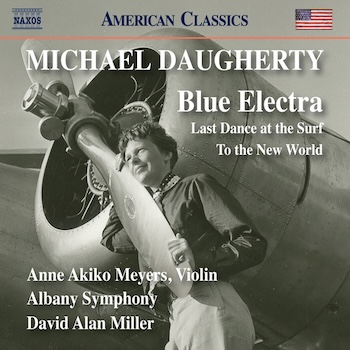 Few composers have mined Americana to better advantage than Michael Daugherty, whose output has drawn on everything from Superman to Jacqueline Kennedy Onassis. His survey of 20th-century touchstones continues with a new album featuring Anne Akiko Meyers, the Albany Symphony Orchestra, and David Alan Miller that’s anchored by a concerto inspired by the life of Amelia Earhart.
That piece, Blue Electra, is the disc’s highlight. Two of its movements draw on poems Earhart wrote and, though the musical content of the first (“Courage”) doesn’t easily relate back to its source material, the larger effort is the work of a true craftsman who knows his stuff.
The freewheeling syncopations of the second section, “Paris,” are perfectly ingratiating, while the third, “From an Airplane,” offers textbook demonstrations of thematic development and a sharp ear for instrumentation. Unsettled, urgent rhythms mark the finale, “Last Flight,” which is both the longest and most inventive part of the score, one that’s constantly turning new corners. Meyers, Miller, and the ASO deliver a thoroughly secure and inviting account, navigating its twists and turns with brio.
Similarly impressive is the orchestra’s rendition of Last Dance at the Surf, a “dance symphony” (as the composer styles it) that pays tribute to Buddy Holly, Ritchie Valens, and The Big Bopper, who were killed in a plane crash shortly after performing at the Cedar Rapids, IA venue. The music’s allusions are subtle—a motto reminiscent of a Holly guitar riff here, a nod to “rockabilly” there—but it’s put together with such finesse that nothing feels trite. Quite the opposite, in fact: the reflective turns before the end are quite affecting.
Alas, To the New World, Daugherty’s ode to the 1969 moon landing, veers into cliché. The inclusion of prerecorded bits—JFK’s 1962 “we choose to go to the moon” speech and Neil Armstrong’s “one small step for man”—are superfluous; a soprano’s spoken repetitions of the latter grow obnoxious in the second movement. Throughout, New World’s musical language is steeped too heavily in sci-fi soundtracks of the ‘60s and ‘70s. The vocal line often imitates a theremin (apparently Armstrong was a fan of that instrument’s sonority), though the score might be better served by just calling for one of those.
Nevertheless, Miller and his Albany band deliver a reading that’s spirited and well-balanced. The vigorous, dancing bits in the concluding “Splashdown” are a particular delight. And soprano Elissa Johnston does all that’s asked of her; her outer-movement impressions of a theremin are impressively on-point.
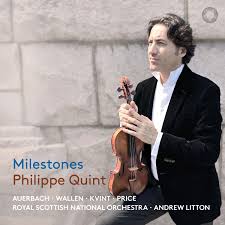 Violinist Philippe Quint is quite the commissioner. Milestones, his new album of (mostly) premiere recordings, showcases three of them, all written since 2003.
That oldest one, Lera Auerbach’s Violin Concerto No. 1, is also the lineup’s most compelling. Its four movements all traffic in darkness and emotional tumult. Throughout, Auerbach clearly has a firm command of musical architecture and an excellent ear for color: just listen to the Moderato’s Schnittke-esque waltz with tone clusters and theremin, or the Andante religioso’s gritty development of its repeated harmonic progressions.
Errollyn Wallen’s Violin Concerto is similarly constructed, though its opening movement is a touch digressive. Even so, the central “Lamenting” is beautifully paced and the finale delivers bursts of humor and some unexpected turns (like a lush episode of island-music-like rhythms and textures near the middle).
Quint’s accounts of both works are urgent and commanding, while the accompaniments Andrew Litton draws from the Royal Scottish National Orchestra are eminently secure. The eerie textures in the Auerbach speak with particular immediacy.
Litton also joins Quint—this time from the keyboard—for Lora Kvint’s Odyssey Rhapsody and Florence Price’s Adoration. The former, written by the violinist’s mother, is a thoroughgoing showpiece while the latter’s soaring lyricism comes through here with gentle understatement.
Jonathan Blumhofer is a composer and violist who has been active in the greater Boston area since 2004. His music has received numerous awards and been performed by various ensembles, including the American Composers Orchestra, Kiev Philharmonic, Camerata Chicago, Xanthos Ensemble, and Juventas New Music Group. Since receiving his doctorate from Boston University in 2010, Jon has taught at Clark University, Worcester Polytechnic Institute, and online for the University of Phoenix, in addition to writing music criticism for the Worcester Telegram & Gazette.
Tagged: "Blue Electra", "Milestones", Michael Daugherty, Naxos, Pentatone