
Cultural Commentary: Time for Arts Groups, Large and Small, to Display Some Bona Fide Irreverence
By Jonathan Blumhofer
The question before arts organizations and companies is the same one that looms over the rest of us: will they—or can they—act before it’s too late?
Presidential Irony at the Kennedy Center
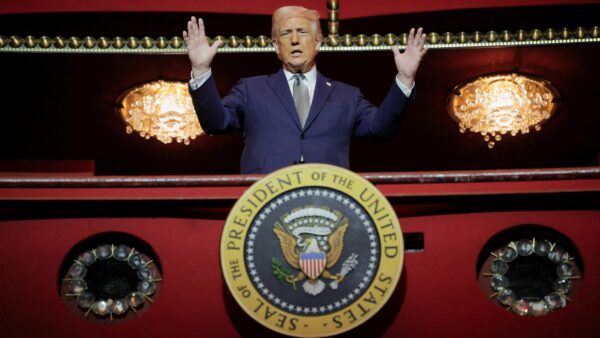
President Trump at the Kennedy Center. After he took over, the Kennedy Center workers voted to unionize. Photo: YouTube
Like ants and cockroaches, irony is hard to kill. And if it’s not on life support after Donald Trump made his first visit to the Kennedy Center as president of its board to attend a performance of Les Misérables earlier this month, we can rest assured that irony is virtually indestructible.
Perhaps that’s for our benefit. Traditional notions of consistency have never been a strength of the Chief Apostle for America. First and, however we make it through the next few years, it won’t be by keeping straight faces and pretending that everything is all right. That the tomfoolery extends to the president’s entertainment preferences is par for the course.
Could a scriptwriter have concocted a more absurd scenario — a xenophobic, aspiring dictator attending a show? In his one-plus term in office, he’s demonstrated a wanton disregard for the rule of law, human dignity, civil liberties, and more; he denigrates freely, casually, and, increasingly, incoherently; his policies seem designed to enrich him and his coterie at the expense of everyone else; he loathes dissent and protest—as well as anything not fitting his myopic understanding of what he thinks “American” means.
What, then, does our patriot go to see? Les Mis: a musical originally conceived for the Paris stage by a French composer and a South African lyricist. A tale whose story celebrates love, kindness, mercy, respect, and sacrifice, particularly for those in need. A work whose sympathies (also those of Victor Hugo’s 1862 novel, on which the production’s based) lie with revolutionaries who take to the streets to fight back against government-sanctioned oppression.
What is it about this piece, exactly, that appeals to our antihero? Perhaps it is the riots it depicts that are violently quelled? Or, given his party’s general hostility towards women, maybe the sad demise of Fantine? Who knows. When asked beforehand if he identified more with Jean Valjean or the Inspector Javert, Trump, to nobody’s surprise, dodged the query.
The zaniness didn’t stop there.
A few days later, on June 14th, Trump’s 79th birthday coincided with the 250th anniversary of the founding of the United States Army. Officially to commemorate the last, the president fulfilled one of the chief desires of his heart, namely to preside over a military parade in the spirit of his buddy Vladimir Putin.
 Partly on account of the city’s sweltering June weather—also, perhaps, because millions were otherwise occupied in thousands of “No Kings Day” counterprotests across the country—the march was sparsely attended. As a result, those who tuned in could pay closer attention to the event’s soundtrack, which was, to say the least, ear-catching.
Perhaps the most notable inclusion on the playlist was an instrumental arrangement of Creedence Clearwater Revival’s “Fortunate Son,” and not just because it was accompanying an Army parade. This 1966 anti-war anthem famously takes aim at individuals who avoid serving on account of their wealth and/or connections. Presumably those lyrics haven’t registered with our draft-dodging commander-in-chief, who’s featured the classic regularly at his rallies.
Taken together, the show—which included selections from bands who’ve been vocal in their opposition to Trump and his policies alongside live, MAGA-friendly country acts—was quite the hodgepodge. Perhaps that made it more relatable than not: few of us are dogmatic musical purists. Still, the dissonance between messages and artists on the one hand, and the man in the spotlight on the other, was glaring, even by the standards of our shallow and morally vacuous age.
Missed Opportunities in Orchestral Programming
At least irony is alive and well. American democracy, on the other hand, hangs by a thread. Given the haphazard, stream-of-consciousness non-method that guides the president’s artistic preferences, one might be excused for thinking that the American performing arts world would have figured out a creative way to respond to him and his act. Alas—ironically—that’s not the case.
With a few high-profile demonstrations to the contrary, the nation’s musical institutions have been distressingly slow to respond to the government’s assaults on basic liberties. Perhaps they think silence will shield them, though Columbia University’s capitulation to the administration’s demands should stand as a stark lesson: the school has yet to see any of its $400 million in cancelled federal grants reinstated.
Then again, cultural institutions are sluggish behemoths, often significantly financed by the 1%, and, even in places like Boston and San Francisco, congenitally wary of provocation. Take Boston Lyric Opera, which, in past years, has had no qualms about addressing issues of race and cultural appropriation in the art form, sometimes at the expense of the music itself. Next season promises bleeding chunks of Wagner and just two staged offerings: Verdi’s Macbeth and Donizetti’s farce, The Daughter of the Regiment.
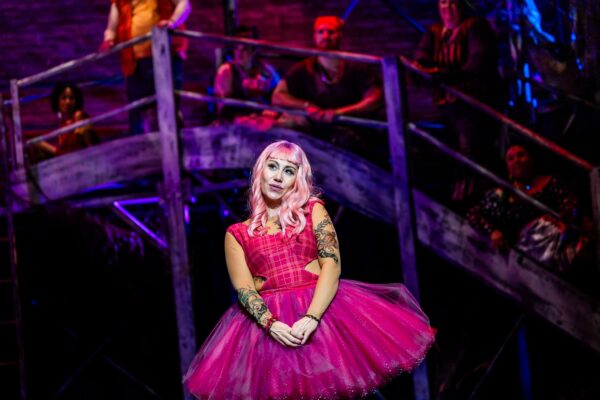
Anya Matanovič as Carrie Pipperidge in Boston Lyric Opera’s Carousel. Next season, the BLO is wary of provocation. Photo by Nile Scott Studios
Sure, the former’s got potential. But the latter—which, in the spirit of the nation’s sesquicentennial, transports the action from the Swiss Tyrol to Revolution-era Boston—doesn’t quite seem equal to a moment in which troops have been mobilized against protesters and the U.S. is illegally dropping bombs on Iran. But who knows? Maybe come next April the antics of Marie and Tonio will be exactly what the times are calling for.
Although the Boston Symphony Orchestra gets a lot right with next season’s calendar, there are some notable misses. In particular, a four-week mini-festival in January billed “E pluribus unum” is laughably one-sided. Rather than offer a serious cross-section of American music, its four orchestral programs include the work of exactly one woman—Allison Loggins-Hull—and nothing written on these shores before 1958.
If we expand to include that fest’s three chamber concerts, two more ladies (Valerie Coleman and Amy Beach) enter the ranks and Charles Ives’s Violin Sonata No. 4 promises at least a little bit of grit. But given the BSO’s rich history championing American music—especially local composers before the Koussevitzky era—as well as the huge catalogue of underserved and underrepresented voices that it rarely taps, the occasion seems like nothing short of a golden opportunity missed.
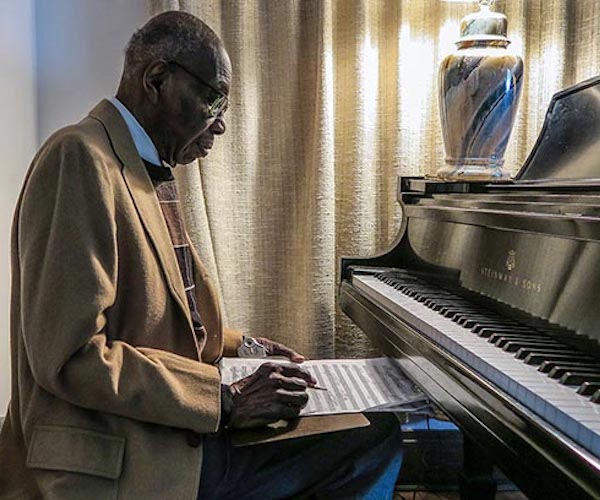
Composer George Walker — the Boston Symphony Orchestra is missing a golden opportunity to feature his music, along with others, such as Julia Perry and Joan Tower.
Yes, composer chair Carlos Simon is represented with two works, and that’s good. But what about William Grant Still? Or George Walker? Or Julia Perry? How about George Whitefield Chadwick and Charles Martin Loeffler? Ellen Taaffe Zwilich and Joan Tower? Henry Cowell?
True enough: a night of John Williams will draw a crowd more reliably than a night of music from the fringes. But if recent efforts to turn the spotlight over to unfamiliar voices has taught us nothing else, it’s that the stories those pieces tell sometimes add profoundly to our understanding of the art form. For proof of this, look no further than the BSO’s November offering of Roberto Sierra’s sensational Concerto for Saxophones and Orchestra with Brahms’s Symphony No. 2—exactly the type of fresh, creative programming that one hopes will increasingly define the orchestra’s Symphony Hall dates.
Music, Protest, and Political Dissonance
We in the Northeast can reasonably wish for such an eventuality. Moving forwards, programmatic daring will likely be in shorter supply at the Kennedy Center for the Performing Arts. Since Trump dismissed its board and installed himself as head in February, the nation’s symbolic cultural heart has been hemorrhaging money, donors, audiences, and, increasingly, acts: in May, Washington Performing Arts announced that it would not be using the space in coming years, instead showcasing artists in venues around the greater Baltimore-Washington area.
Their decision was understandable though, one hopes, not premature. Has the Kennedy Center reached the point where we can adopt Major General Arthur St. Clair’s reasoning for abandoning Ft. Ticonderoga to the British without a fight in 1777: “Although I have lost a post, I have eventually saved a state”?
It’s hard to tell. The Trump administration has, indeed, behaved noxiously, cancelling groups they deem ‘woke,’ with the worst of their wrath falling on artists and ensembles of color as well as collectives that give voice to the LGBTQ+ community. They’ve taken an axe to the NEA’s funding initiatives and the president’s stated goals for making the nation’s arts great again reek of the Zhdanov Decree.
Yet, to this point at least, the Center’s new masters have not censored the programming of ensembles that have appeared in the space. The seasons of the National Symphony Orchestra and Washington National Opera, for example, have proceeded as planned; the NSO’s spring concerts evidently included some fiery Shostakovich performances.
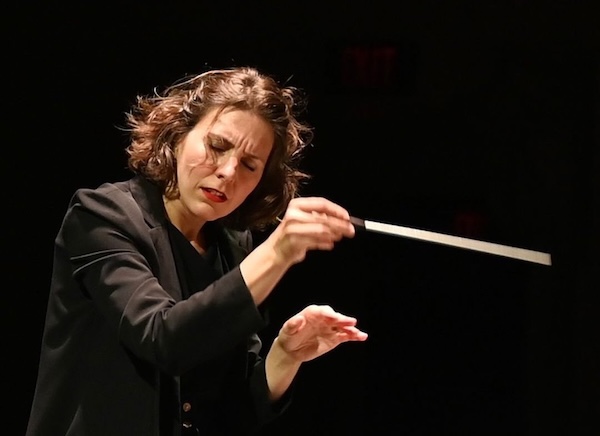
Conductor Lidiya Yankovskaya — “… if we want to fight censorship and ensure a diverse range of programming options, we must continue to support the art that we want to see on the Kennedy Center stage for as long as we can.” Photo: courtesy of the artist
In May, conductor Lidiya Yankovskaya penned a thoughtful op-ed that appeared in the Washington Post in advance of her leading the WNO’s production of The (R)evolutions of Steve Jobs. Born in the Soviet Union, Yankovskaya has some first-hand knowledge of authoritarianism and her piece is worth reading in full. Its central argument is a call to pragmatic resistance: “There might be situations where cutting ties is the best course of action,” she notes, “but…if we want to fight censorship and ensure a diverse range of programming options, we must continue to support the art that we want to see on the Kennedy Center stage for as long as we can.” (Disclaimer: I attended graduate school at Boston University with Lidiya and she led the premieres of two of my works.)
The family of Leonard Bernstein seems to be thinking along similar lines. Around the time of the WPA announcement, the maestro’s three children, who hold the performance rights for their father’s music, wrote their own op-ed in The New York Times explaining their decision to allow selections from West Side Story and Candide to be used in a fundraiser held at the Center for Washington National Opera.
Citing their father—“we can never overestimate the good that comes from artistic communication,” he offered in 1963. “When we touch one another through music, we are touching the heart, the mind and the spirit, all at once”—the siblings made clear that they had no intention of silencing his voice in D. C. now or in the foreseeable future.
The online reaction was predictably mixed. Some approved, some were ambivalent—and some felt that the Bernsteins were no better than the German opportunists who collaborated with Hitler in the ‘30s.
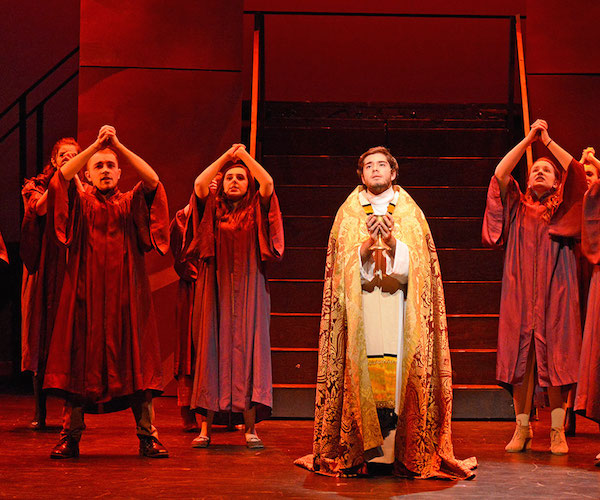
A scene from the Boston Conservatory production of Leonard Bernstein’s Mass. Photo: Eric Antoniou
The last was a bit rich, considering Bernstein’s outstanding legacy as a humanist and his lifetime of frequent, vocal opposition to right-wing overreach at home and abroad. To wit: when writing Mass for the Center’s opening in 1971, he was on Richard Nixon’s enemies list. But it’s also true that the taint of guilt-by-association is real and can leave a considerable stain: the legacies of Wilhelm Furtwängler and Richard Strauss (and, more recently, Valery Gergiev and Anna Netrebko) are rightly cautionary tales.
The Power and Peril of Symbolism in the Arts
Symbols are, of course, potent things, cultural symbols especially so. Trump, for all his shortcomings, understands this and that’s what makes his brazen grab of the Kennedy Center—one of the country’s few true artistic jewels—so unsettling. Like Mussolini strutting on the balcony of the Palazzo Venezia a century ago, he’s got both a plum perch and a megaphone.
Yet even Il Duce came to learn that no aerie is impregnable.
The Achilles heel of authoritarians’ efforts to control the arts has always been the arts themselves. Ideas, as Stalin once memorably put it, are as dangerous as guns—but they’re just as hard, if not harder, to control.
Ultimately they need receptive audiences and, too often, we’re easily distracted. There’s some evidence of the latter tendency at work in the most overheated responses to the Bernsteins’ statement: the family’s argument seemed overwhelmed by visions of the Dear Leader enjoying “Make Our Garden Grow” from his box.
The thrust of their letter, however, was that the music in question is itself symbolic and, as such, can make its own potent political statement. West Side Story, as we all probably know, wrestles with racism. Candide is a satire of blind faith and conformist witch-hunts (particularly McCarthyism). Is it wrong of the Bernsteins to think that these works can stand on their own—even (especially?) when presented in a venue run by an administration wholly at odds with their creator’s beliefs?
I don’t think so, though they are making a somewhat risky ask of audiences, namely that they trust the music (or, more broadly, any art form) while attending to it with heightened awareness. This isn’t a skill set that audiences, especially American ones, have mastered.
We needn’t look back far: only in 2017, a Shakespeare in the Park production of Julius Caesar was undermined by the too-close-to-home connections it drew between historical figures with current ones (Arts Fuse commentary). Shakespeare’s larger warnings about the unintended consequences of political violence were swept aside by a sideshow of manufactured indignation.
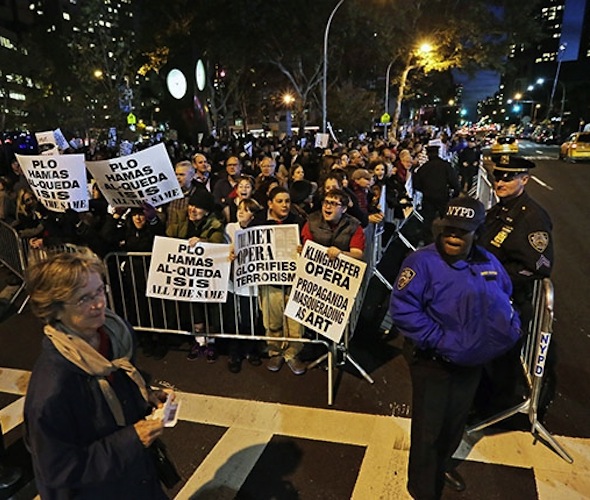
Protesters across the street from the Metropolitan Opera’s production of “The Death of Klinghoffer” at Lincoln Center in New York City. Photo: Peter Foley/EPA/Landov.
A few years before that, I penned a commentary on what, at the time, seemed like a curious phenomenon: protests against the Metropolitan Opera’s production of John Adams’s The Death of Klinghoffer by a mob that, by their own admission, had neither seen nor heard the work in question. Instead, this “know-nothing protest,” acting on hearsay and their own imaginations, objected to a caricature of a perception of a thing.
Instead of proving an embarrassing, one-off display, this utterly preventable exhibition of moral laziness and intellectual rot went mainstream. Six months after Klinghoffer opened, the Donald rode down his golden escalator and our long national nightmare commenced.
Learning from History, Listening for the Future
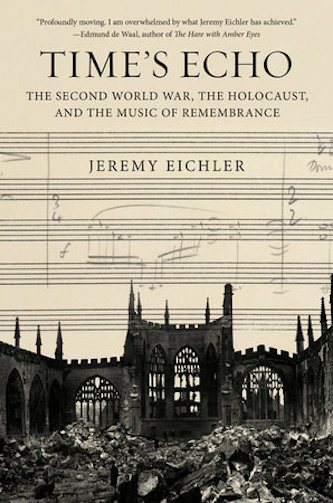
Even as those examples are dispiriting, we should remember that we’ve got the capacity to do better. In his 2023 book Time’s Echo (Arts Fuse review), Jeremy Eichler made a case similar to the one the Bernsteins are arguing, but from a different angle.
There, the Boston Globe’s former classical music critic did a deep dive into four works written in response to World War 2—Richard Strauss’s Metamorphosen, Arnold Schoenberg’s A Survivor from Warsaw, Benjamin Britten’s War Requiem, and Dmitri Shostakovich’s Symphony No. 13—while making a larger case for what he calls “deep listening.” The concept involves engaging with works not just on musical levels but also within their cultural and historical contexts. Only then can we really begin to see the music’s deeper resonance with and for our own times.
Such an undertaking might seem forbidding and may, at times, be an impractical request to make of audiences. But it’s worth pointing out that the process is incremental, not all-or-nothing. What’s more, the effort offers serious rewards that are transferable across the arts: one of the great values of the canon are the reminders it provides that, though it may sometimes feel otherwise, we’re not going through anything that hasn’t happened before—many times, in many places, and to many people.
At the same time, institutions need to be more creative in their offerings. One of the first steps they ought to take it to band together in solidarity. Now, not six months hence, is the time to mobilize—and across artistic disciplines. We live in deadly serious times yet are led by deeply unserious, incompetent people; the arts world needs to rise to the moment.
After that, program boldly and creatively. Not every offering need, or should, be in-your-face provocative. But, at the very least, they should seriously and regularly engage with the times. The great issues of the day, from despotism and corruption to race, gender, immigration, the environment—and more—have all been addressed, artistically. Especially now, we shouldn’t shy away from that.
Having said all this (and as I’ve noted before), art and music alone won’t save us. They won’t do the work that we need to undertake ourselves. “We all wish” the arts could alter the direction of our day’s toxic political headwinds, Steve Reich told a Q&A in The Guardian a few months ago, “but it can’t.”
Nevertheless, they have a role to play. “Even after Orpheus was torn to pieces,” Salman Rushdie noted in a recent essay, “his severed head, floating down the river Hebrus, went on singing, reminding us that the song is stronger than death. We can sing the truth and name the liars, we can join in solidarity with our fellows on the front lines and magnify their voices by adding our own to them.”
Knowing this, audiences, artists, and institutions need to be strategic and wise in the face of so much puffery and outrage. Trump and his minions are counting on their shenanigans and lies to disorient their opponents and push them from the field. So plan accordingly. Keep the long view in mind. These are formidable foes, yes, with real and menacing power at their fingertips. Yet they’re hardly invincible.
Time for Arts Groups, Large and Small, to Wake Us Up
In a sense, Trump’s inability to identify with either Valjean or Javert isn’t unreasonable: he’s got nothing in common with either. The former was a flawed but fundamentally decent fellow. The latter, as Adam Gopnik points out in the New Yorker, is no one-dimensional villain: Javert’s commitment to the ideal of justice becomes an idol that consumes him.
There is a character from a musical, however, to whom the president might well relate. He comes from a much more recent show than Les Mis: Mel Brooks’s 2001 adaptation of his 1967 film The Producers.
No, I’m not talking about Roger de Bris’ flamboyant depiction of Hitler. That’s a tempting but too-easy target that misses the mark (however much “Springtime for Donald” has a nice ring to it). Instead, I’m thinking of Max Bialystock, the down-on-his-luck main character whose scheme to fleece investors and escape with his proceeds to Brazil drives the show’s inane plot.
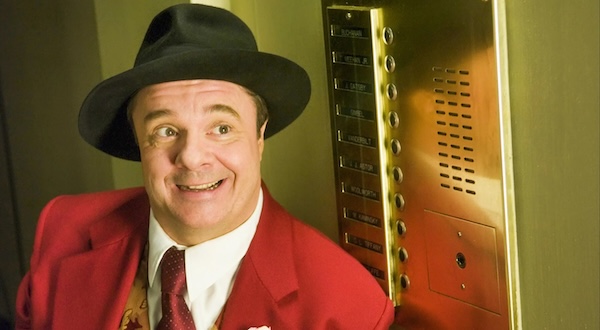
Nathan Lane as Max Bialystock in the musical version of The Producers. Photo: Everett Collection
Look closely and you’ll see that there’s more than a little of Trump in Max: the womanizing wannabe major-leaguer, the fraud, the showman. Also, his career trajectory. (At least in the Broadway version, Max temporarily pays for his sins with a stay in Sing Sing.) Take away the manic charm of Zero Mostel or the sympathetic warmth of Nathan Lane, though, and you’re left with an amoral huckster who’ll stop at nothing to enrich himself and hog the limelight.
Perhaps some enterprising company can soon give us a revival of The Producers. Maybe Brooks—still very much with us as he pushes 100—has one more trenchant show up his sleeve. God knows we could use it.
But it’d be even better if arts groups big and small would demonstrate some bona fide, Brooks-ian irreverence. If nothing else, they might then help us approach things with ears, eyes, and minds wide open. To be sure, this is a mission the arts are uniquely positioned to take on. The question before companies, though, is the same one that looms over the rest of us: will they—can they—act before it’s too late?
Jonathan Blumhofer is a composer and violist who has been active in the greater Boston area since 2004. His music has received numerous awards and been performed by various ensembles, including the American Composers Orchestra, Kiev Philharmonic, Camerata Chicago, Xanthos Ensemble, and Juventas New Music Group. Since receiving his doctorate from Boston University in 2010, Jon has taught at Clark University, Worcester Polytechnic Institute, and online for the University of Phoenix, in addition to writing music criticism for the Worcester Telegram & Gazette.
Tagged: Boston Symphony Orchestra, Boston-Lyric-Opera, Donald Trump, Jeremy Eichler, Lidiya Yankovskaya, The Kennedy Center for the Arts
1 Comment
Leave a Comment
The Arts Fuse has frequently commented on the decline of critics into consumer guides. Boosterism and cheerleading do not encourage challenging productions. Mr. Blumhofer’s point about grant-chasing is significant. It raises a question I’ve wondered about for years: why do arts groups inevitably become corporatized?
I’m not talking about accepting donations from tobacco companies or the Koch brothers. As soon as an organization grows, it appoints a board of directors and adopts a structure similar to what General Motors has. Anyone who has had to deal with “the Board” of an arts group knows that the bottom line invariably trumps aesthetics—let alone confrontational politics. Could there be an alternative? It’s a tough question, few artistic collectives seem to last long. Nevertheless, we face a dire situation today with naught but toadies hopping in the aisles to encourage every performance. Artists are strapped for funds, and this constraint forces them to dance for the paying piper. We approach a desolate society where we are denied bread and the circuses are forced to fold their tents.