
Opera Album Review: Finally, Verdi’s Original 1857 Version of “Simon Boccanegra” Gets the Recording It Deserves
By Ralph P. Locke
The skillful Mark Elder leads a fine cast, including the superb Peruvian tenor Iván Ayón-Rivas.
Verdi: Simon Boccanegra (1857 version). Opera Rara ORC65. Total time: 133 minutes.
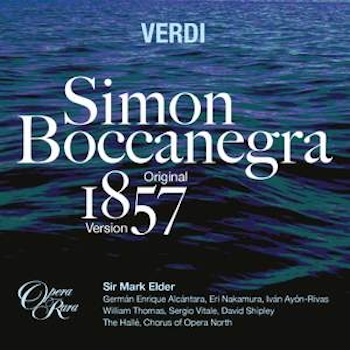 Verdi’s best-known operas are mostly from the years 1851-53 (Rigoletto, Il trovatore, and La traviata) and from his last creative period: 1871-93 (Aida, Otello, and Falstaff). But the ones from the 1850s-60s often seem somewhat puzzling, as if they are trying to negotiate a middle path between the clear-cut traditional structures that Verdi had inherited from Rossini, Donizetti, and Bellini—complete with moments of high lyricism, self-enclosed “movements” within arias and duets, and extensive flights of coloratura, especially for the soprano—and the more fluid and conversational exchanges typical of his last operas. These exchanges feel more conversational in large part because they are set more syllabically, with the main musical continuity entrusted to the orchestra, much as Wagner was doing at the same time in works such as Tannhäuser and Lohengrin.
The operas from this, as we might call it, “late middle period” for Verdi (1855-67) include Les Vêpres siciliennes, Simon Boccanegra, Un ballo in maschera, La forza del destino, and Don Carlos. All of these are performed, of course (the two French ones often in Italian translation) and they demonstrate a composer trying, with much success, to expand his musicodramatic palette.
But one of them, Simon Boccanegra, though staged more often in recent decades than before, has been particularly hard for opera aficionados to “place” in its context, because what nearly is always recorded is the version that Verdi made twenty-four years later for a revival that took place in 1881. Not surprisingly, the revised version of Boccanegra bears signs of having come from two different eras in Verdi’s development (as is true also for Macbeth, 1847, rev. 1865).
This is not necessarily a bad thing: the 1881 version fascinates with its diversity of stylistic and structural means as much as it does with the characterizations and dramatic episodes that are so cherishable in nearly any Verdi opera.
Still, the 1857 version of Simon Boccanegra has its own integrity and coherence, as is now apparent in its first studio recording, under the alert baton of the renowned Mark Elder (music director of English National Opera, 1979-93 and of “the Hallé”—the current name of the longstanding Hallé Orchestra—from 2000 to 2024).
What struck me most is how lively the work is in this version. Verdi scholars often emphasize its grimness (for example, the title character gets no extended aria), as if this explains why it eventually stopped being performed until the composer revised, improved, and relaunched it decades later.
But the revised version is plenty grim, indeed more consistently so. By contrast, the 1857 one turns out to be dotted with colorful, bouncy passages recalling moments in, say, La traviata. Among the highlights that would be excised in 1881 are an immensely attractive prelude that lets us hear four tunes from the opera to come; a highly conventional (but enormously effective cabaletta) for Amelia in the (Act 1) aria, as she awaits a visit from her beloved Gabriele Adorno; and a similarly spiffy cabaletta for Amelia and Gabriele to end their immediately subsequent duet.
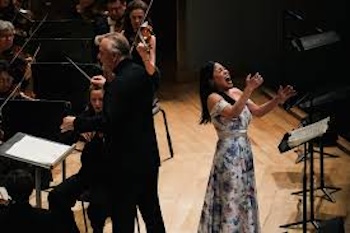
Soprano Eri Nakamura fully involved as Amelia in Verdi’s Simon Boccanegra (during the concert performance made in conjunction with the recording sessions).
The list of passages that were excised or reworked is so extensive that the otherwise informative essays in the thick booklet only mention a few. The full comparison in Julian Budden’s essential three-volume The Operas of Verdi is harder to follow than any other in that immensely insightful study. The problem, of course, is that there’s a vast distance between the work’s original sensibility and that of the aging yet still vital composer who would, in three years, be working on Otello. Still, all commentators agree that the single biggest difference was the composer’s excising of the Act 1 finale, with its celebratory chorus and ballet, and the introduction instead of the Chamber Council scene, which beefs up the role of the Doge Simon and reaches an immensely powerful climax with Simon’s (perhaps idealistic, and certainly not historical) call for peace between the feuding Guelphs and Ghibellines. Along with that, there is his demand that all present join in cursing whoever had abducted Amelia (his daughter, who had, unknown to him, been raised by his sworn enemy Fiesco).
In this recording, we get to hear, in the critical edition carefully prepared by Verdi authority Roger Parker, that original Act 1 finale, complete with its short but vivid ballet (with chorus), which turns out to be a precursor to the Triumphal Scene in Aida (1871). It calls for emphatic displays of ferocity by some of Venice’s proud soldiers and graceful dancing by women captives from the unspecified “African” lands that the Doge’s troops have recently conquered in war. We can assume that these lands are in North Africa, just across the Mediterranean, not least because Verdi quotes, repeatedly, a highly characteristic rising passage in the strings from Félicien David’s much-performed secular oratorio Le désert, a work set in the Arab world, not in sub-Saharan Africa. (David termed the work an ode-symphonie because it contains a spoken narration in verse. It has been recorded twice now: see my review at OperaToday.com.) We already knew that Verdi was inspired by Le désert in three other works: the sunrises in Alzira (1845) and Attila (1846) and when devout Muslims enter the stage for an “invocation of Allah” in the ballet music that Verdi wrote in 1894 for the Paris production of Otello. Oddly, this blatant and highly purposeful borrowing from the David work, given as if in quotation marks, has rarely if ever been mentioned by Verdi scholars. I’m happy to announce it here. (If you want to hear the passage in Le désert, it’s in the choral movement in part 2—the work’s “nighttime” section—and entitled “La liberté au désert.”)
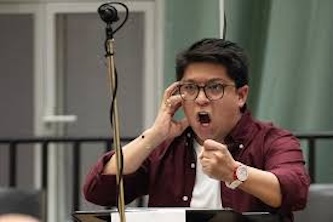
The focused and intense tenor Iván Ayón-Rivas, as Gabriele Adorno, during the recording sessions.
There is so much more that one might say about the 1857 version, as an entity in itself and as a work that looks both back and ahead. For present purposes, I close with some appreciative remarks about the performance, which is conducted by the highly experienced Mark Elder. (In NewYorkArts.net I praised his Lohengrin, recorded at an unstaged performance with the famed Amsterdam Concertgebouw Orchestra.) Elder cultivates a consistently beautiful tone from “the Hallé,” and he sets tempos that always sound natural and convincing.
His vocal soloists are all apt for their roles, the best of them by a good margin being the superb young Peruvian tenor Iván Ayón-Rivas, whose singing I hailed in my review, for The Arts Fuse, of Saverio Mercadante’s highly effective 1842 opera Il proscritto. Ayón-Rivas has mastered not just the basics of operatic tenorizing but the refinements as well, including subtle gradations of loud-to-soft (or the reverse) on single short notes. And all the while conveying the text vividly and meaningfully.
The other singers maintain high competence, though not always with such total mastery. Eri Nakamura, as Amelia, creates a credible character, and her high notes are splendid, whether soft or loud; but she sometimes lacks finesse on short notes, not landing squarely on pitch or with solid breath. English bass William Thomas is capable as the Genoese nobleman Fiesco, but his low notes are pale. The Italian baritone Sergio Vitale brings a solid sound and a welcome clarity of diction to the important secondary role of the goldsmith Paolo. I look forward to hearing him in a bigger assignment. As for the title role, Argentine baritone Germán Enrique Alcántara wins our concern and affection through his solid tone production and vivid rendering of the text—without, almost inevitably, effacing memories of Tito Gobbi or other great baritones who have made this part their own in recordings of the 1881 reworking.
I should mention that there have been two previous recordings of the 1857 version (BBC 1975, conducted by John Matheson; Teatro la Fenice 1999, conducted by Renato Palumbo), but neither was made under careful studio conditions and neither had access to Parker’s critical edition (completed and made available by Ricordi in 2021). Now that we can hear the piece as Verdi first imagined it, published it (in piano-vocal score), and brought it to performance, we can welcome the opera as the coherent and well-thought-out work that it always was and learn to love it for itself — and not as a pale shadow of the 1881 revised version.
Ralph P. Locke is emeritus professor of musicology at the University of Rochester’s Eastman School of Music and Senior Editor of the Eastman Studies in Music book series (University of Rochester Press), which has published over 200 titles over the past thirty years. Six of his articles have won the ASCAP-Deems Taylor Award for excellence in writing about music. His most recent two books are Musical Exoticism: Images and Reflections and Music and the Exotic from the Renaissance to Mozart (both Cambridge University Press). Both are now available in paperback; the second, also as an e-book. Locke also contributes to American Record Guide and to the online arts-magazines New York Arts, Opera Today, The Boston Musical Intelligencer, and Classical Voice North America (the journal of the Music Critics Association of North America). His articles have appeared in major scholarly journals, in Oxford Music Online (Grove Dictionary), and in the program books of major opera houses, e.g., Santa Fe (New Mexico), Wexford (Ireland), Glyndebourne, Covent Garden, and the Bavarian State Opera (Munich). The present review first appeared in Classical Voice North America and is included here, lightly revised, by kind permission.
Tagged: "Simon Boccanegra", Enrique Alcántara, Eri Nakamura, Iván Ayón-Rivas, Mark Elder