
Film Review: “Barron’s Cove” — A Thriller Steeped in Grief
By Peg Aloi
The film offers some intriguing twists and turns, and the excellent cast propels the narrative forward admirably. But the screenplay tries a bit too hard to dramatize character transformations in a short period of time.
Barron’s Cove, directed by Evan Ari Kelman. Available on VOD
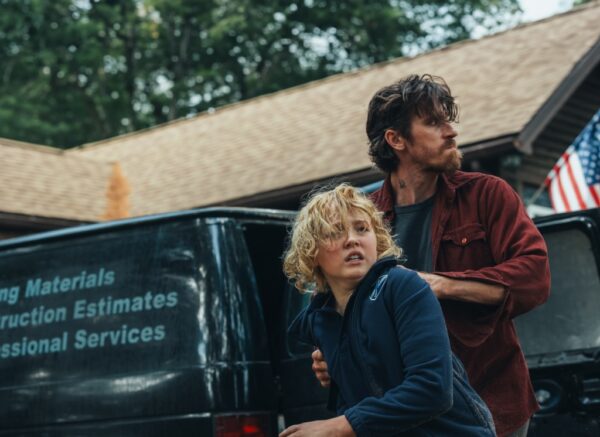
A scene from Barron’s Cove.
In Barron’s Cove, the debut feature by Evan Ari Kelman, the opening scene shows an act of violence that, while not explicit, is nonetheless terrifying and disturbing. Some boys playing dangerous games near railroad tracks experience a horrible accident, and one of them ends up dead. We meet Caleb Faulkner (Garrett Hedlund), a divorced man who wears his past pain and trauma like a tarnished heirloom. He works in construction as both a builder and an occasional hired thug for his Uncle Benji (Stephen Lang, in a juicy, villainous role). Benji uses men like Caleb to ensure his construction supplies empire remains dominant, making sure clients and competitors bend to his rules. When Caleb learns that his son Barron (Dante Hale) has died, his grief is palpable and all-consuming. Jackie, his ex-wife and Barron’s mother (brilliantly played by Brittany Snow in a small but pivotal role), is outraged because Caleb forgot to pick up their son from school that day. She blames him for Barron’s death. Caleb accepts this guilt, but he’s also angry and desperate to learn what happened to his son.
The police investigation is anything but straightforward. One of the boys with Barron at the time of the accident is Alex (Christian Convery, in an impressive performance), the son of Lyle Chambers (the always-excellent Hamish Linklater, best known for Midnight Mass), who is running for state senator. There is evidence of corruption between law enforcement and the press, both of whom are trying to downplay Alex’s involvement. After a police press conference announces that Barron’s death was a suicide, Chambers appears on camera, acting suitably bereft. But Detective Navarro (Raúl Castillo), who also has a young son, disagrees with the ruling of the police chief (Marc Menchaca) and wants to investigate further. Caleb briefly sees Alex at the police station and, after making eye contact, loudly asks if the boy knows anything. Alex taunts him by sticking out his tongue. Caleb is driven into a rage and, despite being warned by police to stay away from Alex, Caleb is obsessed with finding out what the kid knows. He begins to hound Alex wherever and whenever he can, including at the school he attended with Barron.
With the case quickly closed by the police and Chambers pushing full steam ahead with his campaign, Caleb’s reckless quest to avenge Barron’s death quickly escalates. Benji hosts a reception after Barron’s funeral at his enormous mansion; he advises Caleb to lay low and not make waves. After that, Caleb realizes he may not be able to trust in his usual support system. In a rather contrived and implausible scene, Caleb discovers an incriminating drawing at the home of Philip, the third child present at the accident, and sets out to kidnap Alex to force him to reveal what he knows. Given his history of violence and emotional instability, stemming from an abusive childhood, Caleb, wracked by grief, appears to have no qualms about harming Alex. But, as Alex’s own traumatic past is revealed, there are revelations that trigger some emotional twists and turns. On the run, Caleb manages to outsmart the police for a while. He turns for help to a compatriot and former military medic (well played by Severance’s Tramell Tillman). Caleb eventually turns the tables on those who would dishonor his son’s memory by falsely claiming he committed suicide. Jackie cooperates with the police to help find Caleb — until she realizes Caleb is in more danger from the cops than Alex is from Caleb.
The story offers some intriguing twists and turns, and the excellent cast propels the narrative forward admirably. But the screenplay tries a bit too hard to dramatize character transformations in a short period of time. The setting feels authentic: a shot of a diner makes it clear we’re in Springfield, MA, and the film captures the vibe of the city’s working-class neighborhoods. The latter is echoed in the themes of generational trauma and the struggles of low-income families for whom justice is often out of reach. There is little redemption in this film, but evil is exposed, karmic retribution is achieved, and there is some hope for healing and, ultimately, an end to pain.
Peg Aloi is a former film critic for the Boston Phoenix and member of the Boston Society of Film Critics, the Critics Choice Awards, and the Alliance for Women Film Journalists. She taught film studies in Boston for over a decade. She has written on film, TV, and culture for web publications like Time, Vice, Polygon, Bustle, Dread Central, Mic, Orlando Weekly, Refinery29, and Bloody Disgusting. Her blog “The Witching Hour” can be found on substack.
Tagged: "Barron's Cove", Brittany Snow, Evan Ari Kelman, Garrett Hedlund, Hamish Linklater
Christian Convery’s character is Ethan (the original character name was supposed to be Alex). He turned in a great performance.