
Film Review: “The Empire” — Gallic Alien Invasion, Lampooned
By Steve Erickson
Bruno Dumont has always been a divisive filmmaker, drawn to provocation, and the wacky sci-fi parody of the comedy-drama The Empire has proven to be no exception.
The Empire, directed by Bruno Dumont. Streaming VOD

Anamaria Vartolomei in The Empire. Photo: Kino Lorber
Bruno Dumont has always been a hard filmmaker to pin down. Although his first two films, La Vie de Jesus and Humanite, pigeonholed him as an austere descendant of Robert Bresson, his work also showed an interest in the extremes of human behavior. (La Vie de Jesus features unsimulated sex scenes.) His 2014 limited series P’tit Quinquin (Arts Fuse review) spoke with a new, much more personal voice. Without giving up his initial concerns, Dumont worked in a large degree of goofy humor, akin to the Coen brothers. Although his casting of non-professional actors occasionally comes off as condescending, his work following P’tit Quinquin brought a newfound knack for strange, imaginative concepts. (Joan of Arc has been the subject of many films, but only Dumont made a heavy metal musical about her!) He’s always been a divisive filmmaker, drawn to provocation, and the sci-fi parody of the comedy-drama The Empire (following the media satire of his previous film, France) has proven to be no exception.
When The Empire begins, we overhear Line (Lyna Khoudri) speaking offscreen about sunning herself on the beach. The setting is Audresselles, a fishing village in the north of France. A very attractive town, it’s also a thoroughly ordinary one. (In long shots, Dumont lovingly films the countryside.) This bucolic appearance turns out to be a cover for something far stranger. Lyne is a half-demon, half-human hybrid; her son, the Wain, is destined to further the evil plans of an alien race, the 0s. They and their angelic counterpart, the 1s, have arrived on earth to do battle over the boy. While the 0s want to take over Earth, the 1s fight them to establish peace and harmony.
The film is anything but neatly balanced. Dumont doesn’t stint on special effects. Spaceships appear in the sky over this town, as does a black hole. Aliens speak to glowing orbs. Still, the film contains a small degree of documentary observation. One scene spoofs the romanticism of melodrama: music from a bombastic orchestra accompanies Line and her partner Jony (Brandon Vlieghe) as the camera circles around them. The image points out just how distant inflated ideas of romance are from reality. Yet we see horses — real animals, captured by Dumont’s camera — observing the lovers from a nearby field. They ignore it and go about their business. The animals appear throughout The Empire, indicating that, in the midst of the film’s excess, there’s something in the story that refuses to be reduced to spectacle.
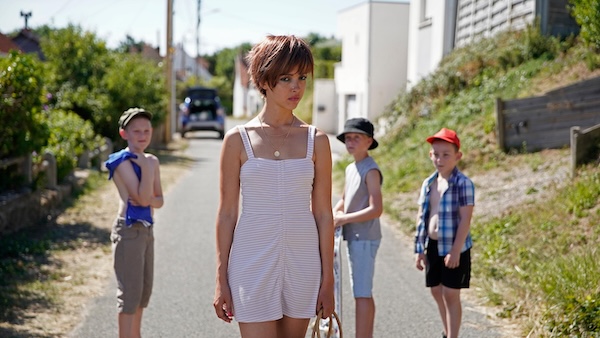
Lyna Khoudri in The Empire. Photo: Kino Lorber
As Beelzebub, the 0s’ leader, Fabrice Luchini chews the scenery into bite-sized shreds. Much of the remainder of the cast comprises non-professional actors. Bernard Pruvost, who plays a cop helplessly witnessing destruction around his town, has a tic that causes his face to twitch continually. (This is the third Dumont project in which he’s appeared, always as the same character.) It’s a real condition that Pruvost lives with, not part of his performance. Yet, by being used in the film, his condition becomes part of the storyline.
The Empire‘s satiric vision is clear: its targets are the clichés of sci-fi blockbusters. Aliens decapitate humans with glowing lightsabers. The Wain represents an inverted savior figure. Above all, the concept that good and evil exist as an absolute binary that can be separated into 0s and 1s is relentlessly mocked. The notion of a demonic child, so common in religious-themed horror, is treated with ridicule as well.
As for geo-politics, the town’s residents are being used as pawns in a cosmic Cold War between two galactic superpowers. The Empire lays out ordinary people’s powerlessness, faced with forces that can swoop in and alter their lives on a whim. That’s not just science fiction. The palaces of the 0s and 1s’ leaders are based on the giant castles of French royalty. One of the country’s great works of architecture, Paris’ Sainte-Chapelle, is transformed in the film into a spaceship cockpit. The Empire is full of references to France’s real history; for example, the aliens land in a demolished bunker that dates back to the ’40s. Dumont also draws on Afrofuturism — manipulation by aliens becomes symbolic of imperialism and slavery, hybrid people are created by sex between colonizers and their prey – in a manner that’s somewhat questionable for a film that revolves around white people in France.
The religious imagery and mythic weight of Dumont’s work have been apparent as early as La Vie de Jesus. It’s always been hard to figure out exactly what he’s doing with them, but this reticence to spell out a message continues to be thought-provoking. The Empire’s finale promises a bittersweet return to normalcy. Change for the better is out of the question, so being left alone by power is the best mankind, at least in this French town, can hope for.
Steve Erickson writes about film and music for Gay City News, Slant Magazine, the Nashville Scene, Trouser Press, and other outlets. He also produces electronic music under the tag callinamagician. His latest album, Bells and Whistles, was released in January 2024, and is available to stream here. H presents a biweekly freeform radio show, Radio Not Radio, featuring an eclectic selection of music from around the world.