
Film Review: “Bonjour Tristesse” — A Capsized Remake
By Gerald Peary
The first thing to note about the 2025 remake of Bonjour Tristesse is that it matches the Otto Preminger rendition with its handsome look, its sumptuous color, and the skilled cinematography of Maximilian Pittner.
Bonjour Tristesse, directed by Durga Chew-Bose. Screening at the AMC Boston Common
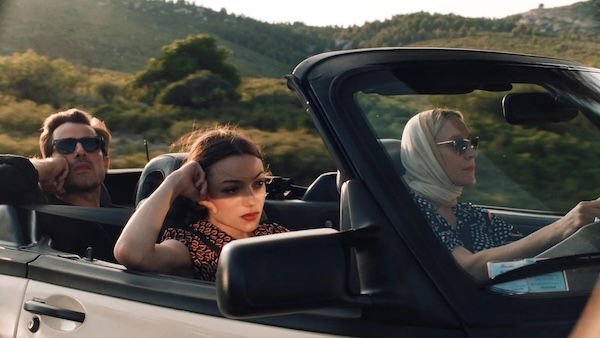
Claes Bang, Lily McInerny and Chloë Sevigny in Bonjour Tristesse. Photo: Greenwich Entertainment
Bonjour Tristesse, Françoise Sagan’s once-scandalous 1954 novel, remains an awesome literary achievement, even if the sexual amorality of the book now seems tame. How could a 17-year-old girl come up with a book that is so smoothly written, mostly so well plotted, and, truly impressive, so psychologically insightful about the minds and motivations of its complicated characters? Has anyone that young EVER written a work of fiction so sophisticated and precocious?
Sagan did ease her task a bit by basing her heroine, also 17, so closely on herself. Like Sagan in real life, Cécile is an unapologetically spoiled and petulant little rich girl, a cocky and attractive Parisian teenager who lives for sensual pleasure. The only clear difference between them is that Sagan somehow found time to be also a teen intellectual, devouring Stendhal and Proust, while Cécile, however sharp and bright, is a determined philistine. She cares not a whit that she’s flunking out of school. At the French Riviera, Cécile spends her days swimming and sunbathing, but emphatically not reading. Not that her father, Raymond, is concerned. He also is a dandy, a rich, handsome 40-ish dude who moves happily from young lover to lover. Raymond and Cécile get along beautifully, a libertine and a libertine-in-the making.
And the plot for That Summer When It Happened? Father and daughter and this year’s mistress, Elsa, are doing just fine down at the beach when Raymond invites to join them an old family friend, Anne, close to Raymond’s age. To Cécile’s horror, Raymond and Anne fall in love, Elsa the mistress is dumped, and Raymond and Anne announce they are getting married. Anne is a prude who bans Cécile’s boyfriend from visiting. And worse, she has ambitious plans for Cécile to clean up her act and study hard this summer so she can pass her exams back in Paris.
The plot thickens when Cécile rebels and — what shocked the world in 1954 — repeatedly has hot sex with her verboten boyfriend. And the plot boils over with what seems to me Françoise Sagan’s one glaring mistake: The Fatal Accident.
It wasn’t very long after the publication of Bonjour Tristesse that the book was bought by Hollywood and a studio cast and crew came to shoot on location by the Riviera. The reception at the time wasn’t very favorable for the 1958 movie, though critics over the years have come to appreciate Otto Preminger’s lavish, visually accomplished work. Most obviously, who can argue with the casting of convivial David Niven and classy Deborah Kerr as Raymond and Anne? And Preminger’s much-publicized discovery, Iowa schoolgirl Jean Seberg, so miserable in Preminger’s Saint Joan (1957), found herself as Cécile. Most famously, Jean-Luc Godard was so taken by Seberg’s cruel amorality in Bonjour Tristesse that he cast her and immortalized her in Breathless (1959). There’s a shot early in Preminger’s film of Seberg’s vacant face which gets repeated in the jolting Breathless conclusion. When Seberg betrays Jean-Paul Belmondo, it’s prefigured with what she does to Anne in the 1958 Bonjour Tristesse.
The first thing to note about the 2025 remake of Bonjour Tristesse is that it matches the Preminger rendition with its handsome look, its sumptuous color, and the skilled cinematography of Maximilian Pittner. It’s not just the blue of the sea, it’s the yellow loveliness to behold when a character slowly slices a pineapple. Danish actor Claes Bang is fine as Raymond, an easygoing sympathetic presence, and Lily McInerney is properly alluring as Cécile with her Audrey Hepburn demeanor, her dark eyes, and sinuous eyebrows. And if there’s a major improvement on the book and the 1958 movie: Canadian feminist writer-director Durga Chew-Bose has done over Raymond’s mistress Elsa from a bubble-head plaything into a professional dancer and the movie’s wisest character. She and Cécile are the best of friends, not — as in the novel and earlier picture — because she’s an arrested character like a teenager herself, but because she’s warm and smart.
The first half hour of Bonjour Tristesse 2025 is winning, buoyed by the delicious relationship established on screen by Bang, McInerney and Nailia Harzoune, the splendid French actress who is Elsa. The movie capsizes and never recovers when Anne arrives at the Riviera. She’s played by Chloë Sevigny. A disastrous miscasting. Anne needs to be cool and righteous but also intelligent and kind, contradictions easily embodied by Deborah Kerr. Sevigny is only stiff and icy. A pill. Is it just me who’s always found her to be a fascinating counterculture person off screen but amateurish and inept before a camera? Anyway, there went Bonjour Tristesse. And Chew-Bose’s well-done direction of her first film completely falters in the flat, uninvolving last quarter. What was overblown melodrama in Sagan — The Fatal Accident — here is thin and subdued, lacking emotion and impact.
Gerald Peary is a professor emeritus at Suffolk University, Boston; ex-curator of the Boston University Cinematheque. A critic for the late Boston Phoenix, he is the author of nine books on cinema; writer-director of the documentaries For the Love of Movies: The Story of American Film Criticism and Archie’s Betty; and a featured actor in the 2013 independent narrative Computer Chess. His last documentary, The Rabbi Goes West, co-directed by Amy Geller, played at film festivals around the world, and is available for free on YouTube. His latest book, Mavericks: Interviews with the World’s Iconoclast Filmmakers, was published by the University Press of Kentucky. With Amy Geller, he is the co-creator and co-host of a seven-episode podcast, The Rabbis Go South, available wherever you listen to podcasts.
Tagged: Bonjour Tristesse, Chloë Sevigny, Claes Bang, Durga Chew-Bose, Françoise Sagan, Lily McInerny, Maximilian Pittner