
Doc Talk: Documenting Defiance –Two Portraits of Courage at the National Center for Jewish Film Festival
By Peter Keough
Claude Lanzmann’s haunted pursuit of testimony and Henrietta Szold’s humanitarian legacy illuminate the enduring power of courage and conscience.
The National Center for Jewish Film’s Annual Film Festival, April 12-26 at the Coolidge Corner Theatre & the Museum of Fine Arts Boston
Two of the documentaries in this year’s National Center for Jewish Film’s Festival focus on fighters who responded to the evils of a broken world not with despair or compliance but with a fierce commitment to projects that have brought about historic change.
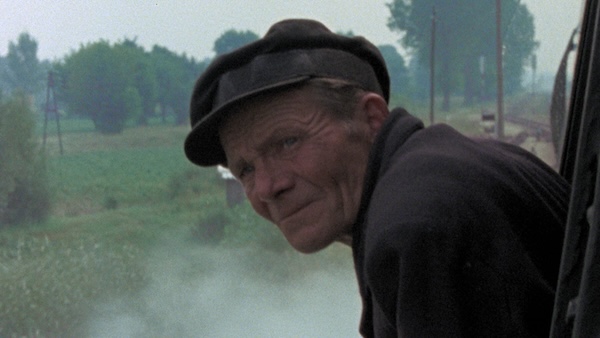
A scene from All I Had Was Nothingness. Photo: Janus Films
As seen in Guillaume Ribot’s All I Had Was Nothingness (2025; screens at the Coolidge Corner Theatre April 14, Yom Hashoah Holocaust Remembrance Day, at 7 p.m.), when Claude Lanzmann was initially offered the assignment to make a film about the Holocaust he was ambivalent. “I knew nothing of it, truly,” he says (all the voiceover in the film is taken from Lanzmann’s writings and read by the director). “My knowledge was nil. Nothing but a statistic. An abstract figure: six million of our people had been murdered.”
But the project soon obsessed him, its mystery and horror proving elusive. “I wanted to film, but all I had was nothingness. The subject of Shoah is death itself.”
In 1985, after twelve years of production and editing, years marked by cut funding, intermittent doubts, evolving tactics, and inexorable resolve, the 9-1/2 hour film was completed. Five more feature films drawn from the same material followed. What remains to be told? Everything and nothing, perhaps. But Ribot’s film, which is culled from 220 hours of previously unseen outtake film footage, is as much about the process and purpose of documentary filmmaking itself as it is about the Holocaust, about the toll of trial and failure, the struggle to clarify ethics, and the ongoing refining of technique, strategy, and vision.
It took years to track down witnesses like Abraham Bomba, the barber who survived imprisonment at Treblinka by cutting the hair of women sent to the gas chamber. No one had spoken to him about his experiences before and he was reluctant to recall them for Lanzmann. But they ended up speaking together for 48 hours. He tells Lanzmann how he had resumed his trade after the war, but it took him a long time to be able to cut women’s hair because, unlike those at Treblinka, they were not naked. He recalls how tightly the victims had clung to each other in death.
Setting up candid interviews with the perpetrators also proved a challenge. In one sequence, Lanzmann tries to gain access to Gustav Laabs, an SS officer who operated a gas van and was responsible for the murder of at least 100,000 people. Warned by neighbors of his approach, Laabs refuses to come to the door. As Lanzmann and his assistant leave, a local couple confront them, asking who they are and why they are there. “Do you know what he did?” asks Lanzmann. “Do you know what a gas van is?”
“Not our business,” they reply.
Honesty, Lanzmann realized, would not be the best policy in making the film. Having a Jewish name, for example, posed a problem. Reluctantly he forged a new identity, Claude-Marie Sorel of the fictitious “Center for the Study of Contemporary History,” complete with a fake passport and other papers. He started wearing a wire and using a hidden camera. Treating the subjects to dinner and a cash payment also helped, though it backfired somewhat with Franz Suchomel, who was responsible for collecting valuables from Jewish victims at Sobibor and Treblinka. After “gorging on salmon and cream” Suchomel has an angina attack and the interview is paused. In an example of Ribot’s acute and ironic editing, Suchomel’s self-serving, maudlin recollections are intercut with the most harrowing of Bomba’s testimony.
Some of the unwilling participants in the genocide, though, such as the Polish train driver whose image is featured on the film’s poster, didn’t ask for such compensation to cooperate. Perhaps he was motivated more by a need to confess and explain his involvement and culpability. Only 20 when he was offered the choice of driving the train or being sent to a labor camp, Henryk Gawkowski chose the former and ended up assisting in the transporting of an estimated 18,000 Jews to Treblinka.
Gamely, he agrees to drive a vintage locomotive for a reenactment scene in the film. He peers out of the engine and looks back. “Gawkowski was hallucinating the imaginary railcars he’s leading to death,” Lanzmann comments. “There is not a single railcar, only the locomotive, rented at great expense from Polish Rail.” Thanks to Lanzmann’s epic labors, that “hallucination” remains imbedded in our memories.
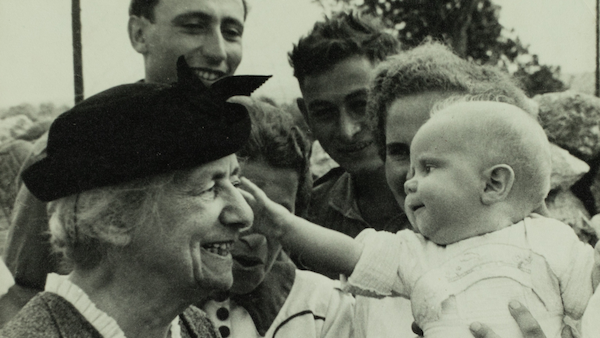
A sene from Abby Ginzberg’s Labors of Love. Photo: Jewish Film Institute
Though not as well-known as Lanzmann, the subject of Abby Ginzberg’s Labors of Love: The Life and Legacy of Henrietta Szold (2026; screens April 12 at 4 p.m. at the Coolidge Corner Theatre) might have had an even greater impact on history.
Szold (1860-1945) was a pioneer for women’s rights (“the greatest feminist, Jewish icon you’ve never heard of,” in the words of one interviewee) who founded night schools for immigrants in her native Baltimore. A trip to Palestine alerted her to the crisis in medical care for the poor in what was then part of the Ottoman Empire. So she created the Hadassah in 1912, which helped establish a health care and education system for all who needed it in that enclave.
With the rise of the Third Reich she assisted in initiating Youth Aliyah, an operation that rescued 11,000 Jewish children from Nazi-occupied Europe. Though a Zionist, she broke with the patriarchal branch of the movement in her insistence that no independent state of Israel could survive if it failed to grant equality to both Arabs and Jews, a warning that today remains sadly unheeded.
Expertly orchestrating such conventional documentary devices as archival footage and photos, newspaper clippings, and interviews, Ginzburg augments Szold’s story with a personal connection. One of the few reenactments in the film is Szold’s collaboration and unrequited romance with renowned Talmudic scholar Rabbi Louis Ginzberg, which ended in humiliating fashion when the Rabbi, who was unaware of her feelings for him, told Szold he was engaged to another woman. A tough break for Szold, but lucky for the filmmaker – Rabbi Ginzberg would become her paternal grandfather.
The screening will be followed by a panel discussion with filmmaker Abby Ginzberg; Judith Rosenbaum, CEO of the Jewish Women’s Archive; and Shulamit Reinharz, film interviewee and Brandeis University Professor Emerita.
Peter Keough writes about film and other topics and has contributed to numerous publications. He was the film editor of the Boston Phoenix from 1989 to its demise in 2013 and has edited three books on film, including Kathryn Bigelow: Interviews (University Press of Mississippi, 2013) and For Kids of All Ages: The National Society of Film Critics on Children’s Movies (Rowman & Littlefield, 2019).
Tagged: "All I Had Was Nothingness", "Labors of Love: The Life and Legacy of Henrietta Szold", Abby Ginzberg, Coolidge Corner Theatre, Guillaume Ribot, museum-of-fine-arts-boston