
Theater Review: Spinning Kindness and Connection — “Charlotte’s Web” at Wheelock Family Theatre
By Joan Lancourt
With its production of Charlotte’s Web, WFT has created a lovely, balanced experience — by turns obvious and full of nuance — that offers life lessons and the value of multigenerational sharing.
Charlotte’s Web, adapted by Joseph Robinette. Based on the book by E.B. White. Directed by Ilyse Robbins. Staged by the Wheelock Family Theater at 200 The Riverway, Boston, through April 26.
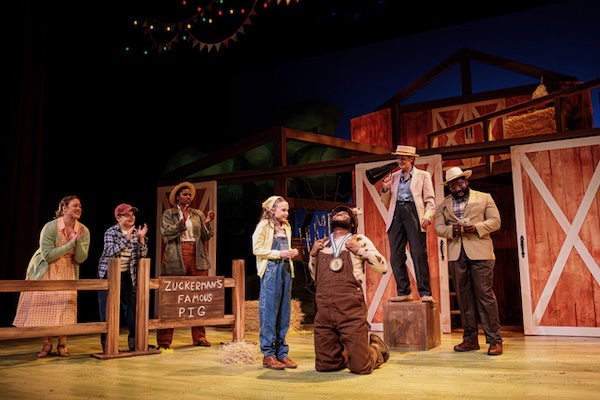
The cast of the Wheelock Family Theatre production of Charlotte’s Web. Photo: Benjamin Rose
Wheelock Family Theatre’s (WFT) final production for the season is a lovingly crafted stage version of E. B. White’s Charlotte’s Web, one of the best-selling children’s books of all time. I was smack in the middle of the age cohort for which it was written (8-to-12-year-olds) when it was first published in 1952 but, for whatever reason, it was not among the many books my parents chose for me at that age. More’s the pity. It was more than half a century before I was introduced to the story in an intimate production at a Theatre for Young Audiences (TYA) conference in the D.C. area. I was charmed –– proof of the story’s ageless appeal. The play’s themes of friendship and death are relevant at every stage of life, and WFT’s full-scale production, adapted by Joseph Robinette and directed by Ilyse Robbins, introduces them in a gentle but focused way.
Wilbur, a newborn pig, the runt of the litter, is about to be killed when Fern, the farmer’s daughter (earnestly played by Anna “AK” Kovaz), persuades her father to let the piglet live.
The message is clear –– that life is precious, even if one appears to have been born with a lesser chance of survival. With Fern’s protection, Wilbur flourishes. However, while extracting the promise that she can visit Wilbur anytime she wants, she is unable to prevent her father from ultimately selling Wilbur to her uncle, Mr. Zuckerman, a neighboring farmer. The story then shifts to Zuckerman’s barn, with its farmyard population of various animals: a goose and a gander, a curmudgeonly old ram, Templeton, a self-serving, always-hungry rat, and the eponymous spider, Charlotte. Once again, the ram raises the specter of death when he tells Wilbur that Zuckerman’s goal is to fatten him up so that he can sell him as ham and bacon. Wilbur is crestfallen and frightened until Charlotte, delicately and engagingly played by Anna Slate, assures him that she will find a way to prevent his untimely demise. She’s as good as her word, using her web-making skills to weave, as if by magic, a series of complimentary words describing Wilbur –– terrific, radiant, and humble –– into her spider’s web.
This brings Wilbur fame in the form of tourists eager to see these mysteriously written words, and a decision by Zuckerman to take Wilbur to the county fair in the hopes that this amazing occurrence will win him a blue ribbon. Unfortunately, Uncle, an arrogant, pompous, and self-absorbed pig (played with laugh-out-loud gusto by David Jiles, Jr.) from a neighboring farm, ultimately wins the blue ribbon. But Wilbur is awarded a prize created just for him, thereby ensuring that he will avoid an early death and live a comfortable life.
Charlotte, having exhausted herself in weaving the series of words into her webs, is not so lucky. Having performed her biological function of ensuring the next generation of spiders by weaving her “egg sac,” Charlotte comes to the end of her naturally short lifespan. Slate made the moments of her farewell to Wilbur, in which she extols the special meaning their friendship has given to her life, deeply touching. And Wilbur repays her friendship with his own, guarding her egg sac after she is gone –– and when the 500-plus baby spiders are born, he devotedly keeps watch over the three who decide to remain in Zuckerman’s barn. Both actors created characters who personified the belief that there are more important things in life than just thinking of yourself.
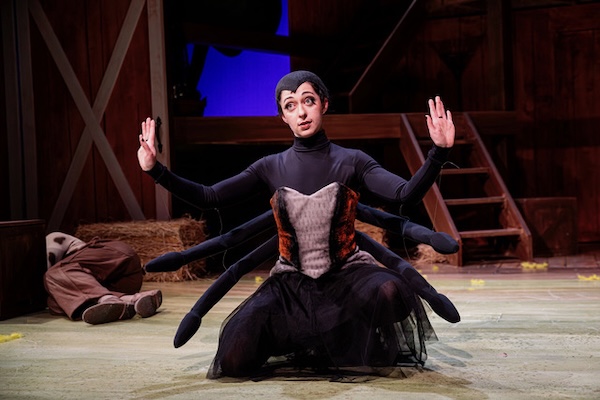
Anna Slate as Charlotte in the Wheelock Family Theatre production of Charlotte’s Web. Photo: Benjamin Rose
It would be hard to imagine a more perfect way to introduce the next generation of humans to the importance and value of friendship –– to the power of kindness and empathy for others, especially those different from yourself, and to the elements of selflessness, sacrifice, and creativity that play a part in weaving those enduring bonds –– and, of parallel importance, how the various eclectic personalities of the barnyard community (including the self-serving Templeton and insensitive ram) can be woven together to create a home of safety and durability.
As usual with WFT, the production values are high. The sets by Shelley Barish enable vertical as well as horizontal movement and are easily reconfigured for the various changes of scene via sliding barn doors and moveable fences and bales of hay. Of special note are Sophia Baramidze’s costumes for Charlotte, devised to enable her to move her multiple arms in graceful unison; and, in the white-feathered jackets of Goose and Gander, Janelle Grace and Tader Shipley managed a distinctive walk and shoulder shimmy that anchored the anthropomorphism of the barnyard critters in the animal world. The acting was uniformly good, with Malik Mitchell deserving special praise for creating a Wilbur that was both vulnerable and joyful and with whom the young audience could easily identify.
And identify they did! It was gratifying to see the large WFT theater just a tad under “sold out,” with youngsters ranging in age from 3 or 4 years old to 12 or 13. Charlotte’s Web is also a perfect example of how TYA theaters can address issues related to all manner of differences, othering, diversity, equity, and inclusion without needing to label them as such. The barnyard becomes an apt metaphor that illustrates the many ways that animals and people of all kinds can come together. While the excellent teachers’ guide and parental guide available online don’t explicitly focus on difference, they include multiple ways to engage children of all ages in experientially based dialogue about the nature of friendship, courage, and selflessness; the importance of taking action by speaking out, as Fern does when an injustice is about to occur; grieving; and the significance and value of community.
On a scale of 1–5, Charlotte’s Web is a welcome 5: WFT has created a lovely, balanced experience — by turns obvious and full of nuance — that offers life lessons and the value of multigenerational sharing.
Joan Lancourt, Ph.D., is the author of More Than Entertainment: Democracy and the Performing Arts Junior Programs, Inc. (1936-1943), Pioneers of Theater for Young Audiences. The book, a carefully detailed documentation of Junior Programs’ seven years of successful productions for children, and their legacy and lessons for today’s TYA theaters and practitioners, was published in January 2025. It has been nominated for the American Alliance for Theatre and Education’s Book of the Year Award.