
Film Review: “Mother of Flies” — Nature is, Well, Healing
By Peg Aloi
This is pure cinema, unpretentious, rough-hewn, mystical, conjured from the earth, offered up at the forest altar of whatever flesh-and-blood gods are still listening.
Mother of Flies, directed, written, edited, and scored by John Adams, Zelda Adams, and Toby Poser. Streaming on AMC+, Shudder (including via Amazon Channel, Apple TV Channel).
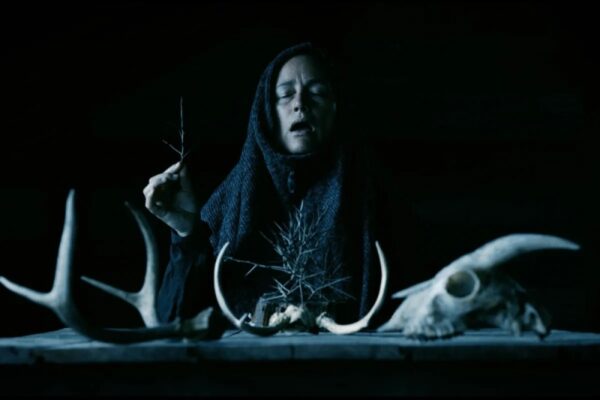
A scene from Mother of Flies. Photo: courtesy of Shudder
Let me tell you about indie filmmakers. They’re different from you and me. They’re not in it for fame and fortune. They’re in it for love and art. This feels even more true for indie horror filmmakers, a cinematic genre that’s chockablock with quirky creators who are themselves huge fans of horror. Low-budget filmmaking is not for the faint of heart, perhaps not even for those of sound mind. But sometimes, if their amateur creations break through and catch on, these creatives land distribution deals and become a genre phenomenon and part of the discourse — and guess what, they still keep being all about love and art. For my money, there is absolutely no one making horror cinema these days like the Adams family is making horror cinema.
Their latest film (and their eighth feature!) Mother of Flies is set once again in the forest-clad Catskill mountains of upstate New York, like their sixth and seventh features, Hellbender (2022) and Where the Devil Roams (2023). Mother of Flies contains some intriguing references and links to Hellbender, the movie that put these filmmakers on the map. A chilling story of a lonely teenager who learns she’s descended from an ancestral family of women with supernatural powers, the film was critically acclaimed and earned wide distribution. It was gifted the holy grail for indie horror — being featured in an episode of “The Last Drive-In” with Joe Bob Briggs. The film’s mother-daughter rock duo is based on the family’s own original band, H6LLB6ND6R, whose spare, compelling, post-punk music is also featured in Mother of Flies.
The vast sylvan landscape where this filmmaking family (mostly) lives and works with their company, Wonder Wheel Productions, serves as the perfect setting for its latest, a dark folk horror tale of witchcraft, healing, and revenge. The film is now streaming on multiple channels after a critically acclaimed and successful run in the festival circuit and a hotly-anticipated debut on Shudder. The intimate realism that characterizes this collective’s films is writ large here, and the story feels particularly personal and authentic — it was inspired, apparently, by actual events.
The film begins with a gruesome visual vignette, featuring a mysterious woman covered in what looks like blood and filth. The mood thus set, we cut to a mundane scene: Young Mickey (Zelda Adams) is leaving her college dorm for summer break, and is asked by the resident advisor if she’s okay. “Has it come back?” she asks. We know, instinctively, that this must be cancer, a devastating diagnosis for such a young person. Mickey says she’s fine, but seems unconvinced. If this wasn’t a horror movie, we might be steeling ourselves for a story of sadness and loss. But this is horror, and what’s more, it’s horror from filmmakers whose stories are anything but rote or predictable. Mickey’s calm but detached demeanor and tired eyes tell us she’s had a difficult struggle.
Mickey’s father Jake (Zelda’s real life dad, John Adams) comes to pick her up. They mention her mom, who died some time ago. The father-daughter bond is warm and casual, a connection that helps as they navigate Mickey’s illness. They’re driving to a place for some sort of treatment Mickey has heard about. On the way, they stop at a diner, then a motel, as they drive deeper into the mountainous forest. After eating a burger at the diner that makes her sick, we understand Mickey may be on borrowed time. Jake is concerned about what the treatment will cost; Mickey assures him that it is free, which sets off some alarms. When dad asks how she found this healer, Mickey says the woman reached out to her. A scary revelation, yes, but so is being diagnosed with cancer as a teenager. With nothing to lose, Mickey boldly decides that venturing into the forest to be cured by a witch is as good an idea as anything else she’s tried. Jake is skeptical, even snarky, but he’s willing to do almost anything to help his daughter.
The witch, Solveig (Toby Poser, real-life mom to Zelda), lives alone in a big sturdy wooden house surrounded by green mossy woods and large cylindrical piles of stones. We see her wandering through the sun-dappled trees, and hear her speak in hushed, incantatory tones about death and nature. One almost expects the house to sit on chicken legs, like the forest hut of Baba Yaga, the fabled witch of Russian folklore. In fact, the inside of the house turns out to be what is curiously fantastical. Solveig greets her guests and shows them to their rustic accommodations. Mickey’s room is full of lush green mosses and branches, while Jake’s has rough, bark-covered limbs and branches with thorns. If this décor adorned the rooms of a high-end restaurant in the city, it would be labeled an exercise in faerycore. The food would be served on shaved disks of cedar with twiggy chopsticks and would cost hundreds per entree.
Solveig greets her guests and shows them to their rustic accommodations. Mickey’s room is full of lush green mosses and branches, while Jake’s has rough, shaggy bark and thorny, twisted limbs. If this décor adorned the rooms of a high-end restaurant in the city, it would be called dryadcore, and serve wildly-overpriced food on chunks of wood with twiggy chopsticks. Here, it’s unsettling yet oddly alluring. Mickey sleeps soundly in her forest chamber; Jake has disturbing dreams.
Solveig’s hospitality is sincere but low key. She seems unaware that her home is like something out of a Victorian children’s book. Similar to the witchy cuisine in Hellbender, the food she offers her guests is meager and weird: dried leaves, pine cones, small wild apples, a speckled bird’s egg, and wrinkly mushrooms gleaned from the forest. Mickey beams, Jake rolls his eyes, and Solveig tries to explain the nature of sacrifice, pain, and grief. Jake’s dismissive hostility is gradually worn down by Mickey’s all-in optimism. It turns out Solveig has motives beyond wanting to help, buried in a torturous past.
What follows is a journey towards healing and redemption, and includes some of the most brutally juicy body horror I’ve ever seen. Even if you don’t like that sort of thing, Mother of Flies still works its magical wiles on the viewer, with its whimsical production design, witchy poetic voiceovers (Toby Poser is mesmerizing), and dreamy cinematography. There are some occasional unavoidable markers of low-budget horror cinema, but these filmmakers labor to get the important things right: the camera work, sound, and special effects are all first-rate — and one hundred percent analog. The level of technical sophistication here is damned impressive — especially given the tiny production crew behind these films, and the scrappy, DIY nature of the art direction. This is pure cinema, unpretentious, rough-hewn, mystical, conjured from the earth, offered up at the forest altar of whatever flesh-and-blood gods are still listening.
Peg Aloi is a former film critic for the Boston Phoenix and member of the Boston Society of Film Critics, the Critics Choice Awards, and the Alliance for Women Film Journalists. She taught film studies in Boston for over a decade. She has written on film, TV, and culture for web publications like Time, Vice, Polygon, Bustle, Dread Central, Mic, Orlando Weekly, Refinery29, and Bloody Disgusting. Her blog “The Witching Hour” can be found on substack.