
Music Festival Review: Big Ears 2026 — Guitars, Big Bands, and a World of Unhinged Sounds
By Noah Schaffer and Paul Robicheau
Over four days of listening (and walking), we found that the 13th Big Ears reaffirmed its reputation for daring curation—fostering a community of eager listeners always ready to discover something new.
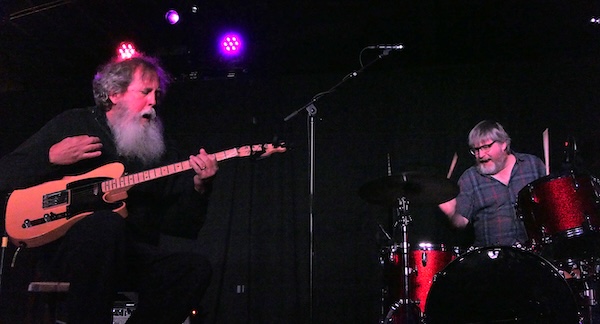
Bill Orcutt and Steve Shelley at Big Ears. Photo: Paul Robicheau
For 20 years, Ashley Capps hosted a show on a Knoxville noncommercial radio station called “Unhinged,” a freeform program where the music of John Zorn, Steve Reich, Richard Thompson, Ethiopian pop, and Sonic Youth might all be heard back-to-back.
Capps went on to found Bonnaroo, but in recent years he’s focused his efforts on Big Ears, which he characterized, during one of the Tennessee fest’s panel discussions, as being a bit like his old radio show come to life. Indeed, from March 26-29, people could hear Zorn, Thompson, and two Sonic Youth alumni, performances of Ethiopian pop, and compositions of Reich. These were part of some 250 shows across Knoxville’s impressive range of theaters, clubs, churches, galleries, including an abandoned Greyhound station.
With as many as 20 of those venues operating simultaneously, no one could see it all. Over four days of listening (and walking), we found that the 13th Big Ears reaffirmed its reputation for daring curation—fostering a community of eager listeners always ready to discover something new. Here are some threads that emerged for each of us over the weekend:
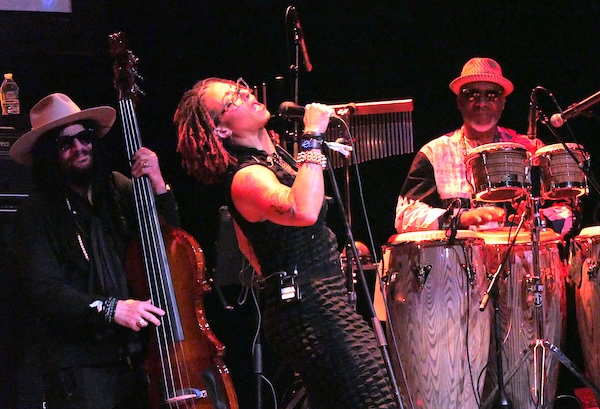
Steffanie Christi’an with Don Was & Pan-Detroit Ensemble at Big Ears. Photo: Paul Robicheau
Expanded visions: Small jazz combos surely soared at Big Ears. Foremost among them was Masada, the darting, dynamic unit of composer/saxophonist John Zorn (who curated sets at the cozy Bijou Theater), trumpeter Dave Douglas, drummer Joey Baron, and acoustic bassist Greg Cohen. In turn, saxman Isaiah Collier’s quartet the Chosen Few honored the centennial of John Coltrane’s birth, taking “Giant Steps” from fiery torrents to fluttering whispers. Yet big bands dominated the festival as well, including conductor Zorn’s freewheeling cue-card game Cobra, bassist/producer Don Was’ Pan-Detroit Ensemble (fronted by brawny singer Steffanie Christi’an uncorking a power-soul take on the Grateful Dead’s entire Blues for Allah), a grooving funk-fusion Miles Davis tribute, and guitarist Nels Cline’s atmospheric Lovers with members of the Knoxville Jazz Orchestra. But the most mind-blowing was the kinetic pianist Brian Marsella’s 12-piece iMAGiNARiUM, which wove electric and acoustic keys, violin, guitar, marimba, and horns into a Zappa-esque circus of sounds, backed by psychedelic/steam-punk animations. – Paul Robicheau
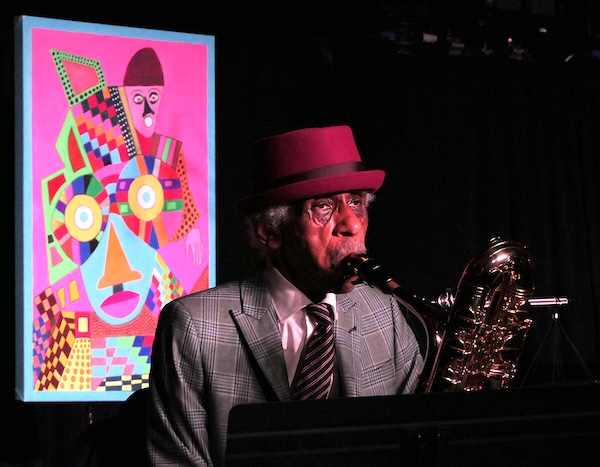
Roscoe Mitchell at Big Ears. Photo: Paul Robicheau
Multigenerational convergences: While there was no shortage of hot young jazz talent, Big Ears has long provided a home for the older avant artists who are typically ignored by other U.S. festivals, such as Marilyn Crispell, who shined in a duo with percussionist Harvey Sorgen. One of the great highlights of the weekend was pioneering drummer William Hooker, whose mix of explosive improvisation and spoken word found him joined not just by fellow violinist Charles Burnham and bassist Jair-Rôhm Parker but also a much younger pianist, Mara Rosenbloom. Chicago bass saxophonist Roscoe Mitchell, 85, showcased both his circular breathing and his visual artwork in his duo set with 45-year-old drummer and Pulitzer Prize winner Tyshawn Sorey. Mississippi’s Annie & the Caldwells, the rare gospel group that has crossed over from church programs to the festival circuit, is a multigenerational group that has kept it all in the family. Caldwell was joined by her guitarist husband, singing daughters, and musician sons for a deeply inspiring set that showed how the group has expanded its repertoire and stagecraft since appearing at the 2024 Lowell Folk Festival. – Noah Schaffer
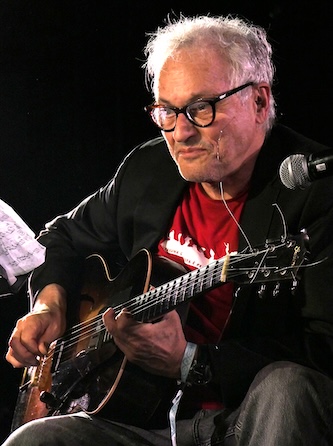
Marc Ribot at Big Ears. Photo: Paul Robicheau
Guitar stars: Jazz guitar virtuosos were around every bend, including Pat Metheny (echoing his eponymous ’80s group on a more tempered scale in the quintet Side-Eye III+), John Scofield, Mary Halvorson, Julian Lage, and Cline, whose sit-ins seemed to rival only those of keyboardist John Medeski. But Marc Ribot made his mark with three varied projects. Joined by Halvorson and added drummer Ches Smith, he revived his ’90s outfit Shrek with tonal painting, which proffered Ramones-like No Wave rumble and funky grooves. Hurry Red Telephone (with Briggan Krauss’ sax replacing a second guitar) summoned spiritual energy as Ribot slid furious riffs over drummer Chad Taylor and acoustic bassist Sebastian Steinberg, only to later murmur the hymn “Down by the River to Pray” while naming the victims of Minneapolis ICE shootings. Ribot’s dusky voice gained focus in a mostly acoustic solo set at a church behind his singer/songwriter-oriented album Map of a Blue City, finding timely resonance in the Carter Family’s “When the World’s on Fire.” – PR
Double drummers: An inspiration to Ribot and Cline in his days as an experimental guitarist, Fred Frith stuck to bass in a pair of bands at Big Ears, his playful Fremakajo (with sax and accordion) and a churning new quartet. That’s where Simon Haynes throttled guitar to Frith’s frisky bottom and occasional vocal screams as they flanked drummers Jordan Glenn (also of Fremakajo) and Max Jaffe. Jaffe later appeared in another double-drummer setup with guitarist Dave Harrington’s Pranksters South, where percussive improv became chaotically interlocked to the point that it stood out alongside such guests as Cline and trumpeter Steven Bernstein. Also, in a modern classical vein beyond double drummers, the four members of So Percussion lined up with Knoxville’s Nief-Norf ensemble to perform Steve Reich’s minimalist piece “Drumming” as one of their three Big Ears programs. – PR
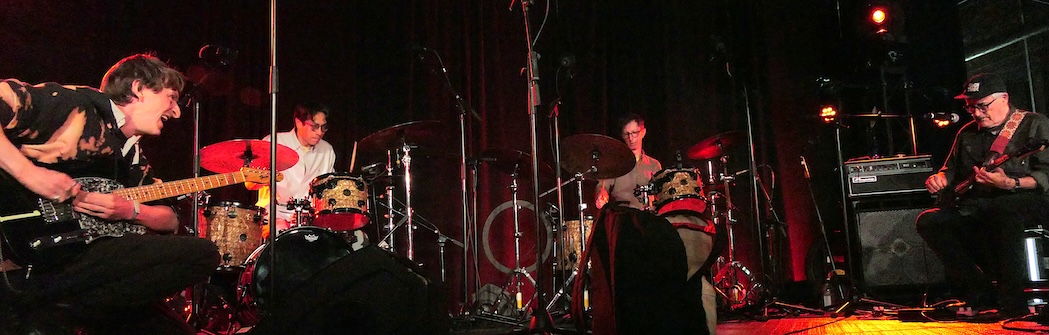
Simon Hanes, Max Jaffe, Jordan Glenn, Fred Frith at Big Ears. Photo: Paul Robicheau
Creative music you can dance to: The jazz-critic community voted vibraphonist/marimba player Patricia Brennan’s last two albums first and second in the Francis Davis Jazz Critics Poll. Live, her septet fully justified that attention as bassist Kim Cass, heavyweight drummer Marcus Gilmore, and burning percussionist Mauricio Herrera lit up her fascinating compositions and saxophonists Jon Irabagon and Mark Shim and trumpeter Adam O’Farrill held nothing back in their solos. While most jazz at Big Ears is presented in sit-down venues, the standing room Jackson Terminal proved to be an ideal spot for this set. Its success raises the question of why more jazz festivals haven’t booked what is such a formidable live band. Another great and beguiling dance set came from drummer/producer Deantoni Park, one of several artists curated by saxophonist Josh Johnson. Park’s one-man Technoself found him with a drum stick in one hand and a sampler in the other. – NS
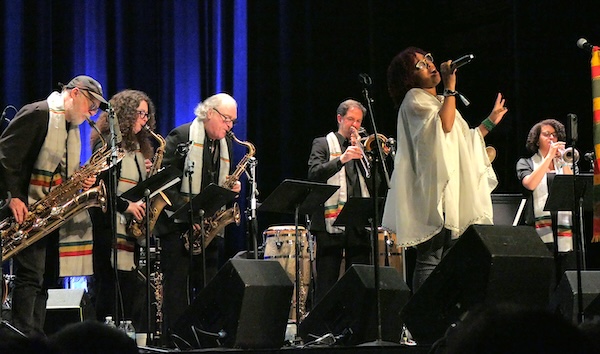
Either Orchestra with Munit Mesfin at Big Ears. Photo: Paul Robicheau
The enduring greatness of Éthiopiques: Nearly 30 years ago, French producer Francis Falceto released the first volume Éthiopiques, a now-32 volume series of classic Ethiopian pop, jazz, and classical music. In the intervening years Ethiopian music became a steady part of Western soundtracks, commercials, and coffeeshop playlists but, as Falceto revealed in a Boyd-hosted panel, this glorious sound was initially ignored. The latest edition features Boston’s own Either/Orchestra in a tribute to Ethiopian-Armenian composer Nerses Nalbandian, whose family instigated the project when the E/O toured Ethiopia. (E/O leader Russ Gershon provided that background in a panel that also included Washington, D.C.-based singer Munit Mesfin.)
Later that day, the music came to life as the E/O spread out over the stage of the Bijou Theatre and joined Mesfin and Bruck Tesfaye (the lead singer of Boston’s Debo Band) for a thrilling set that showed the wide range of Ethio-jazz. The day before, the E/O played their own compositions with music stands adorned by “No Kings!” logos. Another Debo Band alum, accordionist Marié Abe, was part of avant-guitar master Fred Frith’s Fremakajo. Boyd’s many Big Ears activities also included a second installment of a film-and-talk version of his epic book The Roots of Rhythm Remain that found him tying together the 20th century masters of Ethiopian, Brazilian, Argentinean, and Jamaican music. – NS
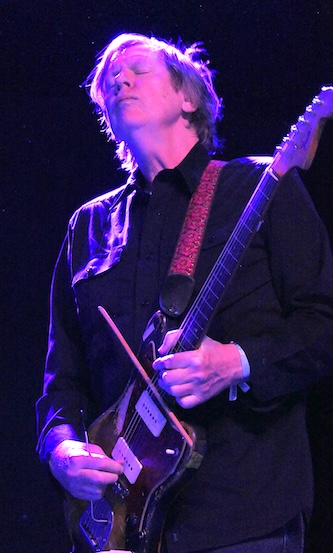
Thurston Moore at Big Ears. Photo: Paul Robicheau
Sonic post Youth: Half of the defunct noise-rockers Sonic Youth convened at Big Ears when guitarist Thurston Moore and drummer Steve Shelley teamed for a pop-up set. But, for Moore, the main event was a duo show with British explorer Shabaka Hutchings (flutes, sax, and electronics) that let him improvise in a space far from rock. He manipulated his strings with a drumstick and whammy bar, picked eerie notes that suggested the theme from The Twilight Zone, then pressed the head of the guitar against his amp to make it moan in pitch. Meanwhile, Shelley bashed away in a power trio with guitarist Bill Orcutt (who cut a gnarly swath on his Telecaster) and equally punchy bassist Ethan Miller. And if all that didn’t supply enough guitar feedback, one could swing by the city’s former Greyhound station to absorb drones from the late Lou Reed’s axes leaned against his amps. – PR
Byrne’s rare air: Artists who play Big Ears are generally those who’ve earned more critical acclaim than actual fame. This year, David Byrne — long an ambassador of underground-to-mainstream audiences — played two nights of separately ticketed shows as part of his tour behind the 2025 album Who Is the Sky? Continuing the conversation he started with American Utopia, Byrne’s audio-visual spectacular enlisted a dozen orange-clad singer/dancer/musicians, all using wireless technology for a tightly and effectively choreographed performance worthy of Broadway. Since Byrne played Boston in October, he’s added to his setlist both Talking Heads’ “Air” and “When We Are Singing,” a song from Who is the Sky? that was arranged by Boston trumpeter Brian Carpenter. The record was made with Carpenter’s Ghost Train Orchestra, which had its own slots at Big Ears, playing music by the street composer Moondog. Byrne was one of several guest vocalists along with Sam Amidon, Joan as Police Woman, and Karen Mantler. A roller-coaster of a second set dove deep into Moondog’s instrumental compositions, with memorable solos from violinist Sara Caswell and bassoonist Sara Schoenbeck. – NS
Anderson’s world: “What do you do when you lose your country?” performance artist Laurie Anderson posed — in her signature deadpan — as she balanced darkness and humor in her Big Ear appearances at a few venues. She shared some sad family history while screening AI-generated photos of her grandfather’s early life (noting that a prompt for a “donkey cart” fused that animal’s front half onto a cart). She duetted with Zorn, who responded to one of her sonorous violin lines with alto-sax squawks, prompting laughter from a Bijou audience. And the tech-savvy performer mused about the power of love from her workstation at the Knoxville Civic Auditorium, though she underused Bernstein’s Sex Mob as her backing band. – PR
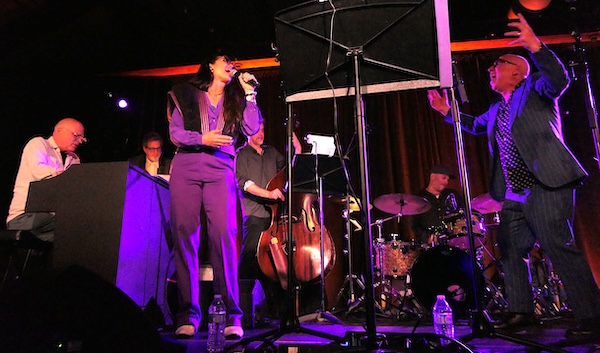
Steve Bernstein’s Millennial Territory Orchestra Plays Sly at Big Ears. Photo: Paul Robicheau
Unusual duos: Asked at a panel about bringing together artists, Capps said that he didn’t attempt forced musical marriages, but will happily encourage a collaboration if he sees artists “flirting.” And many of the best sets at Big Ears came from duos whose instruments or backgrounds made for fascinating and surprisingly successful duets. Wu Fei, who plays the Chinese curved guzheng, paired her astonishing playing with the bass and oud of Shanir Blumenkranz. The harp/accordion duo of Mary Lattimore and Walt Clements was equally mesmerizing in its expansive range of textures and tempos. Maybe the purest moments of musical intensity I witnessed at the festival came during the set by DoYeon Kim, who plays the Korean gayageum. Her arresting, screaming vocals made for a furious contrast with the layered guitar work by her guest Rhafiq Bhatia. – NS
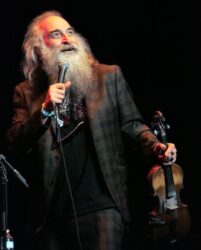
Warren Ellis of the Dirty Three at Big Ears. Photo: Paul Robicheau
Biggest disappointments: With so much on tap, there’s inevitably the rare set that misses the mark. Australia’s titans of instrumental rock, the Dirty Three, are touring the U.S. for the first time in nearly 15 years. But violinist Warren Ellis (known for his collaborations with Nick Cave) rarely made any music. Instead, he spent most of his time in a seeming stupor, delivering Andy Kaufman-style rants and banging on his keyboard. After I bailed, a friend reported that the comedic proceedings continued to descend as Ellis demanded that audience members show him photos of pets on their phones. One hopes it was a very-off night and that the group will be back to its glories when they come to a sold-out Sinclair in Cambridge this Saturday — NS.
The idea of Bernstein’s Millennial Territory Orchestra playing the music of Sly Stone also made that show seem like a sure bet, given its crack horn section, organist Medeski, violinist Charles Burnham, and vocals by Joan as Police Woman and Sandra St. Victor. But the show never really gelled — until Cline arrived to take it higher with a rendition of “Stand.” – PR
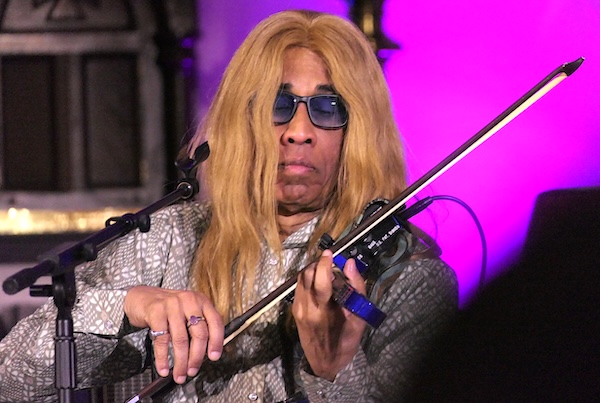
L Shankar at Big Ears. Photo: Paul Robicheau
Innovations in traditional music: Music from around the world has been a Big Ears staple, and that continued, even though the current administration policies have made bringing in international artists harder than ever. (Many of the artists affected by the Mali travel ban have played the festival. This year UK-based dub producer Adrian Sherwood had to scrub his tour because of visa delays.) The daylong Ragamala marathon was a rare chance to hear ragas at their intended time of day, capped by an appearance by L. Shankar, the wild violinist who first came to light with the fusion group Shakti (and also appears Sunday at Regis College in Weston, Mass.). Shankar’s career has included plenty of crossover moments, but at Big Ears he and his double-necked electric violin were paired with Carnatic percussionists Selvaganesh Vinayakram and Swaminathan Selvaganesh (whose respective father and grandfather Vikku Vinayakram was an original Shakti member) for a traditional but still very exciting set of ragas. In a timely reminder that, while war is erupting in the Middle East, it also continues in Ukraine, Big Ears also featured Yagódy, a striking Ukrainian folk/rock quintet of four female vocalists and one disco-leaning male drummer, who are coming to the Crystal Ballroom in Somerville on April 19. One of the best young artists I saw was pianist/singer Brittany Davis, whose Afro-futuristic trio updated the tradition of socially conscious blues. – NS
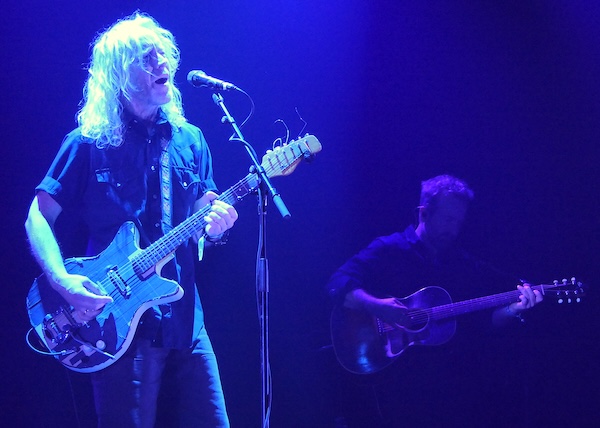
Alan Sparhawk with Trampled By Turtles’ Dave Simonett at Big Ears. Photo: Paul Robicheau
Recast hometown roots: Robert Plant, with his group Saving Grace, performed a sold‑out, ticketed show at the ornate Tennessee Theatre during this year’s Big Ears Festival, immersing himself in the dour, roots‑inflected fabric of his British West Midlands heritage through a set drawn from the Saving Grace repertoire. There were polyrhythmic drums and biting lead guitar as well as banjo and, yes, three Led Zeppelin songs, with Plant lending a subdued slant to “Ramble On” and a strum-stacked “Friends” faring better than “Four Sticks.” But Plant’s harmonies with vocal foil Suzi Dian (plus his harmonica solo in the gospel-folk “Higher Rock”) made the strongest impression. Another moody pairing came when Low singer/guitarist Alan Sparhawk centered Minnesota neighbors in bluegrass-folk outfit Trampled by Turtles for the weekend’s final set at the large industrial space Mill & Mine. The dirge-like “Don’t Take Your Light” was followed by Sparhawk stepping forward to flail his arms in spinning dance moves while singing through a vocoder during “Be Still” — that style-hopping exorcism lent yet another twist to the many surprises at Big Ears. – PR
Noah Schaffer is a Boston-based journalist and the co-author of gospel singer Spencer Taylor Jr.’s autobiography A General Becomes a Legend. He also is a correspondent for the Boston Globe, and spent two decades as a reporter and editor at Massachusetts Lawyers Weekly and Worcester Magazine. He has produced a trio of documentaries for public radio’s Afropop Worldwide, and was the researcher and liner notes writer for Take Us Home – Boston Roots Reggae from 1979 to 1988. He is a two-time Boston Music Award nominee in the music journalism category. In 2022 he co-produced and wrote the liner notes for The Skippy White Story: Boston Soul 1961-1967, which was named one of the top boxed sets of the year by The New York Times.
Paul Robicheau served more than 20 years as contributing editor for music at the Improper Bostonian in addition to writing and photography for The Boston Globe, Rolling Stone, and many other publications. He was also the founding arts editor of Boston Metro.