
Album Reviews: Latin Flair and Jazz Fire — Edward Simon and Alfredo Rodríguez Redefine the Songbook
By Brooks Geiken
Strong albums from trios led by pianists Edward Simon and Alfredo Rodríguez.
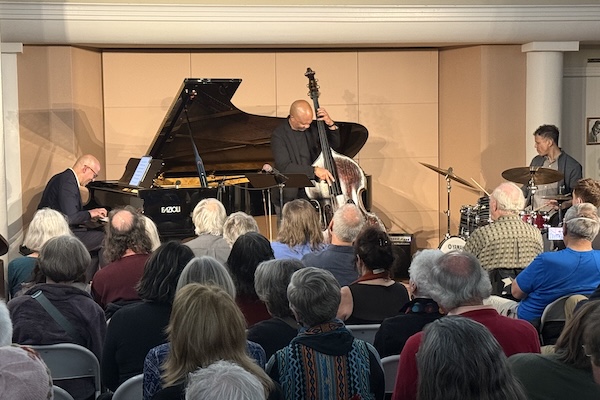
Edward Simon and his trio at the Piedmont Piano Company. Photo: Brooks Geiken
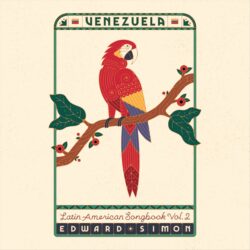
On March 2, Edward Simon and his trio performed at the Piedmont Piano Company. And what a trio it was: Simon on piano, Reuben Rogers on acoustic bass, and Adam Cruz on drums. The show was a celebration of Simon’s new album, Venezuela: Latin American Songbook, Volume 2.
The trio played five selections from the disc with precision and fire in front of an audience that nearly filled the venue on a Monday night. This terrific concert served as a fine introduction to the music on the recording.
Born in Punta Cardón, Venezuela, Simon has a long history of championing popular music from his homeland in a distinctive way, transforming homespun melodies through a jazz sensibility that fuses an irresistible variety of styles.
Simon was a great host that evening, delving into the origins of the music and supplying insights into the composers. The first piece was the complex composition “Dama Antonoña,” which started subtly and moved through five or six changes in tempo and mood. Cruz and Rogers provided strong support during this tune, as they did for all the others. Simon’s beautifully lyrical piano work captivated throughout. In addition to performing with Rogers and Cruz, he has held the piano chair in the SFJAZZ Collective for 16 years and leads another trio, The Three Visitors, with Scott Colley on bass and Brian Blade on drums.
The light and lovely song “Presagio” (“Omen”) was next, giving Cruz an opportunity to display his chops. By the time the group charged into the third number, “Sabana” (“Savannah”), they were firing on all cylinders. The woody sound of Rogers’s bass filled the hall with warmth, and Simon’s playing evoked considerable emotional depth as he channeled the blues, as well as influences from classical and pop music.
The origin of the next song was of particular interest because it is the only track on the album not composed by a Venezuelan. Jacob do Bandolim was an important instrumentalist and composer of Brazilian music. The style he focused on was called choro; there is a similar kind of music in Venezuela known as joropo. According to Simon, everyone plays “El Vuelo de la Mosca” (“The Flight of the Fly”) in Venezuela. On the album, Jacqueline Rago plays the cuatro and maracas, which makes the performance feel even more authentic. Rago was not present at the gig, but the band played a lively version of the tune at a breakneck tempo.
To round out the tunes from the album, the band offered a grand statement with “Anhelante” (“Longing”). Then came the last song of the evening, a danceable melody by Simon titled “Pere.” The three musicians blended together seamlessly as they honored Simon’s lilting composition.
The only tune they didn’t play from the recording was the ballad “Atardecer” (“Sunset”), composed by Alejandro Luis Laguna. The evocative, intimate melody receives an insinuating treatment by Rogers on bass and Cruz on brushes. By letting the music breathe, Simon creates a serene, end-of-the-day mood.
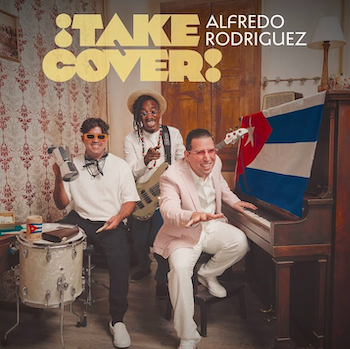
Another intriguing recording of recent vintage, ¡Take Cover! from Cuban pianist Alfredo Rodríguez and his trio, explores cover tunes you may have heard often before — but never performed with such captivating Cuban flair. Rodríguez and his partners, Yarel Hernández on electric bass and Michael Olivera on drums, roar through eleven songs, applying rhythmic intensity or nuance as needed.
The selections run the gamut. There are movie themes (Henry Mancini’s “The Pink Panther”) and pop hits (Stevie Wonder’s “I Wish”). The eclecticism extends to an old Cuban classic, Ernesto Lecuona’s “La Comparsa,” and a rollicking version of the Eagles’ “Hotel California.”
Problems arise with some of the arrangements and song choices. The formulaic approach to “Theme from Mission: Impossible,” “Barbie Girl,” and “Chariots of Fire” is surprisingly uninspired. The tunes are all attacked in a uniform manner: an initial brisk tempo is followed by a piano montuno section. It is engaging at first, but predictability inevitably sets in. As for the song selections, I could do without “The Final Countdown,” along with the aforementioned “Theme from Mission: Impossible,” “Barbie Girl,” and “Chariots of Fire.”
What initially grabbed me about this recording was hearing Pedrito Martínez sing lead vocal on the flamenco crossover hit “Entre Dos Aguas” by the late Spanish guitarist Paco de Lucía. The trio reimagines the tune, hewing to its essence but expanding it into swinging Cuban territory. Martínez’s vocal on the tune is delightful as it evokes the idea of “the two waters” blending together, from La Habana to Andalucía. Also winning are the Tito Puente–penned “Oye Como Va” and the Mexican folk song “La Cucaracha.” They are given unexpected treatments — Rodríguez sets Oye Como Va at a brisk tempo, and Hernández and Olivera handle the folk tune with their usual dexterity.
Even though most of the album is instrumental, the vocals from Alain Pérez and Pedrito Martínez on “The Pink Panther” and “Hotel California” are quite exceptional. The Spanish lyrics complement the tunes and are sung with conviction.
Still, despite the perfunctory arrangements on several of the songs and the occasional silly tune selections, I would recommend listening to ¡Take Cover!. Rodríguez, Hernández, and Olivera’s infectious romp through a wide variety of popular songs generates plenty of fun.
Brooks Geiken is a retired Spanish teacher with a lifelong interest in music, specifically Afro-Cuban, Brazilian, and Black American music. His wife thinks he should write a book titled The White Dude’s Guide to Afro-Cuban and Jazz Music. Brooks lives in the San Francisco Bay Area.
Tagged: "Venezuela: Latin American Songbook Volume 2", "¡Take Cover!", Alfredo Rodriguez