
Visual Arts Review: Wifredo Lam at MoMA — Decolonizing the Modernist Dreamscape
By David D’Arcy
Wifredo Lam can now be seen almost in full in New York — except for his many drawings, which might get a showing soon while the public’s interest is piqued. As for the artist’s paintings in Cuba that never reached MoMA, Americans (perhaps in uniform) might have a chance to see them soon enough.
Wifredo Lam: When I Don’t Sleep, I Dream at MoMA, New York, through April 11.
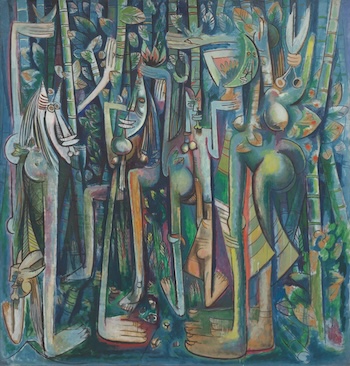
Wifredo Lam’s The Jungle. Photo: courtesy of MoMA
If visitors to the first overview in New York of Wifredo Lam (1902-1982) will recognize anything, it will be his painting The Jungle (“La Jungla,” 1943), a thicket of human forms amid vertical and vegetal green shapes, evidence of how the artist reconnected to the Caribbean after a long time away.
Note that many of the real jungles of Cuba, Lam’s birthplace, had long before been replaced by plantations growing sugarcane, harvested by the descendants of African slaves and Chinese indentured workers. Lam’s father was Chinese, a fact which kept Wifredo, by law, from becoming a Cuban citizen until he was 21. His mother was of African and Spanish descent. The Jungle, his verdant elegy to his home island, is also a meditation on rural servitude.
Lam would explore and blend these human, animal, and vegetal forms in his work for decades to follow.
The Jungle was acquired by MoMA in 1945 and has been shown there since, mostly near an entrance. It was, as they say, good exposure, despite jokes about the picture being invisible in plain sight because it had not been positioned with other works along MoMA’s long gallery march through modern art.
Location matters, and the entrance to the exhibition Wifredo Lam: When I Don’t Sleep, I Dream is a procession toward The Jungle. Along the way, even the lucky few who know Lam will find previously unseen surprises. (The artist’s works in Cuba sought for the show never made it — out of fear that they might be seized.)
In 1992, the Studio Museum in Harlem presented Wifredo Lam and His Contemporaries, 1938–1952. Some readers may remember that the McMullen Museum of Art at Boston College organized the 2006 exhibition Wifredo Lam: Imagining New Worlds. (Arts Fuse review) The show then traveled to the High Museum in Atlanta. A scholarly project, the gathering lacked the major works that can be viewed at MoMA.
Visitors to MoMA will get a sense (still not complete) of Lam’s vision, which so many critics still struggle to define.
Making good on MoMA’s promise to show Lam’s breadth, a few steps inside the show there’s The Civil War (1937), a huge picture painted in Spain on paper (a cheap material), mostly in blue and black. We see shootings, resistance, and the mourning for lives lost. The picture looks as if it was painted in slashes, frenzied with emotion.
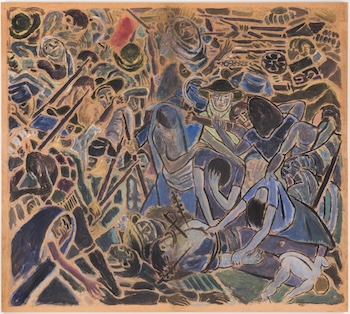
Wifredo Lam’s The Civil War. Photo: courtesy of MoMA
Lam, who left Cuba for Spain, had taken sick while preparing the ammunition for the Republican (antifascist) forces fighting Francisco Franco’s Nazi-supported Phalangists. Is The Civil War Lam’s Guernica? The comparison with Picasso is inevitable — the clearest similarity is its depiction of a savage rehearsal for the bigger war to come.
Early works in the show include smaller pictures that reveal Lam’s precocious skills and his influences. Self-portraits painted at that time are often inspired by Matisse and Picasso; they move from careful observations by a young man toward pictures of iconic figures without discernible faces. By 1931, Lam was impoverished and had lost his wife and baby son to tuberculosis. “That sad experience provoked in me a great rebellion against regimes that make the rich richer and the poor poorer,” he recalled.
Lam later gravitated toward the surrealists in Paris, the artistic “in crowd” of the time. As the Nazis occupied France, he fled with members of the group to Marseilles, painting while waiting for transport abroad. At that time he participated in games around making art that the Surrealists called Exquisite Corpses. Life would change radically once he got on a ship to the Caribbean and reconnected with the land of his origins — he couldn’t get a visa to the US or Mexico. In that period he also connected with the poet Aimé Césaire, a fellow critic of colonialism, who became a lifelong friend and muse.
In the just-published English translation of the monograph Wifredo Lam, Jacques Leenhardt writes that the artist’s anticolonialist politics were reinforced, and his painting pivoted:
With each of these opportunities to move toward another aspect of human, cultural and psychological reality, Lam was searching for possible viewers who would recognize themselves in his paintings. Was he seeking to show recognizable objects in the mirror his works held up? Certainly not. Lam copied no existing things, he had no interest in mimesis. On the dark surface behind the mirror, he painted a human reality whose advent he sometimes despaired of ever seeing.
The title for MoMA’s exhibition comes from Lam’s 1955 painting of an angular reclining figure, with pig-like attributes, set against a dark background. For all the exuberant colors of The Jungle, most of the time Lam didn’t celebrate a “tropical” palette. He often worked in shadows, close to monochrome, an approach that makes his images feel like recurrent dreams. Color, often muted, returned in later abstract works.
As the show’s title suggests, those pictures involved the shedding of inhibitions, the freedom of dreams, a principle at the core of surrealism. Figures often stand upright, with attributes from humans and animals, arousing and being aroused through a sensuality that feels unrestrained. 1944’s The Eternal Present (also called “The Eternal Presence”), a hypnotic cosmology of imaginative eroticism, with its golden glow, is on loan to MoMA from the Rhode Island School of Design. The painting’s mythic shapes feel remarkably alive.
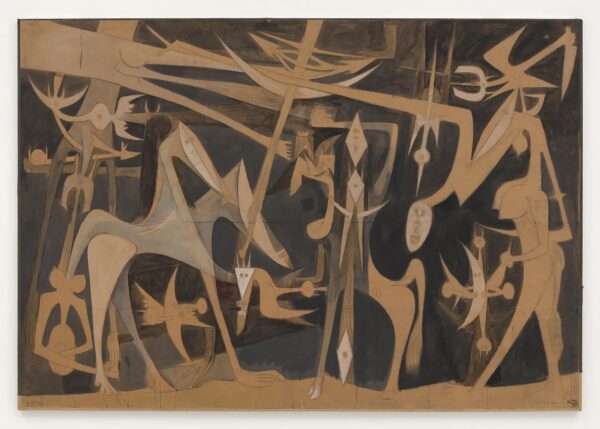
Wifredo Lam’s Grande Composition. Photo: courtesy of MoMA
MoMA’S catalogue quotes Lam (from a Cuban publication) about the efforts of critics to categorize him:
I’ve been considered a painter of the School of Paris, a Surrealist painter, or whatever other movement, but never as a representative of the painting I truly do, in which I believe I largely reflect the poetry of the Africans who arrived in Cuba, a poetry that still holds much pain hidden in its songs.
This sensibility surges out of Lam’s works from that time. In 1949, he painted Large Composition — “large” being the key word here — with multiple figures looking out from the frame as they are being observed, a trick he learned from Picasso (especially Les Demoiselles d’Avignon), whose influence was hard for him to shake. There Lam moved from visualizing a dream to a world of dreams. This painting, as crucial to the exhibition as The Jungle, is being shown in New York for the first time. It was bought by MoMA as the exhibition was being prepared, purchased from an owner in France who told the would-be borrowers at the museum that if they wanted to show this massive work, they would have to buy it. MoMA was lucky to have donors who could afford it. (I don’t know the exact price.) Let’s hope that the museum finds a place to keep it on view after the retrospective closes.
When Wifredo Lam: When I Don’t Sleep, I Dream opened, questions resurfaced on why it took so long to happen, and whether Lam should be called a modernist, a surrealist, a Cuban, or something else — a debate that that the artist himself tried to put to rest. Lam spent the last decades of his life in Europe, mostly in Italy at the end. Still, the Cuban government in Havana adopted him as one of their own. The painter, a Castro supporter when the revolution triumphed, didn’t object. But hard-line Cuban exiles in the United States considered him to be an enemy (which is one explanation for why it took so long for the MoMA show to take place). That said, Cubans in anti-Castro Miami still bought his work when they could get it.
There is more of Lam to be seen, especially his drawings, an opportunity to be seized while the public’s interest is piqued. As for the artist’s paintings in Cuba that never reached MoMA, Americans (perhaps in uniform) might have a chance to see them soon enough.
David D’Arcy lives in New York. For years, he was a programmer for the Haifa International Film Festival in Israel. He writes about art for many publications, including the Art Newspaper. He produced and co-wrote the documentary Portrait of Wally (2012), about the fight over a Nazi-looted painting found at the Museum of Modern Art in Manhattan.
Tagged: "Wifredo Lam: When I Don’t Sleep I Dream", Cuban Art, MoMA