
Theater Review: “Suffs” Marches On — Without the Fire Its Story Deserves
By Debra Cash
Suffs bounces through a timeline of conferences, direct actions, interpersonal snits, and self-questioning over whether the entire endeavor is really worth it.
Suffs, book, music and lyrics by Shaina Taub. Directed by Leigh Silverman. Presented by Broadway in Boston at the Emerson Colonial Theatre, Boston, through March 29.
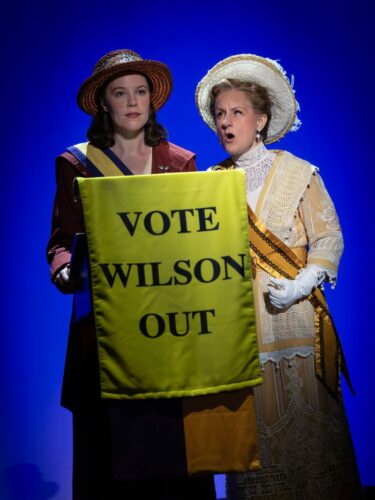
Maya Keleher as Alice Paul and Marya Grandy as Carrie Chapman Cat in the touring production of Suffs. Photo: Joan Marcus
Given that last August Secretary of Defense Pete Hegseth–no, sorry, Secretary of War–posted Christian Nationalist pastor Doug Wilson’s opinion that women should submit to their husbands and not vote independently (a position that the Secretary’s staff later found it had to walk back in the face of a subsequent furor), and that the anti-trans SAVE Act being debated in the Senate this week would require voters to prove their identities with the name given on their birth certificates, effectively throwing up barriers to any woman who has changed her name after she got married, it would seem that this is the perfect moment for the national tour of Shaina Taub’s Tony-winning musical Suffs.
The nearly sung-through show tells the story of the final stages of the fight for the 19th Amendment to the Constitution through the story of the schism between two women’s suffrage leaders, Carrie Chapman Catt (performed in this national tour by Marya Grandy) and Alice Paul (Boston Conservatory grad Maya Keleher in the role Taub created for herself at the Public Theater and on Broadway).
We meet Catt, a mature veteran of suffrage campaigns, and get a bead on her tactics right away: the first song in the musical is “Let Mother Vote.” Framed as a sentimental appeal, Catt’s suffrage fight depends on respectability (“we’ll tidy up your politics until they’re pristine,” she sings) and ingratiating herself to people in power.
Alice Paul, on the other hand, is a fervent hothead who will do whatever it takes to make the dream of women’s enfranchisement come true. Paul’s posse includes the meek but helpful amanuensis Doris Stevens (Livvy Marcus), lively labor organizer Ruza Wenclawska (Joyce Meimei Zheng, with an iffy Polish accent), close friend Lucy Burns (Gwynne Wood), and the freethinking, cigarette-smoking, theatrical socialite Inez Milholland (warm-voiced Monica Tulia Ramirez). The men who oppose them is exemplified by President Woodrow Wilson (Jenny Ashman, cross-dressed with a top hat). His condescension is second only to his gaslighting.
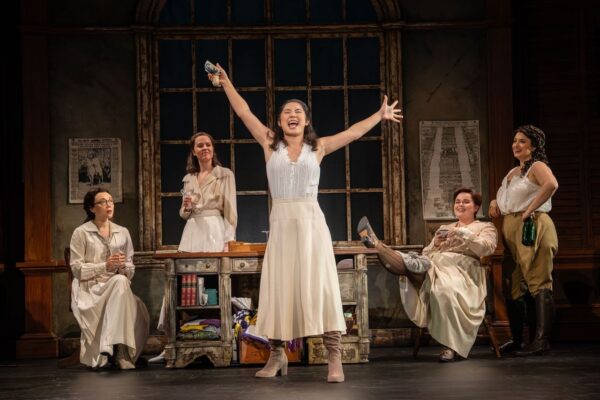
Joyce Meimei Zheng (Ruza Wenclawska) and company in the national touring production of Suffs. Photo: Joan Marcus
But the suffragettes have their blind spots, too. Even if you’ve heard the story before, it’s shocking when Paul tells journalist and anti-lynching activist Ida B. Wells (Danyel Fulton) that Black women will be relegated to the back of the parade the suffragettes are planning and instructs Wells to wait “her turn.” Fulton plays Wells with grave self-possession; she absorbs Paul’s words like a blow but stays on her feet, only sharing her dismay and commitment to resistance with her friend Mary Church Terrell (a delicate Trisha Jeffrey).
If Sherman Edwards’ 1776 is at one end of the historical musical spectrum and Hamilton falls at the other, Suffs falls somewhere in the middle. The great crises of the republic are distilled through famous and less-famous personalities in the hope that audiences will recognize what was at stake on the way to the world we live in now, and, with luck, remember the names of those who fought for progress. Suffs bounces through a timeline of conferences, direct actions, interpersonal snits, and self-questioning over whether the entire endeavor is really worth it. The political is personal.
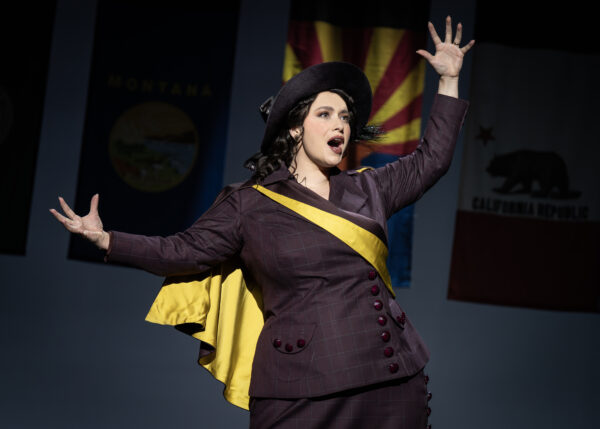
Monica Tulia Ramirez as Inez Milholland in the touring production of Suffs. Photo: Joan Marcus
Sadly, Taub’s research falls flat when director Leigh Silverman has to depict the violent 1917 imprisonment, hunger strike, and force feeding of Paul and her suffragette friends. This harrowing experience should be the beating heart of Suffs, as it was with Sarah Gavron’s somewhat overlooked 2015 feature film Suffragette. Instead, here the women stumble, wrists crossed behind their backs, bang their metal dishes, and crumple to the floor. During a later scene, beautifully set against a simulacrum of the iron gates to the White House, (originally designed by Riccardo Hernandez with the tour version adapted by Christine Peters) the suffragettes burn Wilson in effigy: through haze, they resemble nothing so much as a coven of witches.
There’s a blandness to Taub’s score, and yes, I know it won the 2024 Tony. Despite some admirable singing, especially by Ramirez and Fulton, and thoughtful vocal arrangements that evoke much larger crowds than the cast on stage, the songs are unmemorable.
There’s one line in Suffs so pithy they’ve put it on the merch: “you really put the rage in suffrage.” In Suffs, good, clear, illuminating rage is nowhere in evidence.
Debra Cash is a Founding Contributing Writer to the Arts Fuse and a member of its Board. She encourages Arts Fuse readers to explore the embedded links in this review to learn more about the remarkable foremothers who fought for inclusion in the democratic experiment. Now it’s our turn.
Tagged: "Suffs", Alice Paul, Joyce Meimei Zheng, Leigh Silverman, Maya Keleher, Monica Tulia Rameriz, Shaina Taub