
Jazz Album Reviews: A Roundup of Recent Recordings
By Jon Garelick
Looks at new music from Joel Ross, Al Foster, John Vanore & Abstract Truth, Tomeka Reid Quartet, and John Ellis & Double Wide.

Vibraphonist Joel Ross. Photo: Jati Lindsay
Joel Ross, Gospel Music (Blue Note) I confess, previous albums by vibraphone phenom Joel Ross had never grabbed me. I sensed the craft, the beautiful playing, but, on the whole, they seemed rather bland. And then I caught a live show and saw what all the excitement was about. The band dove into his simple-sounding (to me) vamp-based compositions and dug in harder and harder as the vamp came around again. By the end of the night, Ross was hitting the bars so hard I thought he’d break a stick.
The new Gospel Music is probably Ross’s most ambitious album yet (his fifth for Blue Note), and for the first time I can hear the excitement of that night on record. Part of it is the writing for his now expanded sextet, with alto saxophonist Josh Johnson joining tenorist Maria Grand on the front line. Ross is still working those vamps and repetitions, but now there is a constant exchange. Unlike the typical practice of one solo per player per tune, here alto and tenor trade solos back and forth, or the band will cycle through a series of short solos — vibes, alto, piano (Jeremy Corren), a transitional unison phrase, then tenor, then back to vibes. The piece is enhanced every time through, and the nice stereo separation between alto and tenor helps with overall legibility. These tunes pop. Ross plays throughout with that stick-breaking intensity, in long, unfurling lines, sometimes with roiling drums (Jeremy Dutton) over a contrasting slow repetition of piano chords and bass (Kanoa Mendenhall). There’s a serenity here, even at the most furious tempos, because everything comes back to those calming themes.
As for the title, Ross describes this as “service music,” and his liner notes link each piece to a specific passage of Scripture. I’m not sure I’m hearing the connections. Two traditional pieces here — “Praise to You, Lord Jesus Christ” and “Calvary” — are made explicit in their sung lyrics, as is Ross’s “The Giver,” a setting of a poem by James Baldwin. But does the bright, singing post-bop of “Hostile” really reflect the bloodshed and violence that “filled the land”? Maybe just the other half of the Scripture: “His presence remained, His purpose unshaken.” And I’m afraid the addition of Brandee Younger’s harp on the redemption song “Now and Forevermore” sent me back to Randy Newman’s “Harps and Angels.” I found much of the album’s hour and 18 minutes inspiring — there really is the sound of a mutually supporting congregation/ensemble in Ross’s writing and the band’s playing. Maybe that’s enough.
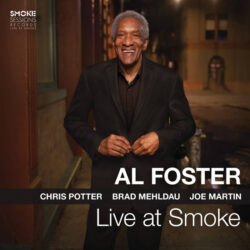
Al Foster, Live at Smoke (Smoke Sessions) There are certain tunes in the canon where you could guess that veteran jazz players (and maybe even younger ones) could create wholly “original” improvisations on muscle memory alone. Wouldn’t that be SOP for hoary chestnuts like “Old Folks” and “Everything Happens to Me” and even newer jazz-school fare like “E.S.P.” (Shorter) and “Pent-up House” (Rollins) ? The beauty of drummer Al Foster’s live quartet album (a late entry from 2025) is that it defies jazz-crit cynicism at every turn. Granted, the ballads tend to leave you more exposed if you’re just coasting, but that doesn’t account for the quality of invention here. It helps that these guys are listening to each other, and part of what’s fresh is in how they respond. Foster, of course, is everywhere. On Chris Potter’s medium-uptempo “Amsterdam Blues,” the drummer responds to one of the tenor’s cadences with one of his signature syncopated fills on the bell of his cymbal, causing the tenor player in turn to answer with his own honking riff and a new direction in the flow of his line. Those little disruptions happen again and again throughout the hour-and-a-half recording (on two CDs) — the smooth flow of eighth notes over the changes suddenly erupts before continuing to flow and flow. There’s plenty else: the downshift in tempo when pianist Brad Mehldau enters following one of Potter’s lightning cadenzas, or the way bassist Joe Martin develops a single singing line as he jumps up and down in registers for his solo on his own “Malida.” This was Foster’s last recording, done months before he died, at 82, in May 2025.
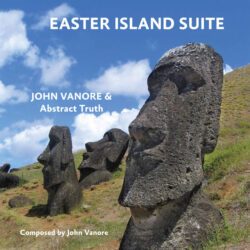
John Vanore & Abstract Truth, Easter Island Suite (Acoustical Concepts) Maria Schneider took on the conflict between the digital and natural worlds. Darcy James Argue tried to convey, musically, “a social history of paranoia in the United States since World War I.” Duke Ellington sought to write a musical piece that was “a parallel to the history of the Negro in America.” If you’re leading a big band, you want to think big — not just in the number of players but in terms of concept and form. By comparison with these previous efforts, John Vanore’s Easter Island Suite is fairly succinct: a meditation on the island in the southeastern Pacific and its legendary maoi, the roughly 900–1,000 giant centuries-old statues standing there. It’s worth mentioning that Vanore has never been to Easter Island. But, decades ago, tales of Easter Island and the maoi ignited his imagination. He began to research and to write about what he thought of as “the loneliest place on earth.” Recorded in chunks, beginning in 1989, the piece, in four movements, seeks to portray the magic and mystery of the place in Vanore’s mind — the “Discovery” of the island by Europeans in the 18th century, the “Gods and Devils” of the native Rapa Nui people, exploration of the island’s “Secret Caves,” and “Rano Raraku,” the volcanic crater from which the stone for the statues was mined. If you knew nothing of that, you would still be taken by Vanore’s writing, and the playing by his long-running Abstract Truth orchestra, from the magisterial opening for French horn (George Barnett) and bowed bass (Craig Thomas) to ripping tenor solos (Mike Falcone), mysterious passages for bass and bass clarinet (Brian Landrus), any number of technicolor brass fanfares, and some extraordinary comping by pianist Ron Thomas, including his final solo and quiet chords as the island sinks back into the mist.

Tomeka Reid Quartet: L-R: Mary Halvorson, Tomeka Reid, Tomas Fujiwara, and Jason Roebke. Photo: Laurence Miner
Tomeka Reid Quartet, dance! skip! hop! (Out of Your Head) If you’re not knocked flat by the title track, then I can do nothing for you. You are reading the wrong critic. The song does just what the title says: cello, guitar, bass, and drums dancing, skipping, and hopping through interlocking patterns of short, riffing melodic phrases, in a tuneful AABA song form that’s twisted and elaborated through solo passages, always with the opening melodic pattern underlying everything. Most of the following four tunes follow that template of tuneful riffing. As in that first piece, strong unifying compositional bones allow for some wonderful out-of-tempo roaming, and cellist-composer Reid has the choice of digging into rhythmic pizzicato or long-lined bowing. On the ballad tempo “Under the Aurora Sky,” the combination of brushes, bowed cello, and guitar could almost be the Chico Hamilton Quintet with Fred Katz and Jim Hall. On “a(ways) For CC and CeCe,” the theme is layered: Jason Roebke’s introductory bass riff with drummer Tomas Fujiwara, then the unison of Mary Halvorson’s guitar and Reid’s plucked cello before the soaring bow takes over. Reid later rips a fierce guitaristic pizzicato solo. Even more unhinged is Halvorson’s distortion-drenched shredding on “Oo Long!”
 John Ellis & Double Wide, Fireball (Sunnyside) Reedman and composer John Ellis’s split personality divides between New Orleans (where he musically came of age, studying with Ellis Marsalis) and New York (where he ended up). You can find the New York jazzman on last year’s Heroes, a quintet date with a nourishing, if familiar, sleek swing aesthetic. Here Ellis works out his funk side with his long-running band Double Wide. Opener “Wash Ya Mouth Out” leads you to expect solid Crescent City funk — check the sousaphone (NOLA mainstay Matt Perine) and touches of barrelhouse piano (Gary Versace, a regular Ellis compatriot). But the grooves keep turning, as does the instrumental color of this sextet. “Top Down” has a flowing Ellis clarinet melody over a Brazilian rhythm from a gently pumping sousaphone and Versace’s Fender Rhodes. There are suggestions of oom-pah circus music on “Clown Car” (naturally) and the title track, with its cross of Henry Threadgill and Nino Rota. Oom-pah doesn’t mean obvious. (Go ahead, try counting the meter.) If that weren’t enough, “The Whistler” is just that: a fetching, twisty melody line from the pursed lips of drummer Jason Marsalis, with endearing reed and organ harmonies. Dispelling any remaining preconceptions is the closer, the appropriately haunting “From the Ashes,” with its slow, swirling counterpoint of Ellis’s overdubbed clarinets (B-flat and bass), sousaphone, and trombone (Alan Ferber).
Jon Garelick is a retired staff member of The Boston Globe opinion pages and former arts editor at The Boston Phoenix.
Tagged: "Easter Island Suite", "Fireball", "Live at Smoke", "dance! skip! hop!", Al Foster, Joel Ross, John Ellis & Double Wide, John Vanore & Abstract Truth, gospel music
Thanks for these updates. Your reviews keep an old guy somewhat in tune with what’s new on the scene….and with Al Foster, dearly missed.