
Book Review: “I Give You My Silence” is Vargas Llosa’s Final, Gentle Vals — A Swan Song of Art’s Quiet Power
By David Mehegan
Mario Vargas Llosa’s final novel is a sweet, light story about art and idealism—and its ever-present opposite, cynicism.
I Give You My Silence by Mario Vargas Llosa. Translated, from the Spanish, by Adrian Nathan West. Farrar, Straus & Giroux. 247 pp. Cloth. $28.
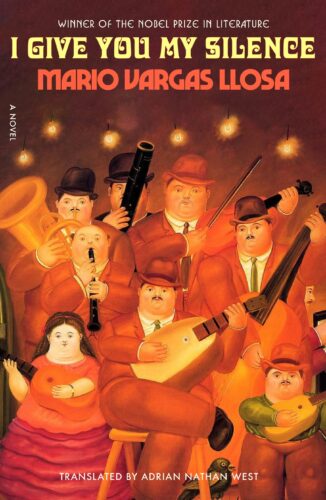
The meaning of his title, I Give You My Silence, is elusive, but might as well apply to the final muting of Peruvian Mario Vargas Llosa, one of the great modern voices of Western literature. The prolific artist and intellectual (and one-time candidate for president of Peru) was diagnosed with an undisclosed illness in 2020 and embarked on what proved to be his last novel. It was published in Spanish in 2023. He died last April.
This is not, and cannot be, an appreciation of Vargas Llosa’s oeuvre. He wrote too many books and I have read too few. A Nobel laureate with twenty-two works of fiction and thirteen of journalism, political thought, and intellectual biography, his titles practically overflow the “Also by Mario Vargas Llosa” page. His 1969 novel, Conversation in the Cathedral, is perhaps his most famous, for its treatment of a corrupt Peruvian dictatorship and for its complex interweaving of narrative voices.
No one could write more convincingly about political cynicism, raw cruelty, and brutality. I reviewed Harsh Times in this space in 2021, a grueling and gripping novel, closely based on history, about the U.S.-supported Guatemala coup of 1954. A youthful fan of Fidel Castro, he became disillusioned with leftist radicalism and eventually became a traditional democratic liberal. In 2023 I reviewed The Call of the Tribe, a bracing set of tributes to seven great European liberals, from Adam Smith to Isaiah Berlin. Every timorous liberal should read it and quit cowering behind the bland “progressive.”
Perhaps there have been fiction writers whose last work was the greatest, but probably not many. I Give You My Silence is a sweet, light story about art and idealism—and its ever-present opposite, cynicism—that is gently comic, set in Peru, where Vargas Llosa had not lived for many years (he became a Spanish citizen in 1993). Seen in light of his mountainous achievements, this is more a five-finger exercise than a fully realized novel.
The story takes place sometime after the 1992 defeat of the Shining Path insurgency. Toño Azpilcueta is a Grub Street music journalist in Lima. Married with two daughters, and with the help of his working wife, he scratches out a living with part-time teaching and writing for low-paying magazines about popular composers and performers, mostly in the Peruvian genre of creole vals.
Vals is a domestic offshoot of the European waltz (though it doesn’t seem to be dance music, per se). It is a beautiful genre, to be sure, but Toño is more than a fan and connoisseur. He has a fixed idea that vals is such an essential part of the Peruvian soul that its beauties and values can draw all of Peruvian society together, overcoming ethnic, political, racial, and class divisions, and even , flow outward to reform the whole world. [1]
In his theory, Toño couples vals with a recondite aesthetic called huachafería, an artistic expression of unrestrained emotion and sentimentality. Alternating chapters of I Give You My Silence consist of excerpts from Toño’s writings. In one, he calls huachafería a “peculiarly Peruvian kind of flamboyance. … a way of feeling, thinking, and rejoicing, a mode of self-expression and a criterion for judgement.” He writes that it “can be brilliant, but it is rarely intelligent: it is intuitive, verbose, solemn, melodic, imaginative, and, above all, maudlin. Whoever is immune to it will struggle to understand and appreciate the creole vals. …”
If this sounds abstruse to us, it is no less so to most of Toño’s readers and friends, even those who admire his erudition (I’m assuming that the many vals composers, performers, and critics cited in the book were real people). This is his big problem and the dramatic tension of the story: his conviction is not shared by most others. They don’t get it. Some of them think he is crazy.
In the opening pages, Toño is invited by a Peruvian music producer to attend a vals performance by a young guitarist from the town of Chiclayo named Lalo Molfino. Toño is surprised that he hadn’t heard of Molfino. But when he hears him, a tall young man with long black hair and patent-leather shoes, he is astounded by his gift. “That young man—a boy, in all honesty,” made the guitar “sigh, soar, and subside before the audience in a way he had never heard before, he who had heard every professional guitarist in Peru, from the legendary to the insignificant.” Toño thinks, “It wasn’t just his skill…. It was something more: wisdom, concentration, and discipline, talent, sure, but also something miraculous…Tears bathed Toño’s face, his soul opened wide with longing, and he longed to embrace his countrymen, his brothers and sisters, who had witnessed this marvel.”
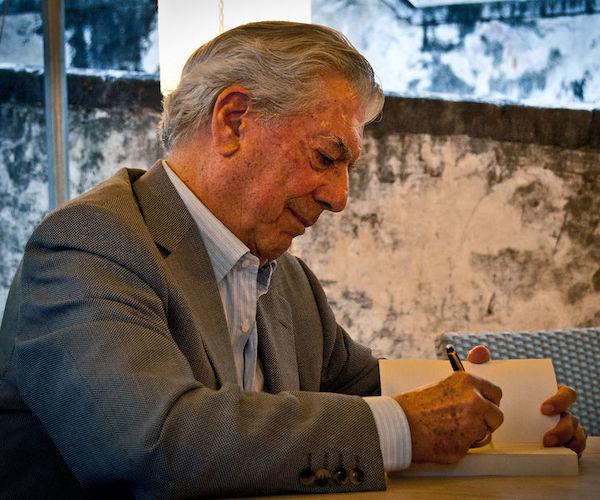
Author Mario Vargas Llosa in 2010. Photo: WikiMeida
So overcome is Toño that he resolves to write a book about vals, about its power and meaning and potential, and about the great Lalo Molfino, who will be its centerpiece. Toño will track him down and tell his life story. A friend is willing to put up money for research. Toño plunges ahead.
Unfortunately, he can’t find Lalo in Lima, and everyone he contacts who has worked with him disparages him as antisocial and impossible to work with, including José Durand Flores, the producer who had invited Toño to the performance. Indeed, Durand Flores reports, without affect, that Lalo is dead, possibly by suicide but more likely from tuberculosis. He had never wanted to be part of a group, anyway, only to play by himself. He has left a trail of annoyed and frustrated musicians. None has a good word to say about him.
Amid this thickening mystery, Toño decides to travel to Chiclayo and Puerto Etén, Molfino’s hometown, to find his roots, and talk to his friends or family, and everyone who has known him. He will uncover the undoubtedly rich backstory of this genius with which to adorn his paean to the redemptive power of vals. He’s bursting with optimism and conviction.
We’re full of curiosity and anticipation, too. Yet the novel never finds its way or sustains its early energy. Toño does learn about Lalo’s orphan roots, having been raised by a sympathetic priest, and finds his one illiterate girlfriend, who tells Toño that Lalo was incapable of sex and was interested in one thing only: playing his guitar alone. He had even abandoned her. The figure of Lalo Molfino, which had seemed so brilliant, winks out like a firefly.
With little other first-hand evidence and without Lalo’s own voice, the story meanders back to Toño, who succeeds eventually in writing his book, Lalo Molfino and the Silent Revolution, and getting it published. But its success is compromised by the author’s unreasonable demands on his publisher and by the critical reception. Vals might save Peru, but it cannot by itself fix the self-made mess of Toño’s personal life.
Although the novel’s central tension seems not quite resolved or released, it is clear that both Toño and Lalo share one premise: that art by itself can supply the key to a rich and full life. Like Toño (but without his eccentricity), Vargas Llosa himself also believed in the redemptive social and psychological powers of art, in his case of fiction. In The Call of the Tribe, he wrote, “I have always believed a novel to be an arbitrary organization of human reality that protects men and women against the anguish produced by our intuition that the world, life itself, is a vast disorder.” Through this transformation, the real world “becomes cohesive, rationalizing and ordering our surroundings, restoring the confidence that we are loath to give up, of knowing who we are, where we are, and, above all, where we are going.” [2]
David Mehegan is the former book editor of the Boston Globe. He can be reached at djmehegan@comcast.net.
[1] Since vals is central to this story, try these online performances: Guitarists Coco Vega and Gonzalo Manrique; even better, a guitar-violin-bass trio:
[2] The Call of the Tribe (New York: Farrar, Straus & Giroux, 2023), 157-58.