
Film Review: Lav Diaz’s “Magellan” — Conquest as Apocalypse
By Peter Keough
Magellan circles the world and the world circles the drain.
Magellan. Directed by Lav Diaz. At the Brattle Theatre until February 12.
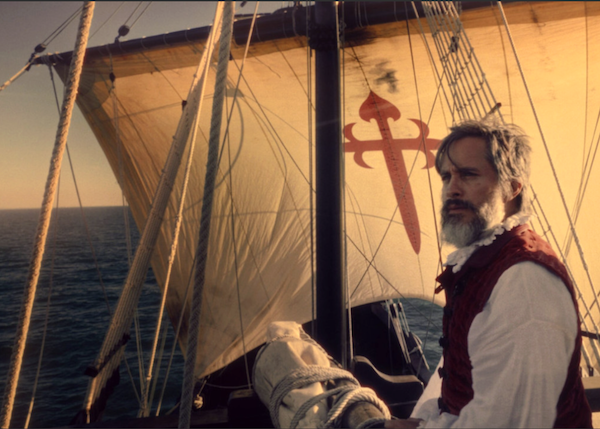
Gael García Bernal stars as the titular imperialist in a scene from Magellan.
The first scene in Filipino filmmaker Lav Diaz’s Magellan, an epic about the 16th- century Portuguese/Spanish adventurer who led the first expedition to circumnavigate the world, shimmers with the kind of paradisal mystery found in certain moments of Terrence Malick’s The New World (2005). A naked young woman wades in a stream, gathering shellfish while immersed in lush greenery and limpid silence. Alarmed, she looks up, sees something, and flees in panic. She alerts her fellow villagers that she has seen a white man. They succumb to a reaction of terror mixed with ecstasy, believing the intruder to be a manifestation of the divine, perhaps a harbinger of the end of the world. They chant: “The promise of the gods of our ancestors is upon us!” “Praise be unto him!”
As prophetic visions of doom go, this one seems on the money. Nor are the Indigenous people alone in favoring the chiliastic tendencies of the time. As a title card reads, it’s Malacca in 1511, and the Portuguese under Afonso de Albuquerque have conquered the locals, who were defending this key outpost in the burgeoning spice trade. The victors are now drunkenly celebrating and, bottle in hand, Albuquerque addresses the troops by way of an Aguirre-like rant, promising them that they are the precursors of the Second Coming and the Kingdom of Heaven. But, unlike Werner Herzog’s terrifying, insane conquistador, Albuquerque passes out mid-sentence to the hilarity of his assembled host. His lieutenant, Francisco Magellan (Gael García Bernal), mocks his unconscious superior, noting that leaders need people like him more than they need them.
But, acting on that notion, Magellan steps into trouble. Diaz doesn’t go into detail, instead picking up the story a couple of years later, back in Lisbon, where Magellan is living in reduced circumstances, limping from a festering leg wound, and out of favor with Manuel, the Portuguese king. Still, he has an overweening dream: to return to Molucca via a new, westward route that will grant access to the lucrative territories, free of the hostile interference posed by other imperial powers. Spurned by King Manuel, he takes his dream to the Spanish Crown, and they grant him command of several ships for his expedition. Before he leaves, Magellan assures his pregnant teenage wife that he will return for her; she visits him during his voyage as a glowing spectral form that comforts and chides him. It is one of the few times that Diaz humanizes Magellan, whom he generally depicts as neither myth nor monster, but as a symptom of a poisonous ideology.
So begins Magellan’s legendary circumnavigation of the world, though, as it turns out, he never completes the homeward journey. After a hellish voyage whose difficulties include the execution of sodomites, a would-be mutiny, the marooning of the Spanish regent’s son and a troublesome priest who curses Magellan, and the death, via scurvy and other causes, of scores of the crew, the dwindling company of sailors arrives at the Philippine island of Cebu. But, rather than pursue his mercenary ambitions, Magellan lingers there, falling prey to an evangelistic frenzy propelled by greed, cruelty, and lust for power. Turning into a self-proclaimed “Wrath of God,” he seeks to convert — via homicidal means — the local indigenous population to the true faith. Suffice it to say that the last words of the film are uttered not by any Westerner but by Magellan’s long-time Malay slave and interpreter Enrique Amado (Arjay Babon), who confesses that he betrayed his master in order to attain his freedom.
The 163-minute Magellan proceeds at a meditative pace in a series of painterly tableaux, a luminous and shocking parable that taps into the fate of Western hubris and deluded religious triumphalism. Unlike Mel Gibson’s pro-Christian-colonialist, Mayan gorefest — Apocalypto (2006) — this historical drama does not display the copious genocidal carnage of which Magellan was guilty. Instead, the violence occurs outside the frame — followed by cuts to the grotesque and sordid aftermath of the mayhem. Omitting actual battle/massacre scenes might have been for budgetary reasons, but the screams and explosions heard offscreen are more powerful than any CGI recreation. A reprise of the themes that the director explored in his previous masterpiece, the Dostoevskian, four-hour-long Norte, the End of History (2014), Magellan proffers a nightmarish vision of history as tragedy, farce, and prophecy.
Peter Keough writes about film and other topics and has contributed to numerous publications. He had been the film editor of the Boston Phoenix from 1989 to its demise in 2013 and has edited three books on film, including Kathryn Bigelow: Interviews (University Press of Mississippi, 2013) and For Kids of All Ages: The National Society of Film Critics on Children’s Movies (Rowman & Littlefield, 2019).