
Theater Commentary: Portrait of the Artist as a Predator
By Bob Abelman
Is it possible to separate the art from the artist or, in the case of Rhode Island’s Contemporary Theater Company, the artist’s husband?
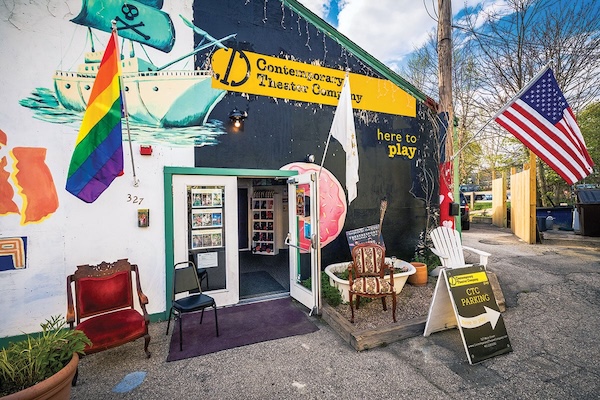
Venue for the Contemporary Theatre Company in Wakefield, Rhode Island. Photo: Wolf Matthewson
In 2017, when The New York Times published a series of allegations against film producer Harvey Weinstein from over 80 women who claimed that he sexually harassed and assaulted them, the hashtag #MeToo went viral and opened the floodgate for similar claims against others in the arts and entertainment industry. And the response, mostly firings and forced resignations, was dramatic and swift.
But since then, art itself has been prosecuted as well.
Most recently, the Justice Department released over 3.5 million emails relating to late sex trafficker Jeffrey Epstein. Of the many names in those files, Nathan Wolfe — the now ex-husband of playwright Lauren Gunderson — appeared 589 times.
As the revelation that Wolfe and Gunderson had a connection to Epstein spread around the theater industry, one community theater — Contemporary Theater Company (CTC) in Wakefield, Rhode Island — announced on February 3 that it was canceling its upcoming production of Gunderson’s The Revolutionists. In the play, according to the Dramatists Play Service, Inc., four women “lose their heads in this irreverent, girl-powered comedy set during the French Revolution’s Reign of Terror.” Gunderson has an impressive track record of writing women-centric stories that offer feminist voices. And her plays have made her the most-produced playwright in America for the past three seasons, according to American Theatre magazine.
Regarding the CTC, “This small and growing community playhouse is transforming itself into a cultural beehive in downtown Wakefield,” suggested Bill Seymour, who covers the theater for the local newspaper, The Independent. “It stands out among area community theaters with its broad and dynamic approach to engaging audiences,” said general manager Maggie Cady in a recent profile in Motif magazine.
Playbill noted that the theater admitted that it was “not clear to what extent Gunderson shared her husband’s relationship with Epstein,” but it “will not produce work by Gunderson unless and until exonerating information does come to light.”
That is unfortunate, because of the whole “innocent until proven guilty” thing. But it is not unprecedented.
In 2018, Goodspeed Musicals in Connecticut — the theater known for giving Annie its start — announced that it had canceled Woody Allen’s Bullets Over Broadway from its fall schedule in light of sexual misconduct allegations. University of California, San Diego considered dropping a course called The Films of Woody Allen from its curriculum, which had been offered since the 1990s.
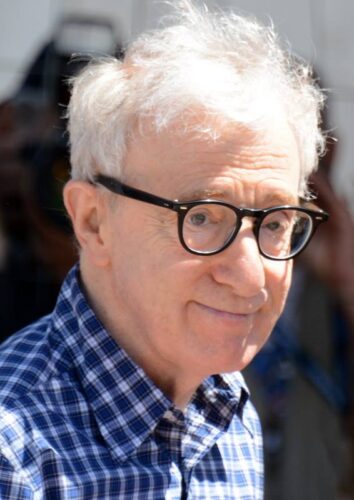
Woody Allen at Cannes in 2015. Photo: WikiMedia
Twenty-two scenes from the film All the Money in the World — about the 1973 kidnapping of John Paul Getty III — were quickly refilmed at a cost of $10 million in a race to erase actor Kevin Spacey after the revelation of a history of homosexual misconduct and assault. And he was cut out of the remaining season of his hit Netflix series House of Cards.
The National Gallery of Art in Washington, DC, canceled a Chuck Close exhibit, amid allegations of sexual misconduct. One of his paintings, Self-Portrait 2000, was removed from the wall of Seattle University’s library.
Mayor Valérie Plante asked the body responsible for administering the Order of Montreal to look into whether Charles Dutoit, former artistic director of the Orchestre Symphonique de Montréal, should be stripped of the honor after several women came forward alleging they were victims of sexual harassment by him.
There are other examples.
The alleged acts are unconscionable. But is it possible to separate the art from the artist? Artists who have strayed from the prevailing moral code deserve what they get from the court of law, and those who have not sought forgiveness will no doubt get what they deserve in the court of public opinion. But can’t the work live on?
The answer is yes. And there is evidence of this.
Not long ago, the art of Amedeo Modigliani — an Italian painter and sculptor in the early 1900s known for portraits and nudes with elongated faces and figures — was given a high-profile exhibit in New York City. The artist led a debauched life that included womanizing and abuse of absinthe and drugs. He died, penniless, from tubercular meningitis. His lover killed herself, leaving behind their nearly two-year-old daughter.
“The task of building up his legend I will leave to others,” wrote novelist Jean Cocteau — a friend whose portrait Modigliani painted — three decades after the artist’s death. “I can speak only of [his] noblest genius.” In 2015, one Modigliani nude fetched a record $170 million at Christie’s.
We haven’t stopped watching The Great Dictator because of Charlie Chaplin’s proclivity for and power over underage girls. We haven’t stopped reading Doctor Faustus because Christopher Marlowe had a proclivity for and power over young boys.
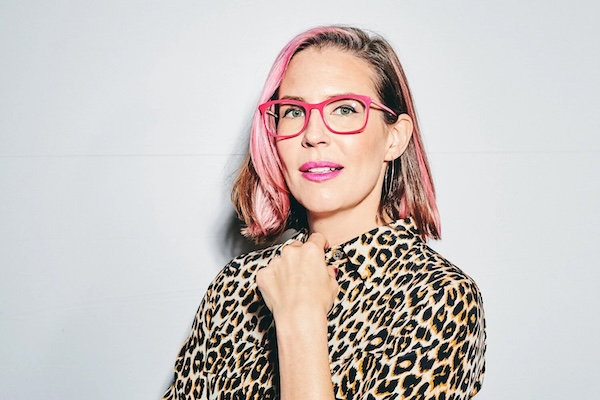
Dramatist Lauren Gunderson. Photo: Photo: Bryan Derballa
The New York Times film critic A.O. Scott argued that Woody Allen’s odious behavior may give us reason to revisit his work in a new light, but it does not detract from its aesthetic merit and cinematic genius.
And so the Contemporary Theater Company’s rash decision to cancel its production of Gunderson’s work is terribly misguided. Worse, it is an insult to its audience and sends the wrong message to surrounding regional theaters. No doubt the survival of a community theater, particularly in this day and age of across-the-board cutbacks to federal arts funding, is a precarious one. But why not champion Gunderson’s The Revolutionists — a play by a woman clearly stuck between a rock and a hard place about women stuck between a rock and a hard place — rather than fold to the imagined fear of subscriber cancellations and donor retaliation.
By all means, chastise the guilty artist and applaud efforts that make short work of the careers of predators. But shouldn’t we leave the work in the galleries, on the stage, on the shelves, and in the cinemas to speak for themselves? If not, our cleaning house will need to start with Plato and Michelangelo. Fortunately, neither had wives.
Bob Abelman is an award-winning theater critic who formerly wrote for the Austin Chronicle. He covers the Providence theater scene for the Boston Globe.
Tagged: Contemporary Theatre Company, Lauren Gunderson, Nathan Wolfe
“Never trust the teller, trust the tale. The proper function of a critic is to save the tale from the artist who created it.” Wise words from D. H. Lawrence, a major twentieth-century artist who held fascist sympathies. Perhaps it should be amended, in the case of the Contemporary Theatre Company, to read: the duty of the critic is to defend the playwright from the company that would cancel her play.
What strikes me in this piece is the charge that the company folded out of “imagined fear of subscriber cancellations and donor retaliation.” This cowardice is symptomatic of too many of our theater troupes at a critical moment in American history and politics, when democracy is under lethal attack. The challenge to our “liberal” stages—to combat the forces of tyranny—is obvious, as is their failure to rise to the occasion. We have three more years of the Trump administration to come—will our theater artists and producers wake up before it is too late?
I strongly agree that CTC’s decision to cancel the Gunderson play is “terribly misguided.” But when Mr. Adelman writes — “By all means, chastise the artist and applaud efforts” — is he including Lauren Gunderson as someone whom we should chastise? Perhaps he is not. But if he is, then her inclusion seems most unfair given Gunderson’s response in Instagram to this insanity which is pasted below and available here: https://www.broadwayworld.com/article/Lauren-Gunderson-Responds-to-Appearance-in-the-Epstein-Files–Im-Appalled-20260204
“I’m appalled. I need to be absolutely and abundantly clear: I never met or knew the monster Jeffrey Epstein, and have had no connection to him for the entirety of my life. His vile crimes and conduct are abhorrent, and I universally condemned his actions and legacy long ago, and still do. I was shocked to discover only days ago that my name appears in the public files because of an electronic Paperless Post 2012 wedding reception invitation sent to him. I was given a sizable contact list by my then fiancé and his email was in it. That same list was blind copied to send two subsequent birth announcements years later. I did not know/meet/have knowledge of/engage in any way with Epstein before or after that initial invitation was sent, nor did he attend any event at which I was present including my wedding.”
While her statement may not suffice as the “exonerating evidence” CTC requires as stated in their announcement about their decision to cancel Gunderson’s play, for me, her statement is enough for me and should allow for CTC to apologize to her and put her play back on their season.
To be clear, I am not including Lauren Gunderson as someone who we should chastise. This in light of her statement and the fact that she has not been found guilty of anything except writing a popular play and marrying the wrong guy.
Thanks for clarifying and for the piece you wrote. They got divorced in 2021 apparently.
So, we’re punishing feminist playwrights with no due diligence, while traffickers and r@p1sts get years long hall passes while information that has been made public eleventy-billion times is “looked into”. This is bizarro world theatre.
This piece feels less like a serious ethical inquiry and more like a familiar critic’s move: flattening complex, present-day decisions into a culture-war screed so it can sound brave and contrarian.
CTC didn’t “prosecute art,” insult its audience, or abandon due process. It made a time-specific programming choice in a moment of incomplete information, heightened harm, and very real community concern. That’s not hysteria or cowardice, it’s discernment. Declining to produce a play right now is not the same thing as banning it, erasing it, or declaring anyone guilty for life.
Invoking Plato, Michelangelo, Modigliani, Chaplin, and Marlowe is a rhetorical dodge. No one is arguing that all flawed historical figures must be retroactively erased. The actual question is what living institutions choose to platform in the present, with living audiences, living artists, and real consequences. Collapsing those distinctions may perform intellectual bravery, but it avoids engaging the actual stakes and consequences.
“Innocent until proven guilty” is a legal standard, not a curatorial obligation. Arts organizations are allowed and should be encouraged to consider context, harm, and impact. Especially small community theaters, which don’t have the insulation of major institutions and don’t owe anyone abstract philosophical purity at the expense of their people.
And here’s the part that the “separate the art from the artist” crowd consistently sidesteps: in our current capitalist arts economy, continued production is not neutral. It is money, prestige, and power flowing upward. Viewership and engagement materially benefit people. That’s not theoretical. That’s how the system works.
As for Gunderson – pausing the production may actually even protect her from being unfairly dragged into a controversy she may have had no part in, ensuring her work is judged on its own merits rather than being weaponized in a moment of heightened scrutiny.
Finally, the CTC didn’t say “never.” They said “not now.” Art is never neutral, and neither are the institutions that platform it. In a moment when the vile insinuations in these files are having a real effect on real people, choosing not to stage this play is responsible. It protects audiences, staff, and the community from harm, and it refuses to reward proximity to power that has proven predatory. Treating that as an existential threat to art feels less like principled defense and more like discomfort with institutions no longer pretending that art exists outside the world that sustains it.
I will let the critic speak for himself to the specific points raised in this reasonable response.
I want to address one point in this argument about the CTC’s decision: “It made a time-specific programming choice in a moment of incomplete information, heightened harm, and very real community concern. That’s not hysteria or cowardice, it’s discernment. Declining to produce a play right now is not the same thing as banning it, erasing it, or declaring anyone guilty for life.”
Right now, democracy is under serious threat. According to KJN’s reasoning, our theaters may be showing “discernment” by not producing plays that directly deal with that central issue. There is fear of harm, community concern, etc., so why not play it safe for now? It wouldn’t be forever — just stay away from the scripts that might speak to the crisis many of us are feeling at the moment. Don’t speak out about ongoing repression or the curtailment of freedom of speech.
I take the point that smaller companies are the most vulnerable. The major theaters are the real culprits because they are turning their backs on their responsibilities to art and the community. But examples of self-censorship — on any level — only embolden the nefarious forces that are out to silence artistic freedom. History suggests that silence now may not mean there will be an opportunity to speak up later. At some point, “discernment” becomes complicity.
Nope, it was not my intention to offer a “critic’s move” to “flatten complex, present-day decisions into a culture-war screed so it can sound brave and contrarian.” Just encourage dialogue and debate.
Pardon me for being amused by this whole kerfuffle, but it’s hard to pretend that Lauren Gunderson is a figure of genuine artistic significance, and comparisons to Modigliani, Charlie Chaplin or even Woody Allen seem overblown. My impression is that her career has soared at least in part on the woke wings of theatrical cancel culture – only now her embedment in that same culture’s amoral striving and money-chasing has tripped her up. (It’s worth noting that, despite her claims to the contrary, Epstein seems to have met her; his emails to her then-husband include the note “Your fiance [sic] is great – that was fun.”) Well, too bad for Gunderson that she cast such a wide net with her wedding invites, but as she seems quite the go-getter I don’t think she’ll be down for long; maybe she’ll even get a new play out of all this. But at the same time, please let’s not act as if “‘art itself has been prosecuted’.”
To quote Gunderson’s own website about the cancelled play, The Revolutionists: The Revolutionists is a new play about four very real women who lived boldly in France during the French Revolution’s Reign of Terror. Playwright Olympe De Gouge, assassin Charlotte Corday, former queen (and fan of ribbons) Marie Antoinette, and Haitian rebel Marianne Angelle hang out, murder Marat, loose their heads [sic] and try to beat back the extremist insanity in the Paris of 1793. What was a hopeful revolution for the people is now sinking into hyper violent hypocritical male rhetoric. However will modern audiences relate.”
Uh-huh. Sound familiar? If it doesn’t, it should; half a dozen of our other woke playwrights could have written precisely this, and provided a blurb with better grammar, too.